
For the China-region 2027 season described in Hanlin Course’s 31 October 2026 report, the Senior Brain Bee regional paper is 80 questions worth 80 points in a 90-minute closed-book sitting on 9 January, 10:00-11:30. The paper is in Chinese, with professional terms marked in Chinese and English. The Senior division is the grade 9-12 division in the China split; the Junior 5-8 and Senior 9-12 labels are China-region specific and should not be pasted onto every International Brain Bee local event. This is an independent preparation perspective, not an official rule sheet.
What the 2027 Senior regional paper actually asks
The first planning job is to separate verified paper facts from assumptions. The same Hanlin Course report says both divisions use a 90-minute closed-book written paper with multiple-choice and fill-in questions. The Senior paper is reported as 80 questions and 80 points; the source does not separately list a weighting, so plan as if each question carries one point in an 80/80 scheme. The paper language is Chinese, professional terms are marked in Chinese and English, and fill-in answers may be written in Chinese or English, with English abbreviations allowed for technical terms. For the wider China entry timeline, see Brain Bee China 2027, Decoded: Entries Close in December and the Regional Paper Moves to 9 January.
| Reported item | 2027 Senior regional detail |
|---|---|
| Date and time | 9 January 2027, 10:00-11:30 |
| Format | Closed-book written paper; multiple-choice and fill-in |
| Question count and points | 80 questions; 80 points |
| Language | Chinese paper; technical terms marked in Chinese and English |
| Division | Senior, grades 9-12 in the China-region split |
Source: Hanlin Course, ‘The exam starts on 9 January! 2027 Brain Bee, from memory to brain disease, how to prepare from zero’, published 31 October 2026. The global International Brain Bee site describes a local-national-world pathway; the China-region paper details above come from the attributed Hanlin Course report, not from that global page.
The only honest average is 67.5 seconds per question
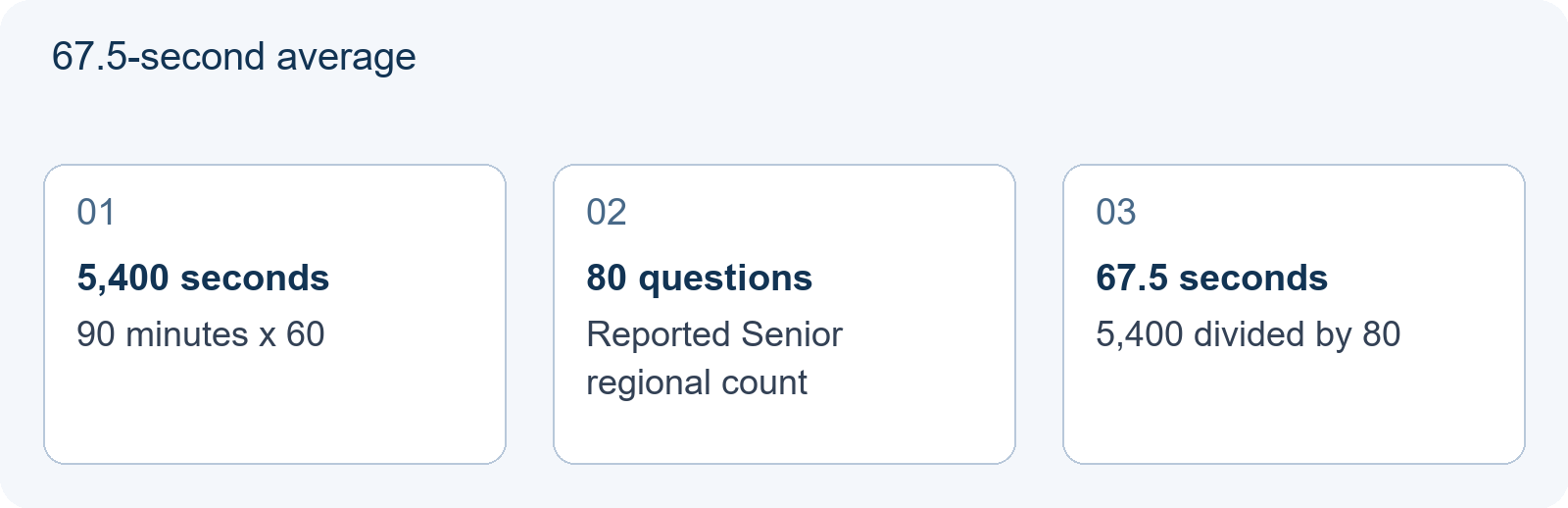
Ninety minutes is 5,400 seconds. Dividing 5,400 by 80 gives 67.5 seconds per question before any review. That number is an average, not a rule for every item. If you reserve five minutes for a final answer-sheet check, the first-pass average becomes 5,100 divided by 80, or 63.75 seconds. If you reserve ten minutes for review, the first-pass average is 4,800 divided by 80, or 60 seconds. The useful planning question is therefore not ‘Can I do each question in 67.5 seconds?’ but ‘Which minutes am I protecting for review, and which questions are allowed to take longer?’
| Review reserve | Seconds left for questions | Average per question |
|---|---|---|
| 0 minutes | 5,400 | 67.5 seconds |
| 5 minutes | 5,100 | 63.75 seconds |
| 10 minutes | 4,800 | 60 seconds |
Students often treat the average as a speed target and rush the first ten questions. A better use is to set checkpoints. A checkpoint tells you whether your pace is drifting while there is still time to change it.
A 90-minute clock plan for teaching, not an official timing rule
The following table is a teaching illustration, not an official timing rule. It deliberately runs the middle block faster than the opening block and banks ten minutes for review. If practice shows that the middle block creates careless errors, move five minutes from the middle block into the final review block.
| Clock window | Question target | Seconds per new question | Purpose |
|---|---|---|---|
| 0-45 minutes | Questions 1-40 | 67.5 | Steady opening; mark uncertain items with a dot |
| 45-70 minutes | Questions 41-70 | 50 | Bank time; do not let one hard item break the checkpoint |
| 70-80 minutes | Questions 71-80 | 60 | Finish the first pass |
| 80-85 minutes | Marked items | Variable | Return to dot-marked questions in confidence order |
| 85-90 minutes | Answer sheet and blanks | Variable | Check transfer, blanks and item numbering |
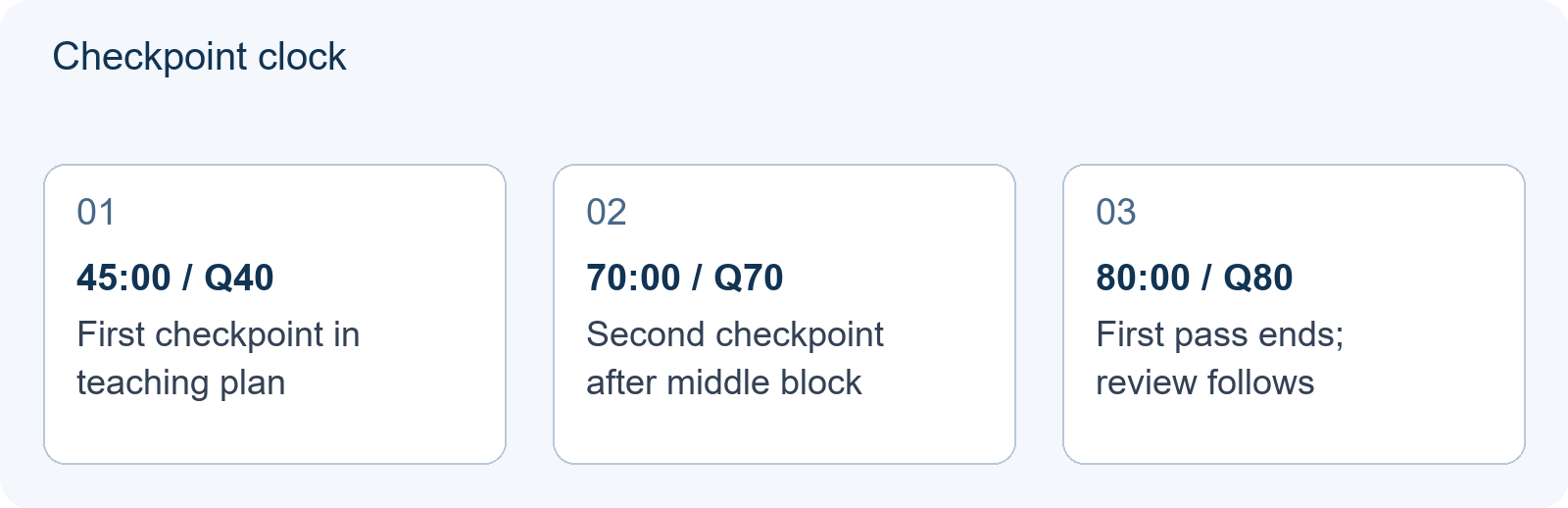
At 45:00, the target is question 40. At 70:00, the target is question 70. At 80:00, the target is question 80. If you reach 45:00 before question 40, do not speed up to use the surplus; use it to reread stems you marked. If you reach 45:00 after question 40, use the 50-second middle block to recover rather than spending another two minutes on one item.
Diagnose the failure before changing speed
Three profiles need different repairs. The labels are teaching illustrations, not student cases.
| Profile | Observable pattern | First repair to test |
|---|---|---|
| Fast but inaccurate | Attempts all 80 in about 60 minutes; 18 wrong; 12 errors are missed stems or changed answers | Slow to a 60-second first-pass average; reread negation and ‘except’ stems before answering |
| Slow but accurate | Attempts 68 in 90 minutes; 62 correct, 6 wrong, 12 blank; four hard items absorb 16 minutes | Cap a hard item at about 75 seconds, mark it and move; return only after the first pass |
| Bilingual-term delay | Attempts all 80; 70 correct, 10 wrong; 8 errors come from failing to map an English abbreviation to the Chinese term | Use bilingual term drills and answer in the language that reduces translation time |
The fast profile does not need a new knowledge unit first; it needs a slower decision point. The slow profile does not need to read faster; it needs a release rule for hard items. The bilingual profile does not necessarily need more neuroscience content; it needs term retrieval practice under time.
Two worked error logs: same raw score, different repair
Teaching illustration: Student F attempts all 80 questions in 60 minutes and scores 62. That is 3,600 seconds divided by 80, or 45 seconds per attempted question. F has 30 minutes left. Of the 18 wrong answers, 12 are stem misreads, 4 are term-mapping failures and 2 are knowledge gaps. F’s pace is not the problem in the sense of being too slow; the problem is that the first pass is too fast to protect accuracy. If F slows to a 60-second average, the first pass takes 80 minutes and leaves 10 minutes for marked items and answer-sheet checks. The extra 15 seconds per question uses 1,200 seconds, or 20 minutes, of the 30-minute surplus. That is a feasible adjustment to test, not a promise of a higher score.
Teaching illustration: Student S attempts 68 questions in 90 minutes and also scores 62, with 6 wrong and 12 blank. S’s attempted pace is 5,400 divided by 68, or about 79.4 seconds per attempted question. The log shows four hard questions took 16 minutes in total. If S caps each of those four at 60 seconds, the time spent falls from 16 minutes to 4 minutes, saving 12 minutes. At 60 seconds per new item, that is enough time to attempt 12 more questions. Whether those attempts become correct is unknown; the point is that S’s blank answers are partly a time-release problem, not only a knowledge problem.
F and S have the same raw score but opposite repairs. F should slow the first pass and use the surplus for review. S should enforce a skip rule and use the recovered time to see more questions. A single instruction such as ‘work faster’ would help neither student reliably.
How to train the plan without an official question bank
If you are practising without a published official question bank, build timed mixed sets that imitate the paper’s format rather than a single topic. A 20-question set at 67.5 seconds per question should take 22.5 minutes; a 40-question set should take 45 minutes. Use the same checkpoints as the full paper: at half the set, record the clock and the question number, not just the score. For general written-test training, see The Brain Bee Written Test: How to Train for the One Round That Appears at Every Level.
Keep a two-column error log. In column one, write what happened: ‘changed answer after rereading’, ‘could not map abbreviation’, ‘ran out of time’, ‘misread except’. In column two, write the evidence and the next drill: ’10 stem rereads’, ’20 bilingual terms’, ’75-second cap on hard items’. Do not log only the topic. ‘Hippocampus wrong’ does not tell you whether the failure was knowledge, language or pacing.
Bilingual term drills should be timed separately. The paper marks professional terms in Chinese and English and allows Chinese or English answers for fill-in items, with English abbreviations for technical terms. That permission reduces writing time, but it does not remove the need to recognise the term when it appears in a Chinese stem. Practise matching the English abbreviation to the Chinese term, then reverse the direction.
When to abandon the plan
A plan is useful only if it has release conditions. At 65:00, if you have not reached question 55, stop trying to complete a perfect first pass. Switch to a high-confidence scan: answer items you can decide quickly, mark the rest and protect the answer-sheet check. If two consecutive errors come from misreading the stem rather than from missing knowledge, slow down by ten seconds per stem until the pattern stops. If you can explain a concept aloud but cannot map the term in the paper, mark the item and return after the first pass rather than spending another minute in translation. If the answer sheet is not current by 85:00, stop new work and transfer answers.
The 80-in-90 plan does not transfer to the national Senior paper. The 16 October 2026 Hanlin Course report describes the later Senior national round as a 50-question written section worth 50 points, a 26-mark image or specimen section and a 24-mark patient-diagnosis section. The 31 October report adds that the 2027 national format remains subject to later organiser notice. Use The Brain Bee National Round Is Marked Out of 100: How the Senior Paper Splits and How to Budget Revision for that separate problem.
Preparing a course-fit or resource request
If you ask for preparation feedback, bring three artifacts: a timed set with the clock recorded at two checkpoints, an error log that separates knowledge from term mapping and stem misreads, and one specific pacing decision you want reviewed. A useful question is: ‘Can you classify my errors before recommending more content?’ A less useful question is: ‘What score will this plan produce?’ No responsible preparation conversation should promise a particular regional score from a timing table alone. Junior readers should not copy the 80-question checkpoints; the reported Junior paper has 60 questions in the same 90-minute format. The separate article ‘Brain Bee Junior National Written Test: A 40-Question Accuracy Clinic for 2027’ addresses a different accuracy problem.
This is an independent preparation guide, not affiliated with, endorsed by, or sponsored by the International Brain Bee.
Frequently Asked Questions
How is the clock plan different for a Junior student?
The same 31 October 2026 Hanlin Course report describes the Junior regional paper as 60 questions and 60 points in the same 90-minute closed-book format. The arithmetic gives 90 seconds per question before review, so the Senior 80-question checkpoints should not be copied directly. Junior students should use a 60-question checkpoint plan and a separate accuracy routine.
Can I use the last ten minutes to guess unanswered questions?
The teaching plan uses 80-85 minutes for marked items and 85-90 minutes for the answer sheet and blanks, so the last ten minutes are for review rather than new hard content. If blanks remain, follow the current paper instructions and a consistent practice policy; do not invent a penalty rule that the source report does not state.
Does this pacing plan apply to the national round?
No. The 16 October 2026 Hanlin Course report describes the later Senior national round as a 50-question written section worth 50 points, a 26-mark image or specimen section and a 24-mark patient-diagnosis section. The 80-in-90 regional plan is a different paper and should not be transplanted to the national format.