Brain Bee — China Region
The Brain Bee is an international neuroscience competition for secondary students, founded in 1998. This page maps the China pathway: the three tiers, the two age divisions, and how to register and prepare.
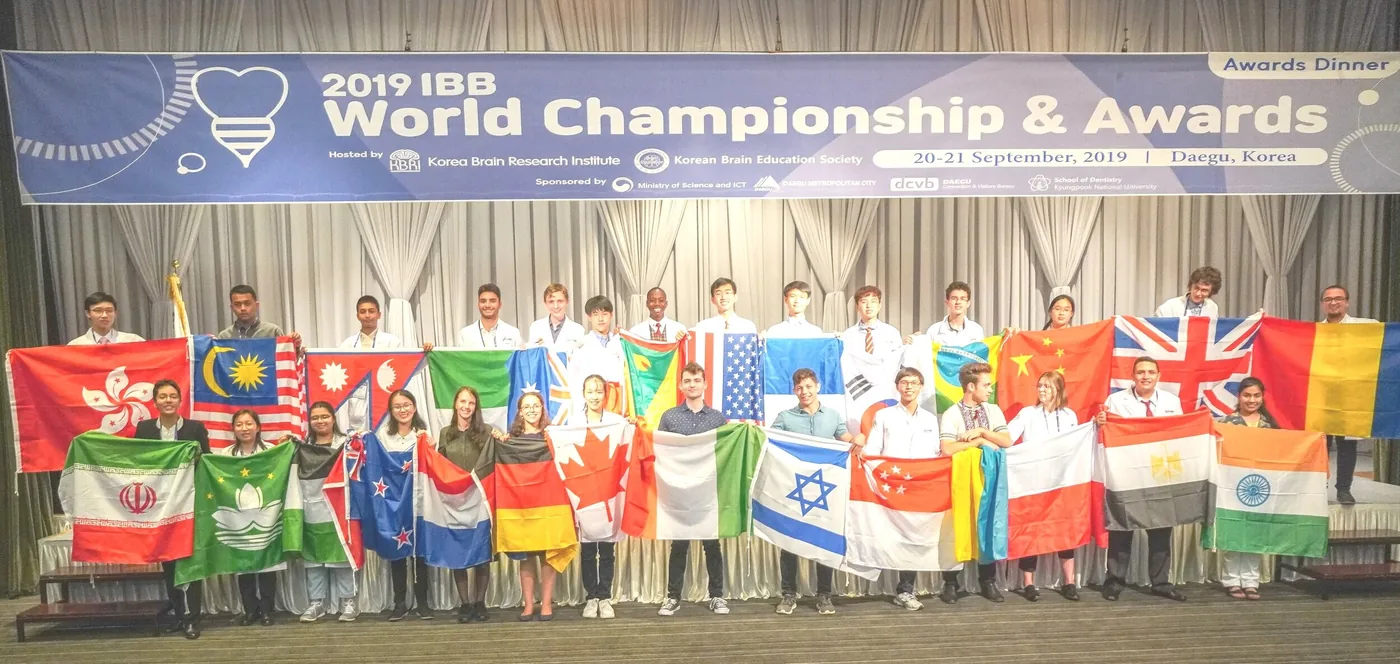
One national champion represents China
China’s senior national winner joins champions from other participating countries at the IBB World Championship. The route begins with regional competition and continues through the China national final.
What is the Brain Bee China Region, and who runs it?
The Brain Bee China Region is the mainland route of the International Brain Bee, coordinated by a national organizing committee with academic support from leading universities and research institutes.
The International Brain Bee began in 1998 under Dr. Norbert Myslinski at the University of Maryland and now reaches 50+ countries and more than 25,000 competitors each year. Brain Bee has run in China since 2013, on the same three-tier structure used worldwide: a regional round, a national final, and a place for the national winner at the World Championship.
In China the competition is coordinated by a national Brain Bee organizing committee and draws academic support from experts and professors at leading institutions.
Academic partners named by the national organizing committee include the Chinese Academy of Sciences, Tsinghua University, Fudan University, Zhejiang University, and the University of Hong Kong. Globally the program is backed by neuroscience bodies such as the Society for Neuroscience (SfN), the Federation of European Neuroscience Societies (FENS), and the International Brain Research Organization (IBRO).
Every tier is anchored on the same source material: the free “Brain Facts” primer. Its chapters cover neuroanatomy, brain function, neurons and signaling, brain disorders, development and plasticity, and research and treatment — the knowledge base a competitor masters before the regional round.
How the rounds work in China
Students in China advance through three tiers in one season: a regional round, a national final, and — for the top senior competitor — the World Championship. Exact dates shift every season and sources disagree, so treat the windows below as the pattern and confirm the current calendar when you register.
ASK VIA WECHAT →Which divisions can Chinese students enter?
The Brain Bee in China runs two age divisions defined by school grade: Brain Bee Junior for grades 5–8 and the Standard Brain Bee for grades 9–12.
Brain Bee Junior
The junior division introduces younger students to the same “Brain Facts” syllabus at an age-appropriate depth. It centers on the closed-book written exam and builds the foundation students carry into the senior division later.
Standard Brain Bee
The senior division, called simply “Brain Bee,” is the championship track. Its winners at the national final are the competitors eligible to represent China at the International Brain Bee World Championship.
How do you register and prepare for Brain Bee in China?
You enter the Brain Bee China Region during the season’s registration window, either through a partner “base school” or as an individual, then prepare from the “Brain Facts” primer.
Registration in China typically opens through partner “base schools” first, with an individual window afterward for students whose school is not a partner. Because dates and channels change each season, read our registration guide, then scan the WeChat code to add a teacher and receive the current entry form.
To prepare, work through the “Brain Facts” primer, then practise with past questions and neuroanatomy identification. Our study resources explain the study path; to receive the preparation materials, scan and add the teacher on WeChat.
2026 has concluded; 2027 details are expected in September 2026
This is the status currently published by the official China Brain Bee website. Do not reuse an earlier season’s dates. Check the official China announcement before registration, travel, or school planning.
What does each China round test?
The national organizing committee publishes a consistent format: a closed-book written paper at every level, with hands-on rounds added at the national final. The details below follow the official China Brain Bee national program.
Choose the Brain Bee support you need
We provide competition registration service and the entry form, periodic RMB 9.9 trial classes, complete Brain Bee tutoring, and a free level assessment.