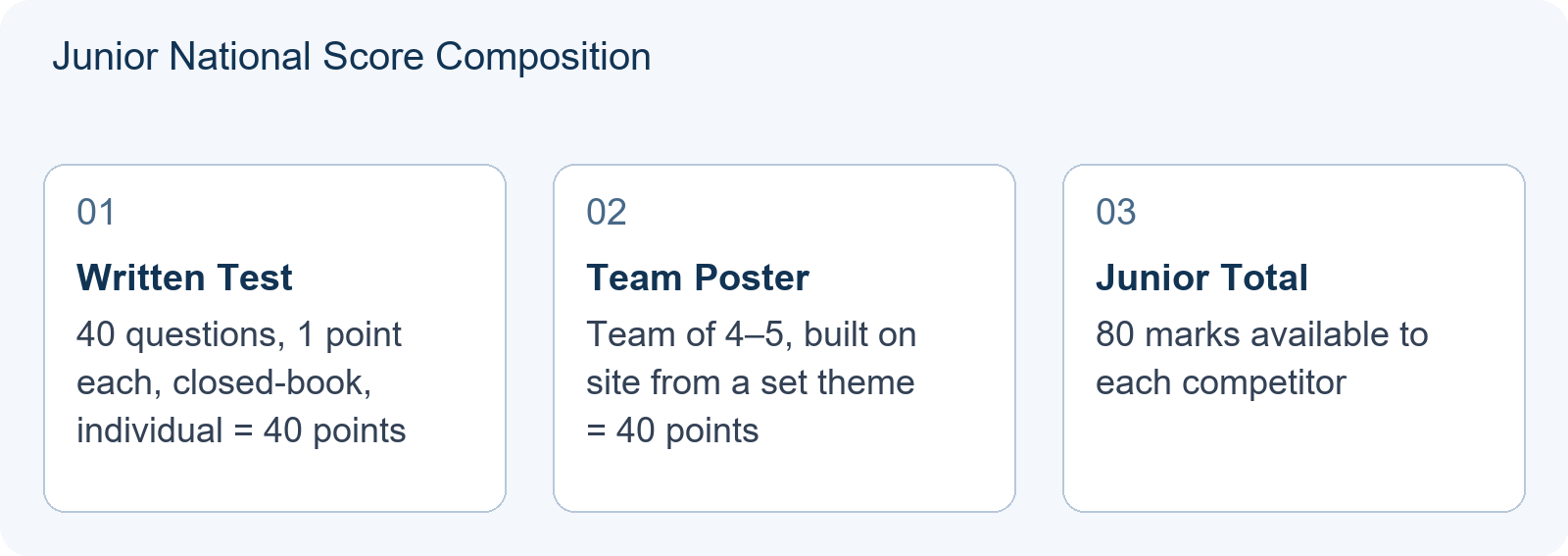
For the 2027 season, the Brain Bee Junior National written test is a closed-book paper of 40 questions, each worth 1 point, scored out of 40. Because the accompanying team science poster is also marked out of 40, the written paper carries half of the 80 marks a Junior competitor can earn at the National round. The paper is taken individually, uses fill-in and multiple-choice items, and is set in Chinese with professional terms printed in both Chinese and English. That is the short answer most Junior families arrive with. The rest of this article is about converting that knowledge into accuracy on the day.
According to the 2027 Brain Bee registration information published by Hanlin Curriculum on 16 October 2026 (retrieved 26 October 2026), the 2027 China Regional round is scheduled for 9 January 2027 and the National round for 13–14 March 2027. The Brain Bee Junior National activity has exactly two scored components: the individual written paper and the team poster. There is no image-identification or case-diagnosis section for Junior students; those belong to the Senior paper. Knowing this early matters, because it tells a grade 5–8 student where to spend limited revision hours.
What the Junior National written paper actually contains
Four features of the paper shape every preparation decision that follows.
First, it is short. Forty questions is roughly half the length of the Junior Regional paper, which the same source describes as a 60-question closed-book written paper. A shorter paper places a premium on quick retrieval of specific terms and concepts.
Second, every item is worth the same. Fill-in and multiple-choice questions both carry 1 point, so there is no strategic reason to spend twice as long on any single question. Because the written paper total is 40, one careless error costs 2.5% of the written score. Over ten scattered errors, the written half loses a quarter of its marks before the poster is even considered.
Third, it is closed-book and individual. No teammate, note sheet or textbook compensates for a personal gap. A team can rescue a poster; it cannot rescue a silent recall failure during the written hour.
Fourth, the language rule is generous. Questions are written in Chinese, but specialist terms appear in Chinese and English together, and fill-in answers may be written in Chinese or English, with professional terms allowed as English abbreviations. A student who learned neuroscience through English-language sources is therefore not starting at a disadvantage.
Does the shorter paper change your error profile?
Yes, and this is the part Junior students most often get wrong. On a long paper, a partly known answer can often be reconstructed; on a 40-question paper, there is less time for reconstruction. What replaces reconstruction is recognition speed and reading discipline.
That shift has a practical consequence for scoring. A student who knows 38 of the 40 concepts but misreads three negative stems (“Which of the following is NOT…”) can finish below a student who knows only 32 concepts but reads every stem carefully. Accuracy clinics for Junior students should therefore treat reading behaviour as a trainable skill, not as a personality trait.
Two error types: knowledge gaps and format traps
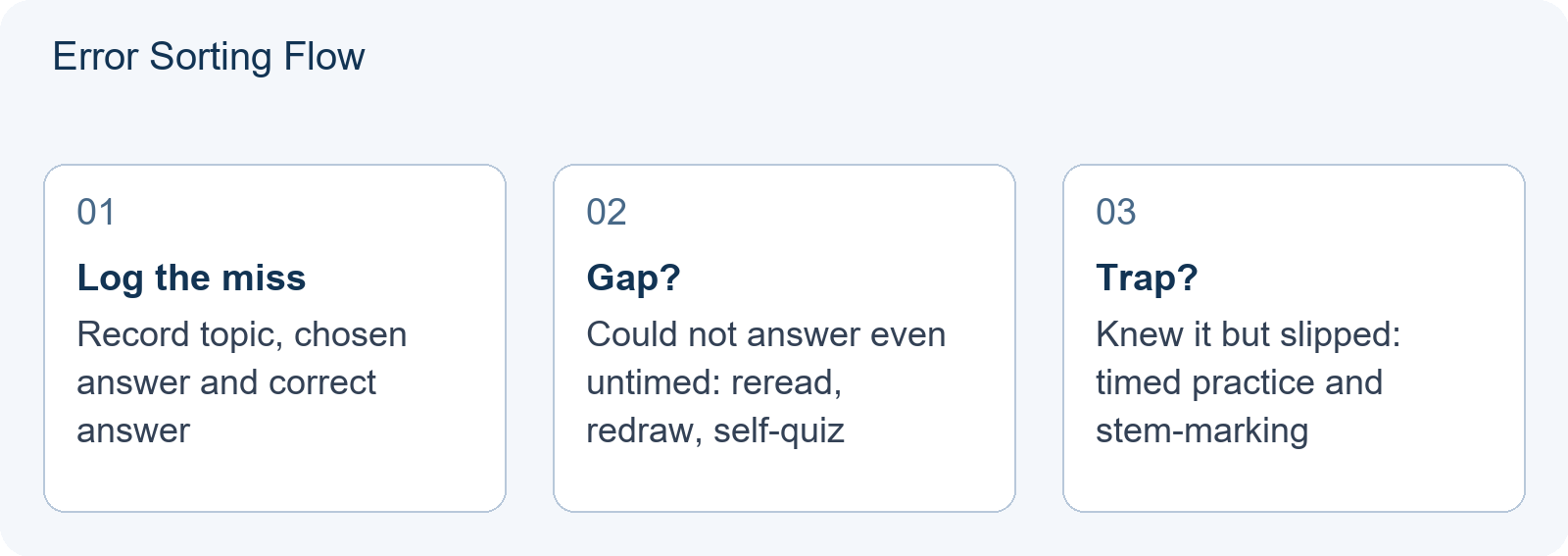
After every practice set, sort each miss into one of two categories. A knowledge gap means the student could not have produced the answer even with unlimited time: they cannot define the term, cannot trace the pathway, or cannot name the structure. A format trap means the concept was available but the answer still went wrong: the stem was misread, two similar options were confused, or the student answered a question about function with a structural term.
The distinction decides the remedy. Knowledge gaps need rereading, drawing and self-quizzing on the underlying content. Format traps need timed practice, deliberate stem-marking and a checklist of the confusions that recur for that particular student. Applying the wrong remedy is common: families often respond to a reading slip by assigning more textbook chapters, which raises study hours without changing the paper score.
Teaching illustration: one concept asked two ways
The following is a teaching illustration written for this article, not a past or predicted contest question.
Suppose the target concept is the myelin sheath. As a fill-in item, the prompt might read: “The fatty sheath that wraps around many axons and increases the speed of signal conduction is called the ______.” A correct answer is “myelin sheath” or “myelin”. As a multiple-choice item, the same concept might read: “Which structure increases the conduction velocity of an action potential? (A) dendrite (B) myelin sheath (C) cell body (D) synapse.” The correct option is (B).
The underlying knowledge is identical, but the retrieval path is not. A student who has memorised “oligodendrocytes make myelin” may write “oligodendrocyte” in the fill-in version even though the question asks for the sheath, not the cell that produces it. The same student may then hesitate between (B) and (C) in the option version, because the question asks about velocity rather than structure. Practising one concept in both formats exposes these gaps before the exam does. A useful weekly exercise is to take five terms from the week’s reading, write one fill-in and one multiple-choice item for each, and answer them the next day without notes.
A 10–10–log accuracy routine
Forty questions is a manageable weekly volume if it is split deliberately. The routine below uses ten questions at a time.
Ten questions. Each week, build a short set of ten items covering material already studied. Mix formats, roughly six multiple-choice and four fill-in, so both retrieval paths are exercised.
Ten minutes. Answer under timed conditions with no notes. The National paper is short, so the goal is to normalise finishing under mild time pressure rather than to simulate a marathon.
An error log. For every miss, write three lines: the topic, the error type (gap or trap), and the correct explanation in the student’s own words. The explanation matters more than the mark. A student who can explain why a distractor was tempting has already begun to neutralise it.
Over four weeks this produces roughly 40 items — the same volume as the real paper — but with twenty separate corrections layered in. That is a better use of the same number of questions than a single 40-item mock followed by one round of marking.
Language rules: Chinese questions, bilingual terms, flexible answers
The 2027 source states that the Junior National written paper is set in Chinese, that professional terminology appears in both Chinese and English, and that fill-in answers may be written in Chinese or English, with accepted abbreviations for professional terms. For a student who studied from English material, this removes the largest avoidable risk: translation failure on a concept they already understand.
Two practical points follow. First, decide in advance how you will write each term and keep it consistent; switching between a Chinese term and an English abbreviation mid-paper costs seconds and invites uncertainty. Second, if a term has a widely used abbreviation, writing the full English term alongside it is a reasonable habit — but this is a study suggestion, not a published scoring rule, and the safest approach remains the full term when space allows. Students who want a systematic method for building bilingual terminology can use our guide to Neuroscience Vocabulary in English: A Word-Building Method for Brain Bee Students.
Balancing the written half with the poster half
The poster is memorable, collaborative and visible; the written paper is quiet and individual. That asymmetry is exactly why the written half gets under-prepared. Both are worth 40 points, and current qualified students form teams of four or five — with classmates or with qualified students from other schools — after the national qualifier list is published, then build and present the poster on site from a specified theme within a set time limit. The written paper, by contrast, is a solo task with no post-hoc correction.
The four-week block below keeps both halves moving without letting either dominate.
| Week | Written focus (individual) | Poster focus (team) |
|---|---|---|
| 1 | Core anatomy and physiology; run one 10-question diagnostic and open the error log. | Confirm team membership and roles; collect two or three candidate themes. |
| 2 | Disorders and systems; review the Week 1 log and rewrite every missed explanation. | Draft the visual layout; gather credible figures and data. |
| 3 | Mixed-format set of ten; practise stem-marking and negative-stem reading. | Rehearse the spoken explanation; tighten the text on the poster. |
| 4 | Light review of the three weakest topics only; no new material. | Full dry run of assembly and presentation; confirm logistics. |
If a team’s rehearsal schedule is tight, protect the written slots first. They are the only component that cannot be recovered by a group effort. Readers who want more detail on the collaborative half can use our The Brain Bee Junior Team Science Poster: Half the National Marks, Decided on the Day, and the general techniques in our The Brain Bee Written Test: How to Train for the One Round That Appears at Every Level apply here once adapted to the shorter Junior format.
Scope note
This article is a preparation clinic based on the 2027 registration information published by Hanlin Curriculum on 16 October 2026. It describes the Junior National format, not official scoring policy, and it makes no claim about award lines, invitation numbers or admission outcomes. The International Brain Bee operates a local-to-national-to-world pathway, but national chapters administer their own rounds, so confirm any last-minute procedural detail with your regional organiser. Nothing here guarantees a score or a result.
General event background is available at Event background.
This is an independent preparation guide, not affiliated with, endorsed by, or sponsored by the International Brain Bee.
Frequently Asked Questions
Can I use English answers for the fill-in-the-blank questions?
Yes. The 2027 registration information states that fill-in answers may be written in Chinese or English, and that professional terms may use English abbreviations. Decide on one format in advance and keep it consistent across the paper.
Is the Junior written test open book?
No. The Junior National written test is a closed-book paper, so answers must come from memory. The article’s routine is designed around that constraint.
How many questions are on the Junior National written test?
There are exactly 40 questions, each worth 1 point, for a total of 40 points. With the 40-point team poster, that gives a Junior competitor 80 marks at the National round.