Every other Brain Bee round appears at some levels and not others. The written test appears at all of them: it is the entire China regional round, one component of the national round, and one of the tasks at the IBB World Championship. That makes it the single highest-leverage thing a student can train — and the round most people prepare for badly, because they revise by reading instead of by retrieving.
Why the written test deserves more of your time than it usually gets
Students naturally over-invest in the dramatic rounds. Specimen identification and live judging feel like the real competition, so that is where the anxiety and the study hours go. But look at where the written test sits in the structure. At the China regional stage it is the whole gate: the official chapter's national programme page describes both divisions sitting a written paper, 80 questions for the Brain Bee group and 60 for Brain Bee Junior, with multiple choice and fill-in-the-blank items and multiple choice predominating. Nothing else is assessed at that stage.
Then it appears again as a component of the national round for both divisions, and again as one of the task types at the World Championship. If you want the fullest picture of how the tiers fit together, our overview of what the Brain Bee is lays out the whole ladder. The short version for planning purposes: written performance is the only skill that pays you at every stage, so it should not be the thing you leave to general reading.
A caveat before the technique. Question counts, timing and marking for any given cycle are set by the organisers and do change — the numbers above are what the official China chapter publishes for its regional papers, and details for the national written exam and the World Championship written test are not published in the same detail. Confirm the specifics for your cycle on the official chapter site rather than assuming last year's paper.
Multiple choice and fill-in-the-blank are testing two different memories
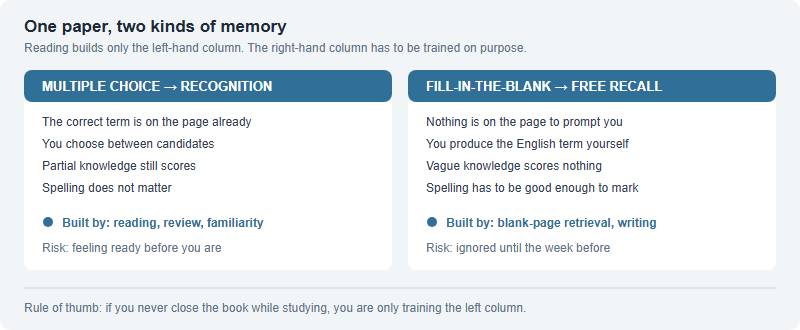
This is the insight that changes how people study. A multiple-choice item gives you the answer somewhere on the page — your job is to recognise it among distractors. A fill-in-the-blank item gives you nothing — your job is to produce the term, in English, spelled well enough to be marked correct. Cognitive scientists call these recognition and free recall, and they are not the same ability. You can have comfortable recognition of a hundred terms and be able to produce perhaps sixty of them.
Reading and highlighting builds recognition almost exclusively. That is why the classic Brain Bee failure pattern is a student who felt fluent while revising, scored well on the multiple-choice section, and then dropped a stack of marks on the short blanks. Nothing was wrong with their knowledge. Their study method had only ever trained the easier of the two memories.
A study loop that matches the paper
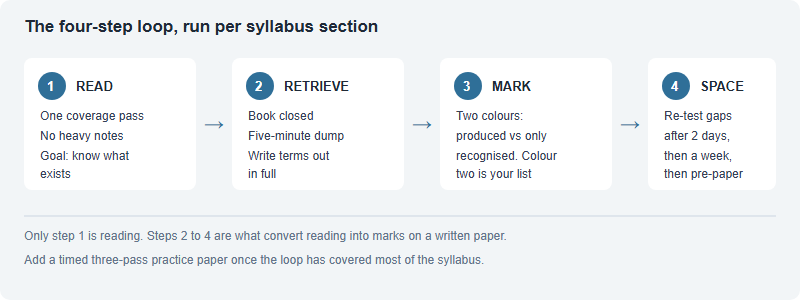
The fix is structural, not heroic. Replace one reading pass with one retrieval pass, on a fixed loop. A version that works well for students revising in a second language runs in four steps.
- Read one section for coverage, once. Do not highlight everything and do not stop to make beautiful notes. The goal of this pass is to know what exists, not to memorise it.
- Close the book and write a blank-page dump. Give yourself five minutes to write down every term, structure and process you can recall from that section, spelled out. This is the step that builds the recall memory the blanks test.
- Reopen and mark your own dump in two colours. One colour for things you produced correctly; another for things you recognised only once you saw them again. The second colour is your actual revision list — everything else is already learned.
- Re-test the second-colour list after a gap. Two days, then a week, then before the paper. Spacing is doing the heavy lifting here; the specific interval matters far less than the fact that you left a gap at all.
Notice what this loop does not include: rewriting notes, making summaries of summaries, or reading the same chapter a fourth time. Those feel productive and mostly train recognition you already have. If you want the reading half of the system done well, pair this with a chapter-by-chapter pass through the syllabus text; this piece is about what happens after the book closes.
Pacing: an 80-question paper is a time-management test in disguise
Long papers punish perfectionism. On a paper of 80 items, every minute you spend agonising over question 12 is a minute unavailable to questions 70 to 80, which may well be easier. Students routinely lose more marks to running out of time than to not knowing content.
Work in passes. On the first pass, answer everything you know immediately and mark anything that needs thought — do not stop. On the second pass, work the marked items in order of how close you already are. Leave the genuinely unknown items for a third pass where you make a decision and move on. On multiple choice, eliminating options you can rule out and then committing is nearly always better than leaving an item blank; on a fill-in-the-blank, write your best attempt at the term rather than nothing, because a blank scores zero with certainty.
One caution specific to this competition: marking schemes are not published in enough detail for anyone to promise you how a partly correct spelling or an unanswered item is treated in a given cycle. Check the instructions on the paper itself and confirm any rules that matter to your strategy with the official chapter beforehand.
The four ways students lose written-test marks, and what each one needs
When you mark your own practice, do not just count the score. Sort the wrong answers into causes, because each cause has a different fix and treating them all as "need to study more" wastes weeks.
| Failure type | What it looks like on the paper | Root cause | The fix that actually works |
|---|---|---|---|
| Coverage gap | You have no idea what the question is about | Part of the syllabus never read | A reading pass, not more drilling. Audit which sections you have genuinely covered. |
| Recognition-only knowledge | Right on multiple choice, blank on fill-in-the-blank | Studied by reading, never by retrieving | Blank-page dumps and written self-testing; close the book. |
| Confusable pairs | You pick the neighbouring term: afferent for efferent, axon for dendrite | Terms learned in isolation, never contrasted | Learn confusables in pairs, with one distinguishing feature written for each. |
| Pacing loss | Correct answers cluster early; late questions blank | Spent too long on hard items early | Three-pass technique under a timer, practised before the real paper. |
Practising with past questions without fooling yourself
Practice questions are worth a lot, on one condition: you use them as a test, not as reading material. Working through a question set with the answers visible beside you produces the same false fluency as re-reading a chapter. Cover the answers, sit a block under time pressure, then mark and triage using the table above.
We maintain our own gathered pack of practice material and past-style questions for students preparing in China, which you can ask us for through the contact banner at the foot of this site. Two honest caveats: worked solutions exist for some years and not others, since the set has been assembled over time rather than published as a complete archive; and no practice pack substitutes for the official chapter's published rules for the cycle you are entering.
Finally, keep the written test in proportion. It is the round that pays at every tier, which is why it deserves the largest single share of your hours — but the national round adds specimen and case work for senior students and a poster for Junior students, and our structural overview of the competition is the place to check that your plan is not lopsided. Strong written performance gets you through the gate. It is not, on its own, the whole competition.
How long is the Brain Bee written paper?
The official China chapter lists 80 questions for the Brain Bee group and 60 for Junior at regional level. Confirm timing for your cycle officially.
Is the written test only multiple choice?
No. The chapter describes multiple choice and fill-in-the-blank items, with multiple choice predominating. The blanks require you to produce terms yourself.
Should I guess on questions I do not know?
Check the instructions on your paper. A blank scores nothing for certain, so a reasoned attempt is usually better than leaving it empty.
Does the written test appear at the World Championship too?
Yes, a written test is one of the World Championship task types, alongside neuroanatomy work, patient diagnosis and live oral judging.
This is an independent guide operated by Hanlin Education for China-based international-school students. We are not affiliated with, endorsed by, or sponsored by the International Brain Bee (IBB), and we are not the official Brain Bee China national round; the official China chapter is chinabrainbee.com. Confirm current rules, dates and eligibility on thebrainbee.org and the official chapter site before acting on anything here. Errors reported to us are corrected within 7 working days.