
Direct answer. For the 2027 China-region Brain Bee Junior national activity, the two scored components carry equal weight: a 40-question individual written test worth 40 points and a team science poster worth 40 points. The cited report does not publish an official split of preparation hours, so the practical answer is a readiness-based ratio. Protect enough individual accuracy work to stop written errors, and rehearse the poster process enough that a team can turn an unseen topic into a clear neuroscience explanation. The national activity is listed for 13–14 March 2027, and students take part only after meeting the regional advancement requirement. Source: Hanlin Courses WeChat article, “2027 Brain Bee registration open: a cross-disciplinary contest accessible from Grade 5,” 16 October 2026. This article is preparation analysis, not official scoring guidance.
What each 40-point half actually rewards
The written half is individual and closed-book. The cited Hanlin Courses report describes 40 questions worth one point each, a Chinese paper with technical terms marked in Chinese and English, and fill-in answers that may be written in Chinese or English, with English abbreviations accepted for technical terms. That mix rewards precise retrieval, not just general familiarity. A student who recognises “hippocampus” in a sentence but cannot produce the term in a fill-in blank can still lose a mark. The written test therefore responds well to timed sections and an error log, because the errors are visible and repeatable.
The poster half is different. It is completed in teams of four to five, the topic is assigned on site, teams may consult materials while making the poster, and the poster may be made and presented in Chinese or English. The cited report also states that the team score is counted in full for each member: if the team poster is scored 35, each member receives 35 for that component. That creates shared fate, not an averaged individual score. The poster rewards prompt interpretation, role allocation, visual explanation and oral linking under time pressure. It cannot be pre-written, but the process can be rehearsed. For the written half, the existing Brain Bee Junior National Written Test: A 40-Question Accuracy Clinic for 2027 is the closer drill guide; for the poster half, the existing The Brain Bee Junior Team Science Poster: Half the National Marks, Decided on the Day covers the format in more depth.
Why equal marks do not mean equal preparation hours
Two 40-point halves do not imply a 50/50 study split. The written test has a relatively direct practice loop: attempt questions, mark them, classify the miss, and retry a comparable set. The poster has a less direct loop because the exact topic is hidden until the day. A team can practise reading an unfamiliar prompt, choosing a neuroscience mechanism, dividing roles and presenting a visual argument. Those drills improve process, but they cannot guarantee a particular topic. Preparation time should therefore follow the weaker process, not the mark total.
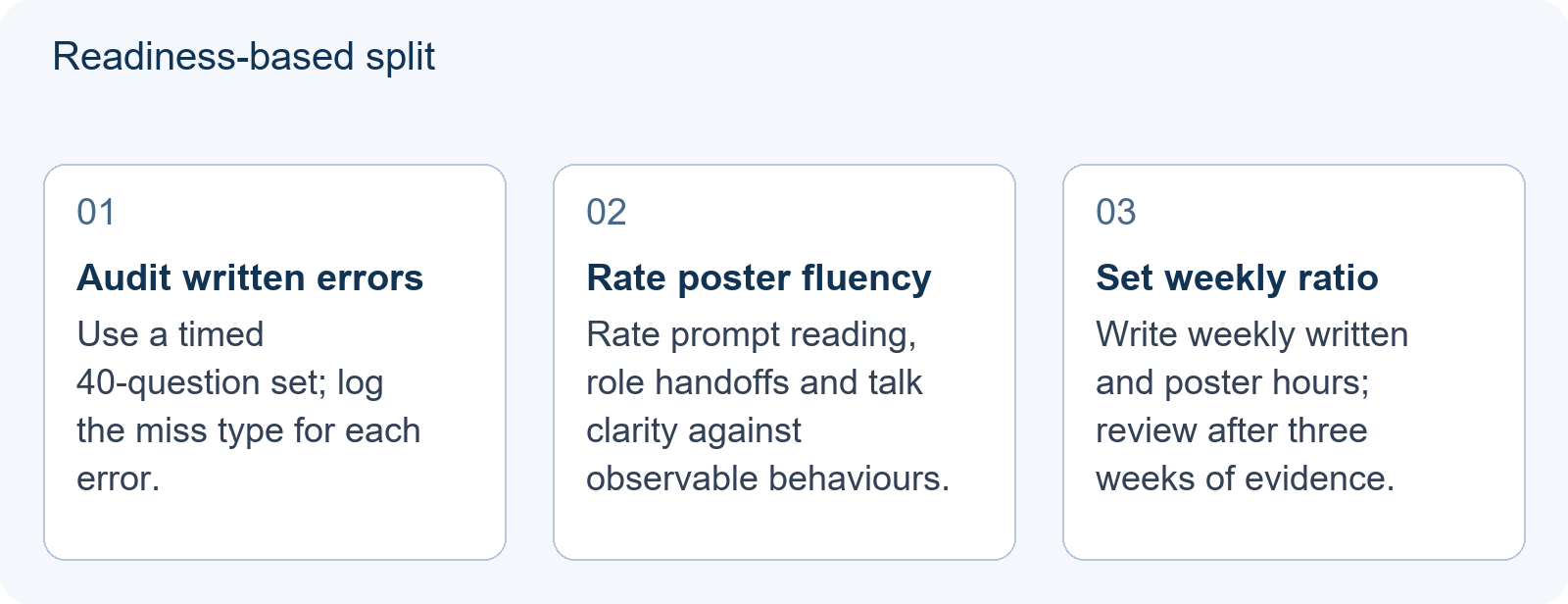
A useful diagnostic has two axes. On the written side, use a timed 40-question set and record the score plus the error type: term retrieval, concept confusion, misread question, or incomplete answer. On the poster side, rate the team against observable behaviours: can someone restate the prompt in one sentence, can the group assign roles without a long argument, can a speaker connect each panel to a mechanism, and can an editor catch unsupported claims? These are coaching judgments, not official scores, but they make the split defensible.
| Profile | Written evidence | Poster evidence | Starting split | First correction point |
|---|---|---|---|---|
| Strong recall, new to team poster work | 34/40 timed set; errors mainly careless term spelling | No poster presentation; team roles unclear | 40% written, 60% poster | After three weeks, if written falls below 32/40, add two weekly hours to written work. |
| Comfortable presenter, uneven recall | 22/40 timed set; several concept confusions | Has presented group work; can organise a short talk | 60% written, 40% poster | After three weeks, if written reaches 30/40, move two weekly hours to poster rehearsal. |
| Balanced but untested | 28–32/40 timed set; mixed error types | Some group work; no timed poster simulation | 50% written, 50% poster | Rebalance after the first full simulation, not after one good or bad day. |
Worked contrasting examples: two six-week plans
Teaching illustration, not a real student case. Student A scores 34/40 on a timed written set but has never made a team poster. With five hours a week for six weeks, the plan gives 12 hours to written work and 18 hours to poster process. In a normal week, written work is one 60-minute timed section plus a 60-minute error-log review. Poster work is two 45-minute prompt-to-outline drills plus one 90-minute role rehearsal. Six weeks therefore gives 12 written hours and 18 poster hours, matching the 40/60 starting split. If the written check falls below 32/40 after three weeks, move two weekly hours from poster rehearsal to written review.
Student B scores 22/40 but has presented group projects before. The same 30 available hours are split as 18 written and 12 poster. Written work uses three weekly hours: one 60-minute timed section, one 60-minute concept-repair block and one 60-minute mixed retry. Poster work uses two weekly hours: one 60-minute role drill and one 60-minute short presentation with feedback. After three weeks, if the written check reaches 30/40, move two weekly hours to poster rehearsal. If it remains near 22/40, keep the split written-heavy and give Student B a clear but limited speaking role rather than a large content load.
The arithmetic matters because it prevents vague intentions. “Do more poster practice” is not a plan; 18 hours across six weeks is. “Fix the written test” is not a plan; a timed set plus a classified error log is. The ratios are teaching judgments, not official weightings, and they should change after evidence.
A six-week teaching-illustration schedule
Weeks 1–2 establish baselines. The written track uses one timed 40-question set and a simple error table: question number, term or concept missed, error type, and the correct answer in one sentence. The poster track practises prompt reading: give the team a short neuroscience topic, ask one member to restate the required question, then have the group produce a three-panel outline without making a final poster. This is not topic prediction; it is practice in interpreting an unseen brief.
Weeks 3–4 add integration. The written track moves to mixed sets and retries only the error types that appeared twice. The poster track runs a full timed simulation with a new topic, four to five roles, permitted reference materials, a visual draft and a short oral explanation. The team should review the recording or notes against three questions: did the poster answer the assigned question, did each visual connect to a mechanism, and did the speaker explain the connection rather than read labels?
Weeks 5–6 taper and rebalance. The written track keeps one full timed set plus a short review of the error log. The poster track rehearses handoffs: who reads the prompt, who checks the neuroscience, who edits the visual, who speaks, and who watches time. The team should also rehearse a recovery move for the most likely process failure: if the topic is unfamiliar, narrow to one mechanism the team can explain accurately instead of filling the poster with isolated facts. For visual structure, the existing Brain Bee Science Posters: Turn a Neuroscience Question Into a Clear Visual Explanation is a useful companion.
Team formation after qualification
The cited report says the national-round qualifier list is published before teams are formed, and students may team with students from their own school or with qualifiers from outside their school. Teams are four to five members. This means a school group is not the only option, and a strong individual qualifier can look for teammates beyond their own school. The practical task is to recruit for process roles, not for identical knowledge. Five students who all know the same chapters may still produce a weak poster if no one can edit a visual claim or run a rehearsal.
| Role | What the role protects | What to rehearse |
|---|---|---|
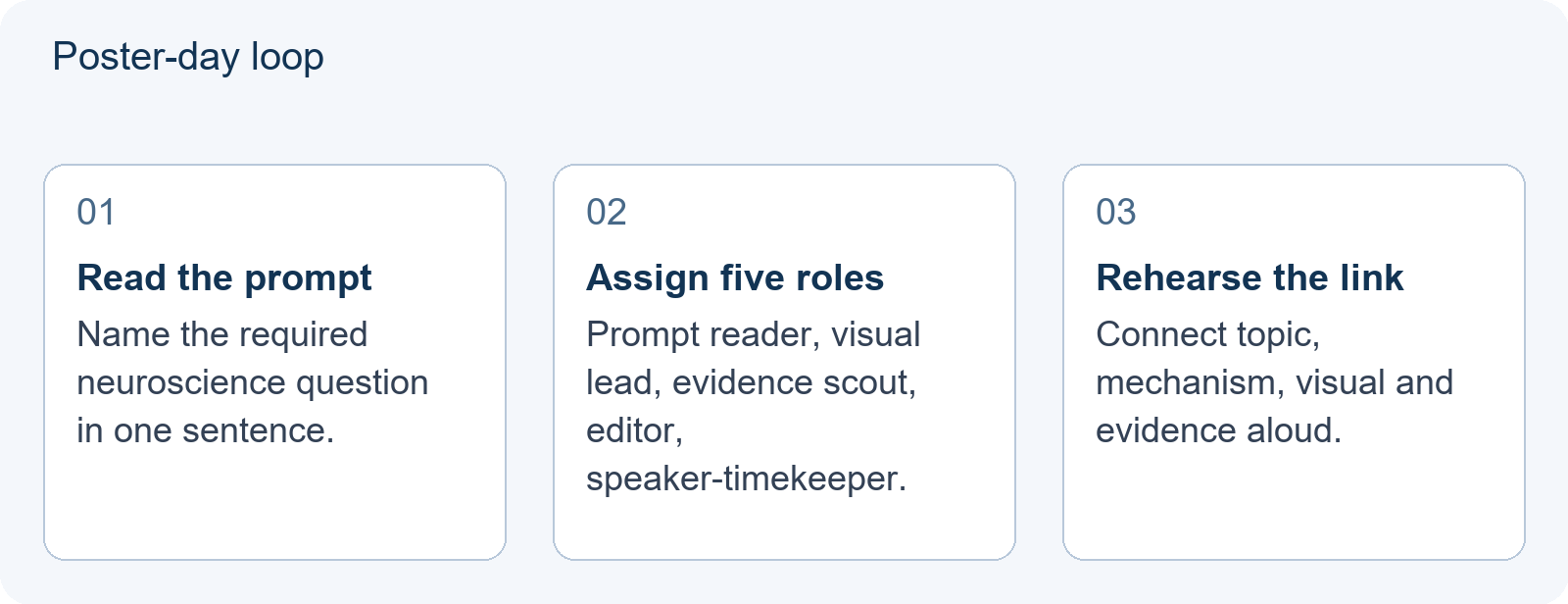
| Prompt reader | Accurate interpretation of the assigned topic | Restate the question in one sentence; identify the required neuroscience terms. |
| Visual lead | A diagram sequence that explains, not decorates | Turn one mechanism into three labelled panels with arrows that carry meaning. |
| Evidence scout | Use of permitted materials without losing the main thread | Find two supporting details and one limitation; record where each came from. |
| Editor | Consistency of labels, claims and causal language | Check every arrow, term and sentence for overclaiming. |
| Speaker and timekeeper | A clear oral explanation within the available time | Practise transitions between panels and a short closing summary. |
With four members, the editor and speaker roles can be combined, but the team should still assign the checks explicitly. With five, keep the roles separate. The point is not to create bureaucracy; it is to make the poster process observable during practice.
Poster-day workflow: from prompt to explanation
On the day, the first move is not drawing. The team should read the assigned topic aloud, underline the required terms, and agree on one neuroscience question the poster will answer. A poster that answers a narrower question clearly is usually stronger than one that lists everything vaguely. The second move is a one-page plan: what mechanism will be shown, what evidence or example will support it, and what the team will not claim beyond the prompt. Because materials may be consulted, the evidence scout can check details while the visual lead starts the panel layout.
The third move is role activation. The prompt reader keeps the group anchored to the assigned question; the visual lead controls the diagram sequence; the editor checks labels and causal claims; the speaker begins drafting the oral explanation from the panels, not from a separate script. The timekeeper sets checkpoints for outline, draft, edit and rehearsal. The fourth move is a short rehearsal in front of someone outside the immediate drawing circle, if the setting allows, because a listener exposes gaps that the makers no longer see.
The final check is explanatory: can the speaker connect the topic to a mechanism, then to the visual, then to a consequence or example, without reading every label? If not, the poster is still a collection of facts. The team should cut or relabel rather than add more text.
If you ask for a preparation review
A useful preparation review should distinguish individual recall from team process. Bring a timed written set with the error log, not just the score. Bring a poster practice record: team size, roles used, what broke down in the first ten minutes, and whether the oral explanation matched the visual. Bring the team status: confirmed members, whether anyone is from another school, and the practice slots the group can actually share. Ask for process feedback, not a predicted topic. A responsible review can help a team rehearse prompt reading, role handoffs and visual explanation; it should not promise a national placement, a team placement or a particular score.
Scope note. This article describes the China-region Junior pathway reported for the 2027 season. The China-region division split — Junior for grades 5–8 and the standard division for grades 9–12 — is region-specific and should not be assumed for every International Brain Bee national chapter. The 40-point written test, 40-point team poster, team size, on-site topic rule, materials rule, language rule and full-team-score rule above come from the cited Hanlin Courses report; the organizer’s national-round notice should be checked for any update. This is an independent preparation perspective, not official scoring guidance.
General event background is available at Event background.
This is an independent preparation guide, not affiliated with, endorsed by, or sponsored by the International Brain Bee.
Frequently Asked Questions
Can a Junior team include students from another school?
Yes, according to the cited 2027-season Hanlin Courses report: after the national-round qualifier list is published, students may form teams with students from their own school or with qualifiers from outside their school, in teams of four to five. The organizer’s current national-round notice should still be checked for any update.
How is the team poster score counted?
The cited report says the team score is counted in full for each member. If the team poster is scored 35, each member receives 35 for the poster component; it is not divided among members. Check the organizer notice for any scoring update.
Can we prepare the exact poster topic in advance?
No. The cited report says the topic is assigned on site. Teams may consult materials while making the poster, so preparation should focus on prompt reading, role assignment, visual explanation and rehearsal rather than pre-writing an unseen topic.