
Short answer. For Brain Bee 2027 neuroethics work, use a three-lens answer: state the scientific claim and its inference limit, name the stakeholder conflict, then propose a proportionate governance safeguard. This turns a personal opinion into an auditable argument for short written answers and poster-style explanations. The three lenses are a study method, not an official scoring rubric.
Why a three-lens method beats a personal opinion
Brain Bee neuroethics questions can feel slippery because students often answer with a preference: I think privacy matters, or I think AI is useful. A preference is not yet an argument. A reliable move is to separate three jobs that are easy to blur: describing the science, identifying the human conflict, and proposing a rule or safeguard. The public International Brain Bee page describes a local, national and world competition structure. That tells a student about progression, not how to reason through an ethics case. The three lenses are our teaching method for building an answer that a reader can audit.
Hanlin’s course article “2027 Brain Bee Registration Opens: Linking Biology, Psychology and AI into One Language” (14 September 2026) lists brain-science law and ethics, plus social issues around AI and wearables, in the knowledge outline. That is a scope signal: ethics is part of the wider syllabus conversation, not a decorative add-on. The article does not supply an official ethics rubric, and this lesson does not claim one. It supplies a reasoning habit that can be used across written, oral and poster-style work.
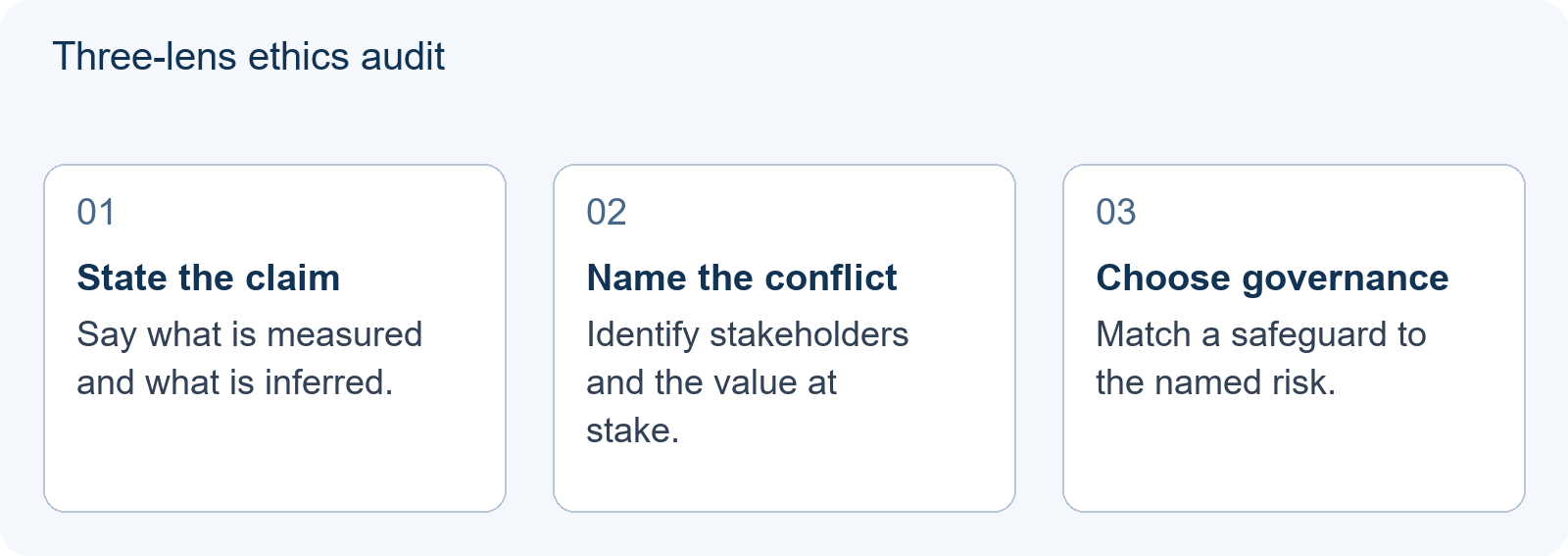
Our teaching judgment is that a weak ethics answer can fail at the join between lenses. A student names a brain region, then jumps to “so schools should ban it.” Or a student lists consent, privacy and regulation without saying what is being measured or whose choice is at stake. The three-lens method forces those joins into the open.
| Lens | Question to ask | What a good answer produces |
|---|---|---|
| Scientific claim | What is measured, what is inferred, and where does evidence stop? | A qualified claim, not a slogan |
| Stakeholder conflict | Who gains, who bears risk, and whose autonomy or privacy is affected? | A named tension between real parties |
| Governance | What rule, consent process, monitoring or responsibility follows? | A proportionate safeguard and accountable actor |
Lens 1: the scientific claim — what is measured and what is inferred
Start with the measurement. If a device reports an “attention score,” ask what physical signals feed that score and what construct the score is supposed to represent. A wearable might record movement, heart-rate variability or a manufacturer’s proprietary index. None of those is identical to “attention” in every classroom context. The scientific claim has layers: the sensor records a signal; a model converts the signal into a score; a teacher or software interprets the score as attention, distraction or effort. Each layer can fail. A still student may be attentive or may be frozen; a moving student may be restless or may be taking a movement break that supports concentration.
A precise answer states the inference boundary: “The device can detect changes in movement and autonomic signals, but it cannot by itself establish a student’s internal attentional state.” Replace “the device measures attention” with that qualified sentence. It also creates the next question: what evidence would justify using the score for a high-stakes decision? The answer might require validation against classroom observation, comparison across learners, and awareness of false positives. This is not statistical decoration; it is the difference between a measurement claim and an ethical claim. Ethics begins when someone proposes to act on an uncertain inference.
A second useful distinction is between group evidence and individual use. A study might show that a score correlates with something in a sample, but that does not prove the score is accurate for one named student in one lesson. Students should say what level of evidence the proposed action requires. Using a score to trigger a friendly check-in is a different evidentiary demand from using it to remove a student from a class or to label a child as inattentive. The ethical weight changes with the consequence, even when the sensor is identical.
Lens 2: stakeholder conflict — autonomy, privacy, access, coercion and trust
Once the claim is qualified, name the people and institutions affected. In a school wearable pilot, students are not the only stakeholders. Teachers may be asked to interpret dashboards; parents may consent or object; school leaders may face liability; a vendor may control data storage; classmates may pressure one another; a regulator may set limits. The ethics question is rarely “is this technology good or bad?” It is usually “which value is being traded against which other value, and for whom?”
Consider three conflicts. First, privacy versus perceived safety: a school may want early warning about distress, while a student may not want continuous physiological monitoring. Second, autonomy versus institutional authority: a parent may consent for a minor, but the student may still dissent. Third, access versus exclusion: if a tool is optional and expensive, advantaged students may benefit while others are monitored more heavily or left out. An answer does not need to resolve all three at once; it selects the most relevant conflict and explains why it matters for the proposed use. Selecting the most relevant conflict keeps the answer focused.
Trust is a stakeholder issue too. If students believe the device is being used to punish them, they may conceal or manipulate it, and the data quality may fall. If teachers believe a dashboard replaces their judgment, they may over-rely on a score. If parents are told only that the device is “safe,” they cannot weigh the data flow. Naming these trust effects turns ethics into something observable in how the system is introduced, not just a set of abstract values.
Lens 3: governance — consent, regulation, monitoring and responsibility
The third lens asks what rule or safeguard follows from the first two. Governance can include consent design, data minimisation, retention limits, teacher training, independent review, opt-out routes, appeal mechanisms and clear responsibility when a system misclassifies a student. Hanlin’s course article “When Brain-Computer Interfaces Become ‘New Infrastructure’: Brain Bee and Neuroscience Preparation Logic” (3 July 2026) mentions UNESCO’s 2025 global recommendation on neurotechnology ethics as context for governance questions around neurotechnology. That is useful background, not a rule that automatically decides a school policy. A student should distinguish a recommendation, a national law, a school policy and a vendor contract.
A proportionate governance answer is specific. “The school should get consent” is thin. A specific version: “The school should separate parental permission from student assent, explain what data leave the device, set a retention period, allow a human review before any disciplinary use, and name a responsible data controller.” That answer connects a safeguard to a named risk. It also avoids the common trap of treating regulation as evidence. A law may permit an activity while an ethical question remains about whether the activity is fair, coercive or poorly validated.
Accountability matters when the system fails. If a student is wrongly flagged as distracted, who can review the flag? Can the student or parent contest it? Is the raw data retained, and for how long? Is the dashboard used only for support, or can it feed into grades and discipline? These questions are not administrative decoration; they decide whether the governance is real. A complete ethics answer names at least one responsible actor and one review route, not just a list of values.
Teaching illustration: a school wearable attention tracker
Teaching illustration (not an official contest problem). Suppose a secondary school pilots a wristband that records movement and heart-rate variability and produces a “focus score” for each lesson. The school says the score will help teachers identify students who need support. A student draft says: “The wearable is good because attention is important for learning, and the company says the device is safe.” A second draft says: “The wearable is bad because privacy is important.” Neither draft is complete. The first confuses importance with evidence and treats a vendor claim as proof. The second names a value but not the measurement, the conflict or the remedy.
A three-lens answer would say: the device measures movement and autonomic signals, then infers focus; the inference needs validation before individual decisions. The main conflict is between a student’s privacy and dissent and the school’s wish to support learning. A safeguard could be voluntary participation, student assent plus parental permission, aggregated rather than individual dashboards, no disciplinary use, a short retention period and an independent review after one term. That answer can be shortened for a short written response or expanded for a poster paragraph. Two weak distractors to identify are “the device is safe because it is sold” and “attention matters, so tracking is justified.” The first is an appeal to commercial status; the second is an appeal to importance. Neither supplies evidence or governance.
Answer formats: short response, fill-in frame and poster work
For a short written response, the three lenses act as a diagnostic. Eliminate options or sentences that make an unqualified measurement claim, ignore a stakeholder, or propose a safeguard without naming the risk. A complete short answer contains a qualification and a consequence: for example, “the score may reflect movement rather than attention, so individual use requires validation and an appeal route.” For a fill-in sentence frame, use: Because the system measures ____, the claim about ____ is limited by ____; the main conflict is between ____ and ____; a safeguard is ____. This frame prevents a one-word value from standing in for an argument.
For poster-style ethics work, the same three lenses can become three panels. The first panel states the claim and the measurement boundary; the second maps stakeholders; the third proposes a governance choice. The poster article Brain Bee Science Posters: Turn a Neuroscience Question Into a Clear Visual Explanation is useful adjacent coverage for visual communication, but the ethical reasoning must still come before the layout. Students interested in AI should also see Brain Bee for AI and Computer-Science Students: Where the Syllabus Meets Their Interests for a different angle on how the syllabus connects to computational interests.
Common traps and a short practice diagnostic
| Trap | Why it weakens an answer | Repair |
|---|---|---|
| Regulation as evidence | A rule does not prove a device works or is fair | Separate validation from permission |
| Mechanism as ethics | Naming a brain system does not name a stakeholder | Add who is affected and how |
| Consent as a complete answer | Consent does not cover coercion, exclusion or misuse | Add monitoring, retention and appeal |
| One-sided benefit | Ignores burdens on students or teachers | State the trade-off explicitly |
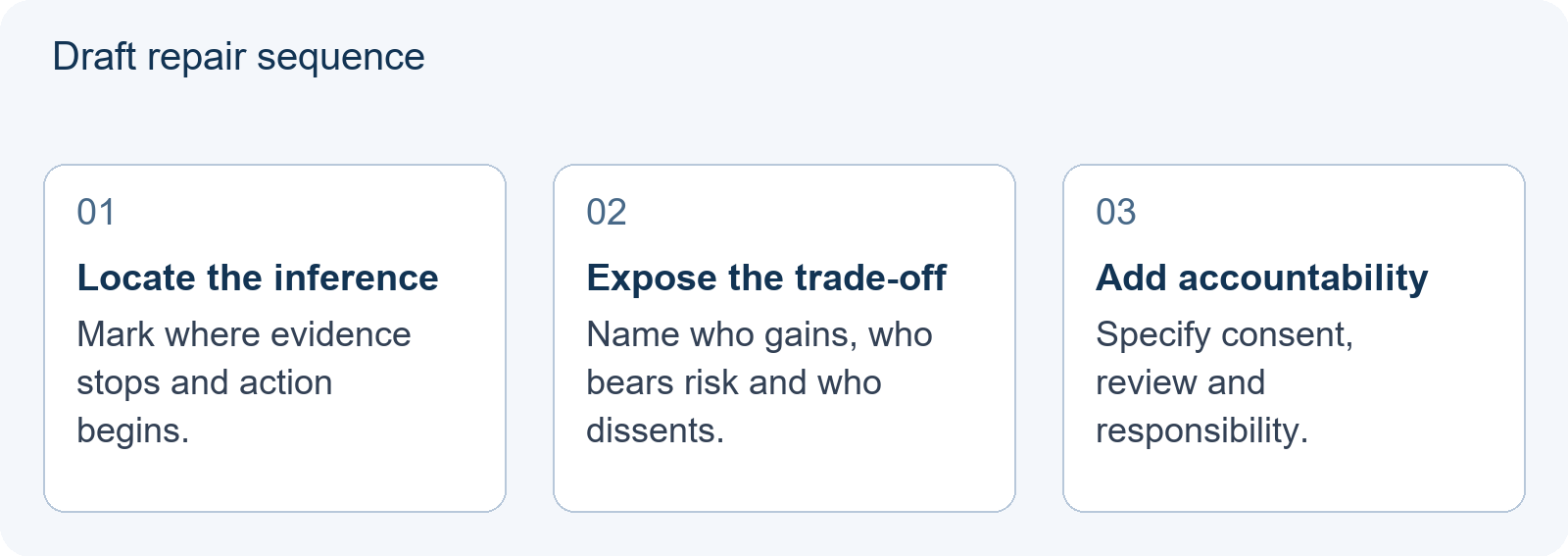
Use this teaching checklist before rewriting a draft: Does it state what is measured and what is inferred? Does it name at least two stakeholders and one conflict? Does it propose a safeguard that matches the risk? Does it avoid pretending a recommendation, a vendor claim or a law settles the ethics? A score of zero to four is not an official mark; it is a revision aid. Students can also swap drafts with a partner and ask the partner to underline the exact sentence where evidence stops and action begins. That exercise makes the reasoning visible before revision.
Preparing a resource or course-fit question
If you ask a teacher or provider for help, bring a one-page draft rather than a vague request. Mark the scientific claim, the stakeholder conflict and the governance proposal. Note which source you used for each factual claim and which part is your reasoning. A useful question is: “Which lens is weakest in this draft, and what evidence would I need to strengthen it?” That question directs feedback to a specific gap. For background reading, Brain Bee Study Materials: Matching Essential Neuroscience, BrainFacts and Atlas to the Questions You Will Actually Face helps students separate general neuroscience sources from ethics-specific reasoning. The aim is not to collect more definitions; it is to build a defensible answer that a reader can audit.
General event background is available at Event background.
This is an independent preparation guide, not affiliated with, endorsed by, or sponsored by the International Brain Bee.
Frequently Asked Questions
What is the fastest way to improve a Brain Bee neuroethics answer?
Separate the scientific claim from the ethical claim. Say what the device or study measures, what is being inferred, and where the evidence stops. Then name the stakeholder conflict and one governance safeguard that follows from it.
Do I need to memorise regulations for neuroethics questions?
No. Regulations can be relevant, but a regulation is not evidence that a technology works or is fair. A complete answer distinguishes a recommendation, a law, a school policy and a vendor claim, then explains which safeguard is proportionate to the risk.
Can the three-lens method be used for a poster or short-answer item?
Yes. Use the lenses as three planning moves: claim, stakeholder conflict and governance. For a short response, compress each move into one sentence. For a poster, use the same moves as panels, but keep the reasoning clear before adding visual design.