If you have completed the 2027 Brain Bee regional paper on January 9, your immediate next step is to verify whether you have been selected for the national round and to understand what that selection means for your preparation. The China committee has announced that the 2027 national round expects about 600 participants across both the Brain Bee and Junior groups, though this is a planned number rather than confirmed attendance. Beyond this headline figure, specific allocation methods and cutline scores have not been published, so your focus should be on verifiable checkpoints rather than speculative quotas.
What Happens After the Regional Paper?
The Brain Bee China pathway follows a three-tier structure: regional, national, and international. According to the International Brain Bee, students typically begin at the local level, with top performers advancing to their country’s national competition. In China, the regional round is a 90-minute closed-book paper held on January 9, 2027. The national round is scheduled for March 13–14, 2027.
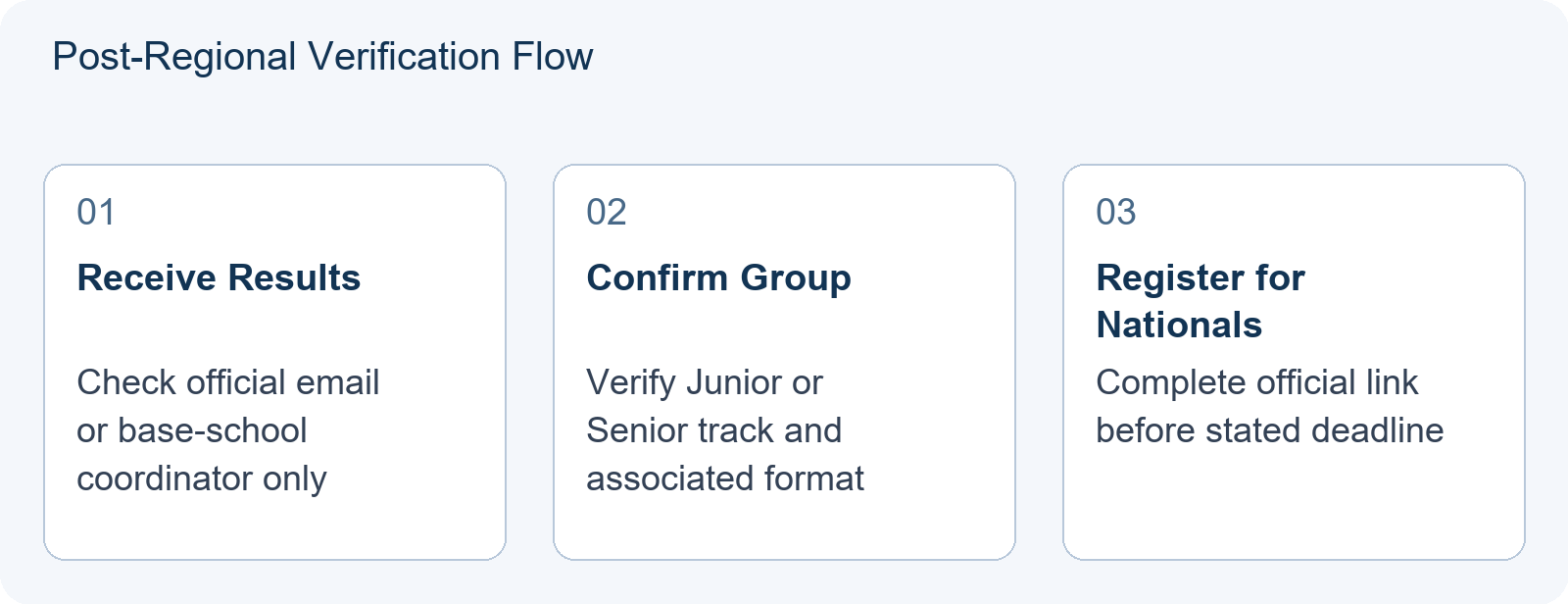
Your first task after the regional exam is to confirm whether your score places you in the pool invited to the national round. The official channels for this notification are:
- Your base school coordinator, if you registered through a base school
- The official Brain Bee China registration platform, if you used the individual non-base-school route
Do not rely on unofficial score aggregators or social media posts claiming to know the cutline before official release.
Checklist: Four Verifiable Details to Confirm
Instead of speculating about quotas, use this practical checklist to verify your status and plan accordingly.
1. Your Official Qualification Status
Verify directly through your registration channel. Base-school students should check with their designated teacher; individual registrants should monitor the official platform. There is no public leaderboard, so unofficial rankings should be treated as unverified.
2. Your Group Assignment
Confirm whether you are registered for:
| Group | Grade Range | Regional Paper | National Round Components |
|---|---|---|---|
| Brain Bee Junior | 5–8 | 60 questions, 90 minutes | 40-point written test + 40-point science poster |
| Brain Bee (Senior) | 9–12 | 80 questions, 90 minutes | Written test, image identification, case diagnosis |
Your preparation focus differs significantly between groups. Junior students should begin planning their poster structure; senior students should start practicing image-based questions and clinical reasoning.
3. National Round Location and Schedule
The national round dates are fixed for March 13–14, 2027. However, specific venue details and exact daily schedules are typically announced after regional results are finalized. Mark your calendar with the confirmed dates and set reminders to check for venue announcements once official results are released.
4. Required Documentation and Fees
Previous seasons have required participants to submit identification and health declarations. While 2027 specifics depend on official notification, prepare standard documents in advance: student ID, registration confirmation, and any medical accommodations documentation previously requested.
Teaching Illustration: How to Interpret Uncertain Selection Information
Because the exact selection mechanism is not publicly detailed, here is a teaching illustration showing how to think about your position without inventing specific thresholds.
Scenario: Three students from the same province receive different information after the regional paper.
- Student X receives an official email with a national-round registration link and deadline. Action: Follow the link immediately and complete registration before the stated deadline.
- Student Y sees an unofficial WeChat post claiming “the cutline is 55/80” but has no official communication. Action: Disregard the unverified claim and continue monitoring official channels.
- Student Z is told by a classmate that “only top 10 from each province advance.” Action: Recognize that this specific claim is unverified; wait for official notification rather than assuming elimination.
This illustration demonstrates that only direct official communication should trigger your next steps. Indirect claims, even from knowledgeable sources, lack standing until confirmed.
Preparing for the National Round: What Changes
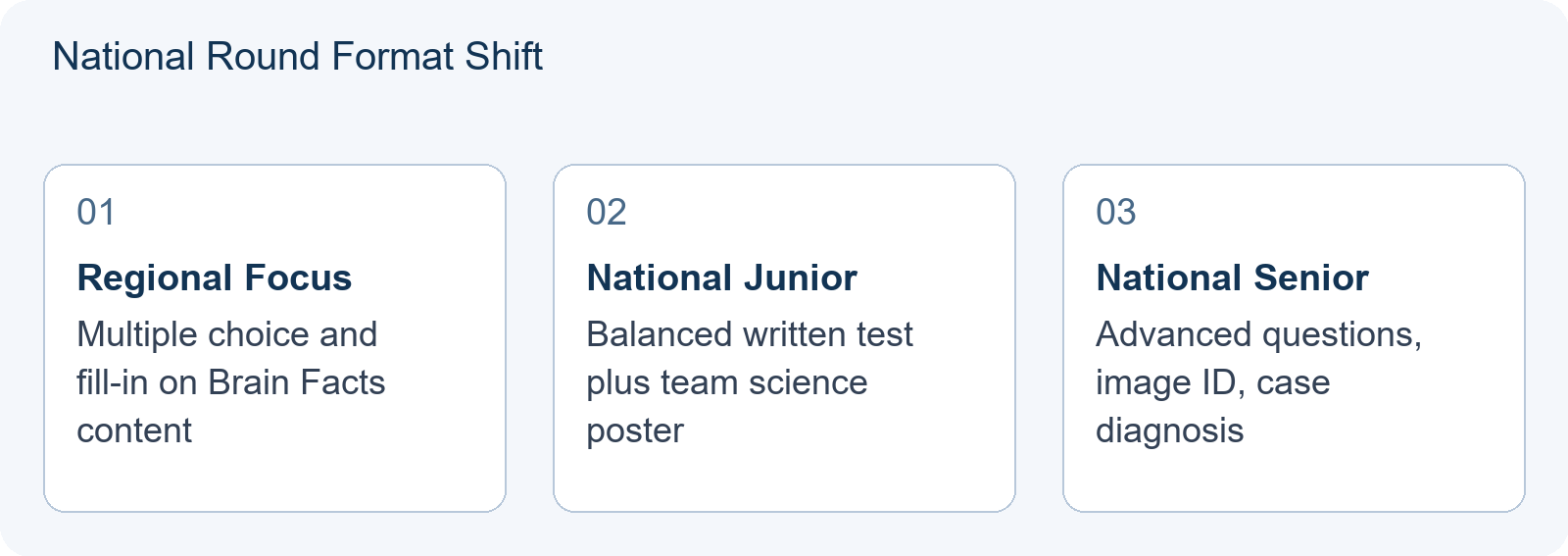
The national round demands skills beyond the regional paper’s multiple-choice and fill-in format. Based on verified competition structures from past seasons and the official Brain Bee framework, expect these differences:
For Brain Bee Junior: The Poster Component
The national round adds a team science poster worth 40 points, balanced against a 40-point written test. This means your preparation must now include:
- Visual communication of neuroscience concepts
- Collaborative planning with assigned teammates
- Practice in synthesizing research into a structured poster format
Our article on Brain Bee Junior National Round: Balancing the 40-Point Test and 40-Point Poster provides a detailed framework for this balance.
For Brain Bee Senior: Applied Neuroscience Skills
Senior students face image identification and case diagnosis in addition to advanced written questions. Preparation should now emphasize:
- Recognition of CT and MRI scan features
- Correlation of symptoms with lesion locations
- Timed practice with complex, multi-step problems
Resources for this transition include our guides on Brain Bee CT and MRI Image Identification: A 26-Mark Visual Strategy for the National Round and Brain Bee Lesion Localisation: Connecting a Symptom Pattern to a Neural Pathway.
Common Post-Regional Questions
When Should I Expect Results?
Historical release patterns for regional results are not officially guaranteed. For planning purposes, educational advice: check your registered contact method weekly after the January 9, 2027 exam without assuming a specific notification date. Base-school registrants should maintain contact with their coordinator; individual registrants should monitor the official platform.
Can I Appeal or Request a Score Review?
The official rules for 2027 have not specified a score review process. If you believe an administrative error occurred, document your concern with specific details (exam date, location, candidate number) and contact the official channel through which you registered. Retain your exam admission materials as evidence.
If you receive communication describing a waitlist or alternate status, confirm the conditions directly with your official registration channel: whether alternates are ranked, what triggers advancement, and any time-sensitive response requirements. Do not assume automatic inclusion or exclusion based on list position.
Some past seasons have maintained alternate lists for national-round placement. If you receive communication describing this status, confirm the conditions: whether alternates are ranked, what triggers advancement, and any time-sensitive response requirements. Do not assume automatic inclusion or exclusion based on list position.
Study Transition: From Regional to National
Regardless of your current certainty about selection, you can productively prepare for the national round’s different demands. The regional paper tests breadth of knowledge from sources like Brain Facts; the national round tests depth, application, and presentation.
A phased approach:
- Week 1–2 post-regional: Rest, then review regional paper topics you found uncertain. This consolidates foundational knowledge regardless of national-round outcome.
- Upon qualification confirmation: Shift to national-round-specific formats. Junior students begin poster drafting; senior students begin image identification practice.
- Four weeks before national round: Simulate national-round conditions. Time your poster preparation or case-diagnosis responses.
What We Know, What We Do Not, and Why It Matters
| Verified Information | Unverified Information | Practical Implication |
|---|---|---|
| About 600 planned participants nationally across both groups | Exact allocation between Junior and Senior groups | Plan for competitive preparation without assuming specific group size |
| National round dates: March 13–14, 2027 | Specific venue or hybrid format details | Block calendar dates; await venue announcement for travel planning |
| Junior national round includes 40-point poster | Exact judging rubric or weighting subcomponents | Practice general scientific poster principles; await rubric for fine-tuning |
| Senior national round includes image ID and case diagnosis | Specific image types or case sources | Build general neuroanatomy and clinical correlation skills |
Operating with this distinction prevents both complacency (assuming qualification is certain) and unnecessary anxiety (assuming specific competitive thresholds).
Final Preparation Reminders
As you await official notification, maintain these habits:
- Check official channels weekly, not daily, to avoid notification fatigue
- Preserve all registration confirmations and exam materials
- Begin format-specific national-round practice without yet knowing your opponent pool
- Coordinate with teammates or study partners if your school has multiple qualifiers
The transition from regional to national round is a shift from standardized testing to applied demonstration of neuroscience understanding. Preparing for that shift—rather than fixating on unverified quota mechanics—serves your competitive interests best.
For students still preparing for the regional paper or considering future participation, our guide on Brain Bee China 2027, Decoded: Entries Close in December and the Regional Paper Moves to 9 January covers registration timelines and exam structure in detail.
Practical Study Resources and Workspace Setup
While awaiting official confirmation, you can prepare your materials and study environment to match the national round’s demands. For Junior students, this means identifying a suitable space for poster drafting and collecting supplies that support visual presentation of neuroscience concepts. Large-format paper or digital design tools, a consistent color scheme for diagrams, and access to peer-reviewed images of brain structures will all support the poster component. Senior students should organize their reference materials by anatomical system rather than by topic, since the national round requires rapid switching between image identification, case diagnosis, and written response.
Both groups benefit from maintaining a single dedicated notebook or digital equivalent for national-round preparation. In this notebook, record official communications with timestamps, paste registration confirmations, and note any questions you need clarified. This practice creates an audit trail if discrepancies arise and keeps your planning grounded in verified information rather than informal updates. If your school has multiple potential qualifiers, consider forming a study group with clear agreements about information sharing: each member tracks official channels independently, then confirms findings with the group. This redundancy protects against misinformation spreading from a single mistaken source.
Finally, review your regional exam experience to identify format-specific skills that transfer to the national round. Time management during the 90-minute regional paper, comfort with bilingual terminology, and strategies for fill-in questions all remain relevant. The shift to national competition adds new formats but does not erase these foundational competencies. Building confidence in what you have already demonstrated allows you to approach new challenges from a position of strength.
General event background is available at Event background.
This is an independent preparation guide, not affiliated with, endorsed by, or sponsored by the International Brain Bee.
Frequently Asked Questions
How many students advance to the Brain Bee China national round?
The 2027 national round plans for about 600 participants across both the Brain Bee and Junior groups, according to official planning documents. This is a planned number, not confirmed attendance, and the exact allocation method between groups and regions has not been publicly detailed.
What should I do if I see an unofficial cutline score online?
Disregard it. Only official communication through your registration channel—base school coordinator or official platform—carries authority. Unofficial scores, rankings, or claimed cutlines on social media lack verification and should not guide your planning.
When and how will I be notified about national round qualification?
Regional results are typically released after the January 9 exam date, but no guaranteed timeline exists. Base-school registrants should check with their coordinator; individual registrants should monitor the official platform. Avoid assuming specific notification dates.