The 2027 Brain Bee China season starts far earlier than the last one. According to the notice the National Brain Bee Organizing Committee published in September 2026, the regional paper is on Saturday 9 January 2027, from 10:00 to 11:30. Students at base schools enter through their school by 5 December 2026; everyone else has a one-week individual channel from 5 to 12 December. The national round follows on 13–14 March. Last season's regional paper was on 21 March.
That change reaches into every decision a family makes this autumn. The notice on chinabrainbee.com is the document to plan from; below, we set it against the 2026 season and flag what it leaves open.
What does the 2027 notice change, line by line?
Where a cell says "not compared", we have no like-for-like 2026 figure and have not guessed one.
| Item | 2027 season, per the notice | 2026 season | What it means for you |
|---|---|---|---|
| Regional paper | Saturday 9 January 2027, 10:00–11:30 | Saturday 21 March 2026 | About ten weeks earlier in the season |
| Entry through a base school | Enter at your own school; deadline 5 December 2026 | Window closed 25 January 2026 | Entries now close before the winter holiday |
| Individual entry, if your school is not a base school | 5–12 December 2026; link published then; venues arranged after entries close | 26 January–1 February 2026 | A one-week window, no link yet |
| Regional paper format | Closed book; multiple choice and fill-in; 80 questions for grades 9–12, 60 for grades 5–8; one mark each | Same counts and marks, in 90 minutes | The paper stayed the same; the runway shrank |
| Language of the papers | Questions in Chinese, technical terms marked in Chinese and English; written answers in Chinese or English | Not compared | You can answer in English, but you read in Chinese |
| National round | Saturday–Sunday 13–14 March 2027; no venue given | 18–19 April 2026 | About five weeks earlier |
| Gap between the rounds | Nine weeks | Four weeks | More time for the parts the regional paper never tests |
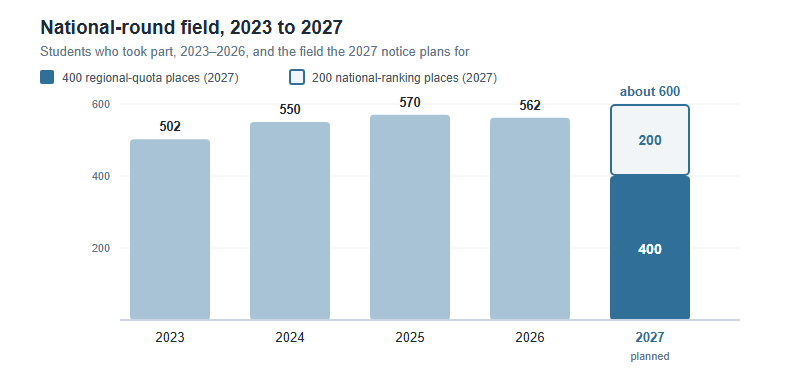
| National field | About 600: 400 regional-quota places and 200 by national ranking | 562 students took part | A slightly larger field |
| Fees | RMB 450 for the regional round; RMB 850 for the national round | Not compared | Budget for both if you intend to go through |
The arithmetic: ten weeks lost before the paper, five gained between the rounds
Count from mid-September, the same starting point for both seasons. A student starting on 16 September 2025 had about 27 weeks before the 2026 regional paper, and entries stayed open until about week 20. A student starting on 16 September 2026 has about 16 weeks before the 2027 paper, and entries close in weeks 11 and 12. Whatever plan you drew up last year, roughly ten weeks of it have gone.
The national round moved by less, about five weeks, so the space between the rounds more than doubled, from four weeks to nine. Not all of it is usable, because the qualifier list is published after the regional round on a date the notice does not give. It is still far more room than last season gave for the national components the regional paper never touches.
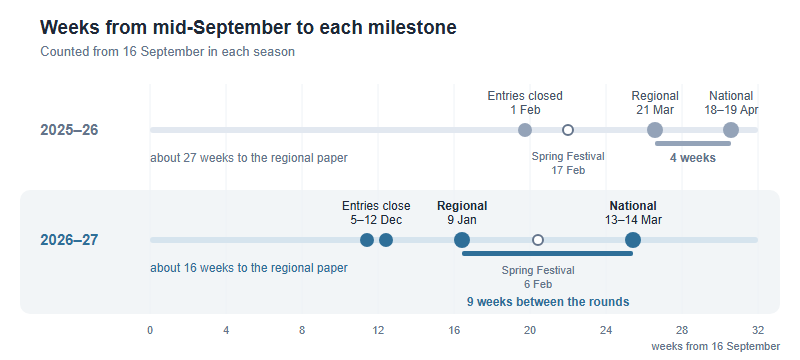
One date outside the notice matters too. Spring Festival falls on 6 February 2027, inside the gap between the rounds; last season it came on 17 February 2026, about five weeks before the regional paper and in the middle of final revision. A holiday between the two papers is a better position, provided those weeks are planned rather than lost.
Entering: two routes, and the base-school deadline comes first
Regional entry runs through base schools. If your school is on the base-school list attached to the notice, you enter through the school by 5 December 2026. The list grows as schools are confirmed, and schools not yet on it can apply now, so if yours is missing, talk to a science teacher in September or October rather than December.
Otherwise you use the individual channel, open from 5 to 12 December 2026. The notice says its link will be published at that time and that venues are arranged once entries close. A one-week window with no link to save yet is easy to miss, so diary both dates now and check chinabrainbee.com in early December.
- Fees. The notice sets the regional round at RMB 450 per student and the national round at RMB 850 per student for those who qualify.
- Studying outside China. Chinese-national students at schools overseas are asked to enter in the country or region where their school is located.
- Hong Kong, Taiwan and Macao. These run as separate International Brain Bee chapters, so students there should follow their own chapter's arrangements rather than this calendar.
- Who takes entries. Registration sits with the committee at chinabrainbee.com. We are an independent guide; we do not run any round and cannot enter anyone.
What stayed the same: the paper, the marks and the book behind it
The regional paper keeps its shape: a closed-book paper of multiple-choice and fill-in questions, 80 for the Brain Bee group in grades 9–12 and 60 for Brain Bee Junior in grades 5–8, one mark each, in 90 minutes. That is about 67 seconds a question for the older group and 90 seconds for Junior, reading included. Eligibility is unchanged too: grades 5 to 12, split into the two divisions by grade, in a competition that has run in China since 2013.
The notice attaches a two-page knowledge outline that groups the content into four modules, covering brain basics, brain function, brain disease, and brain research and technology, and it marks with an asterisk the topics Junior students are not required to know. It does not prescribe a textbook, but it recommends Brain Facts, published by the Society for Neuroscience and available at brainfacts.org, as basic reading for both groups to finish in full, and it says the regional paper draws mainly on it. If the structure of the competition is still new to you, our guide to what the Brain Bee is sets out the tiers before you commit a term to them.
One line deserves a second reading. Questions are written in Chinese with technical terms marked in both languages, while blanks may be answered in Chinese or English and English abbreviations are accepted for technical terms. For students who learned neuroscience in English, the pressure moves from writing to reading.
The national round: a larger field, and for Junior, a team you choose yourself
The notice keeps the national field at about 600 across both groups. Four hundred places are a regional quota, shared among provinces, municipalities and autonomous regions in proportion to participation and filled by ranking within each; the other 200 go to the best remaining regional scores nationally. The split between the two groups also follows participation. Older quota figures, including those our own earlier selection guide used, are superseded for 2027.
The two groups then sit very different national rounds.
- Brain Bee group, grades 9–12: individual, 100 marks. A 50-question written paper worth 50 marks; 13 identification items asking for the names of brain structures on specimens or on images such as CT and MRI, at 2 marks each; and 8 case-diagnosis questions analysing a patient's condition from case information, at 3 marks each. All three parts are closed book.
- Brain Bee Junior, grades 5–8: 80 marks. An individual 40-question paper worth 40 marks, and a team science poster worth 40 marks.
The Junior poster rules differ from what many families expect. After the qualifier list is published, students form their own teams of four to five, and a team can combine qualifiers from their own school and from other schools. On the day, each team makes a poster to a designated theme within a set time and presents it; reference materials may be consulted while the poster is being made; the poster may be made and presented in Chinese or English; and the team's score counts for every member. Choosing teammates is now part of preparation, and the weeks between the list and 13 March are when it happens.
For grades 9–12, half of the 100 marks sit outside the written paper, so the nine-week gap is the season's best chance to train identification and case reasoning. Start the week after 9 January, not the week the list appears.
Each country or region sends one student to the international stage. The notice gives the China place to the highest-scoring first prize in the grades 9–12 group, says the organiser covers that student's costs, and adds an invitation to the organiser's academic annual meeting. The timing it lists for the international stage does not match the International Brain Bee's published World Championship scheduling, so we are not quoting a month; check thebrainbee.org.
For scale rather than promise: per Hanlin's own de-identified records, 31 of our students advanced from the 2026 regional round into that year's national field of 562, and their national placings included 2nd and 8th in Junior and 11th and 13th in the grades 9–12 group. Those are not official statistics, and results vary between students and seasons.
The dates to put in the calendar now
| Date | What happens | Have this done by then |
|---|---|---|
| September–October 2026 | Base-school list being updated | Know your school's status and your entry route |
| 5 December 2026 | Base-school entries close; individual channel opens | Entered, or ready to enter individually |
| 12 December 2026 | Individual channel closes | Entry confirmed; a first full read of Brain Facts done |
| 9 January 2027 | Regional paper, 10:00–11:30 | Timed full-length practice with Chinese stems |
| After the regional round, date not given | Qualifier list published | Junior: teammates in mind. Grades 9–12: identification and case practice started |
| 6 February 2027 | Spring Festival | Two or three short sessions a week kept through the holiday |
| 13–14 March 2027 | National round | Junior: team and poster routine rehearsed. Grades 9–12: all three parts practised under time |
Grade 12 students applying abroad should note one more effect: the regional result will not exist when early deadlines pass, and the national round follows many regular ones. A result can still help later: admissions readers check an award against the transcript, activity list and essays, so a Brain Bee result that fits a sustained interest in neuroscience or medicine makes the whole file more believable. Whether you can add it after submitting depends on each university's update policy. Our overview of the Brain Bee tiers shows how the rounds fit together.
Questions students ask
When is the 2027 Brain Bee China regional round?
Saturday 9 January 2027, 10:00–11:30: a closed-book paper of 80 questions for grades 9–12 and 60 for grades 5–8, one mark each.
When do Brain Bee China 2027 entries close?
Base-school students enter through their school by 5 December 2026. Others use the individual channel, open 5–12 December 2026.
Can I answer the Brain Bee China papers in English?
Yes for written answers. Questions are in Chinese with technical terms in both languages, and blanks may be answered in Chinese or English.
How many students reach the 2027 national round?
About 600 across both groups, per the notice: 400 regional-quota places plus 200 awarded by national ranking of regional scores.
This is an independent guide operated by Hanlin Education for China-based international-school students. We are not affiliated with, endorsed by, or sponsored by the International Brain Bee (IBB), and we are not the official Brain Bee China national round; entry, rules and dates for the China region sit with the National Brain Bee Organizing Committee at chinabrainbee.com. Confirm current details on thebrainbee.org. Any factual error reported to us is corrected within 7 working days.