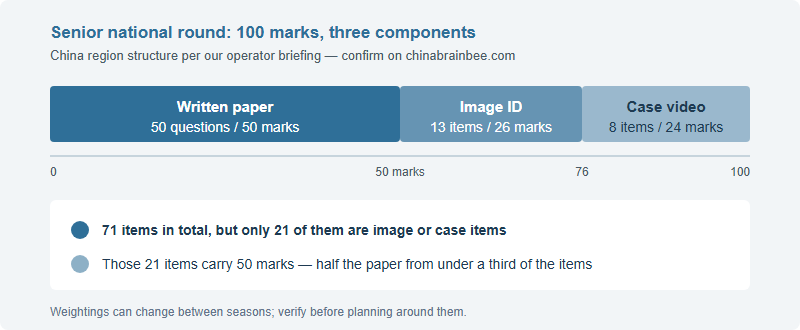
In the China region, the Senior national round is marked out of 100 and runs in three parts: a 50-question written paper worth 50 marks, 13 image or specimen identification items worth 26 marks, and 8 case-diagnosis items worth 24 marks. That split matters more than most students realise, because half the marks sit in under a third of the items. This guide turns the structure into a revision budget.
Where the 100 marks actually sit
Most students prepare for the national round as though it were one long biology exam. It is not. It is three assessments stapled together, and they reward three different kinds of study. Below is the structure as set out in the operator briefing we work from for the China region.
An important scope note before you read on. This is the China region's national-round structure. It is not the International Brain Bee World Championship format, and the organiser has not published these figures on a public page, so treat them as our working understanding rather than a quoted official rule. Component weightings can be adjusted from season to season. Confirm the current structure with the National Brain Bee Organizing Committee at chinabrainbee.com before you plan anything irreversible around it.
The number that should change your calendar: marks per item
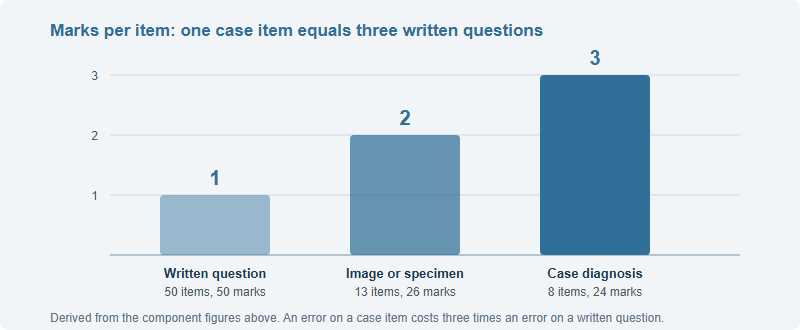
Divide marks by items and the paper looks completely different. A written question is worth one mark. An image identification item is worth two. A case-diagnosis item is worth three. One case item is worth as much as three written questions.
This is an average worked out from the component totals rather than a published per-item tariff, and it is the single most useful thing you can know before you build a revision plan. Students who spend eighty per cent of their hours re-reading chapters are optimising the cheapest marks on the paper. If you have limited weeks — and with a full IB or A-Level load you do — the mark-per-item figure tells you where an extra hour earns the most.
A revision budget that follows the marks
Here is the budget we would defend if a student asked us to allocate a hundred study hours. The point is not the exact percentages — it is that the shape of your hours should resemble the shape of the paper, with a deliberate overweight on the components where a single mistake is expensive and where most students have no practice at all.
| Component | Share of marks | Marks per item | Suggested share of study hours | Why |
|---|---|---|---|---|
| Written paper (50 questions) | 50% | 1 | 40% | Highest mark total, but the cheapest marks per item and the one component most students already train by default. |
| Image and specimen identification (13 items) | 26% | 2 | 30% | Requires visual recall you cannot build by reading. Brain structures plus CT and MRI views are a separate skill from naming a structure in prose. |
| Case diagnosis from video (8 items) | 24% | 3 | 30% | The most expensive item on the paper and the one with the least available practice material. Reasoning from a presentation to a mechanism is a trainable habit. |
Notice what this does to a typical schedule. A student who reads a chapter each week and never opens an image is, on our numbers, spending nearly all of their effort on 50 of the 100 marks. Shifting even a fifth of those hours into image recall and case reasoning moves work onto items worth two and three marks each.
The 26 marks most students under-train
Image and specimen identification covers brain structures as well as CT and MRI images. Reading about the thalamus and recognising the thalamus on a coronal section are different competences, and the second one does not arrive for free once you have enough of the first.
- Train recognition, not recall. Cover the label, look at the image, name the structure, then check. Reading a labelled diagram feels productive and teaches you almost nothing about identification under time pressure.
- Learn the planes before the parts. Most identification errors we see are orientation errors: the student knows the structure but cannot tell whether they are looking at an axial, coronal or sagittal view, so they place it wrongly.
- Work in both directions. Given a name, sketch roughly where it sits. Given an image, name it. The two directions catch different gaps.
- Treat radiology as its own vocabulary. A structure on a stained section and the same structure on an MRI can look nothing alike. Practise both, and get used to lower-contrast images rather than only textbook-perfect plates.
If you are still deciding whether this competition suits you at all, our guide to what the Brain Bee is sets out the three tiers and the syllabus before you commit a term to it.
The 24 marks that behave like a different subject
Case diagnosis at the national round is based on case video. You are not being asked to recall a definition; you are being asked to move from what you can observe to a plausible mechanism, and to do it eight times for three marks each.
The habit that earns these marks is a fixed reading order, applied every single time so that you are not inventing a method under pressure:
- Describe before you diagnose. Name what you can actually see — which side, which function, gradual or sudden, what is spared. Students who jump to a disease name and then look for confirmation get anchored on their first guess.
- Localise, then mechanise. Ask where a lesion would have to be to produce this pattern, and only then ask what kind of process could sit there.
- Use the spared functions. What is intact is often more diagnostic than what is impaired, because it rules regions out.
- Commit and justify. A named answer with one clean line of reasoning tends to read better than a hedged list of possibilities.
Practice material is the honest constraint here, because there is no official public question bank. We keep our own gathered pack of past-style questions and case prompts, assembled by our teachers rather than downloaded from an official source; scan the QR code in the site footer if you would like it. Worked solutions exist for some years and not for others, and we are still adding to them, so treat the pack as practice volume rather than a complete answer key.
What the mark split does not tell you
Two cautions, because a structure this tidy invites over-reading.
First, the numbers above describe the Senior division. The Junior division in the China region sits a different national assessment, including a team component, so a grade-8 student should not plan against this table. Second, mark structures are set by the organiser and can be revised between seasons. Nothing here is a quoted official rule, and none of it is the World Championship format — that is a separate assessment held in November alongside the Society for Neuroscience annual meeting, with its own sections on real brains or images, a written test, patient diagnosis from video footage with a written history, and a live oral round.
For context on outcomes rather than structure: at the 2026 China national round our own students took 7 first prizes — including 2nd and 8th in the Junior division and 11th and 13th in Senior — along with 11 second prizes and 10 third prizes; separately, 31 students advanced out of the regional round. Those are our own de-identified figures, per Hanlin; results vary between students and cohorts, and we treat the Brain Bee as an extracurricular interest activity rather than anything tied to school advancement in China.
Registration for every round in the China region runs through the National Brain Bee Organizing Committee at chinabrainbee.com. We do not administer the China national round and we cannot enter you for it. What we can do is help you read the structure honestly — which is also the aim of our overview of the competition and its syllabus.
Frequently asked questions
Is the Senior national round really out of 100 marks?
That is the structure in the operator briefing we work from for the China region: 50 plus 26 plus 24. It is not published officially, so confirm on chinabrainbee.com.
Which component should I start with?
Start with image identification and case reasoning. They carry two and three marks per item, and most students have no structured practice in either.
Does this mark split apply to the World Championship?
No. The World Championship is a separate assessment with its own four sections, held in November alongside the Society for Neuroscience annual meeting.
Is there an official past-paper bank I can download?
Not that we point students to. We use our own gathered practice pack, with worked solutions for some years but not all.
This is an independent guide operated by Hanlin Education for China-based international-school students. We are NOT affiliated with, endorsed by, or sponsored by the International Brain Bee (IBB), and we are not the official Brain Bee China national round; registration runs through the National Brain Bee Organizing Committee at chinabrainbee.com. Confirm current rules, dates and formats on thebrainbee.org. Any error reported to us is corrected within 7 working days.