Brain Bee is not a coding contest, but China’s 2027 syllabus explicitly includes brain imaging, brain-computer interfaces, neural-network principles and AI ethics—modules that speak directly to computer-science and AI interests. The catch: in China’s Senior division (grades 9–12), every tested round still requires neuroscience fundamentals, anatomical image identification and clinical case reasoning; the Junior division (grades 5–8) uses a written paper plus a team science poster, and the IBB World Championship follows its own format. Whether the overlap justifies your preparation depends on whether you want the biological context behind the algorithms you already study.
The Interdisciplinary Map Hidden in the Syllabus
According to Hanlin’s 2027 Brain Bee briefing, the competition’s knowledge outline is organised into four tiers—brain foundations, brain function, brain disorders, and brain research and technology—and the fourth tier is where CS and AI students find the most direct relevance. The briefing lists the following modules under brain-research and technology connections: brain imaging, gene therapy, deep brain stimulation, brain-computer interfaces, and neural networks with AI principles. A separate ethics-and-law section covers AI and wearable-device social issues. (The four-tier outline structure and the core tested formats are confirmed by the national programme source. The specific 2027 module names listed above reflect Hanlin’s organiser briefing as of September 2026.)
For a student who has already built a convolutional network in Python or read about EEG-based BCI spellers, these modules are not abstract biology. They describe the biological substrate—neurons, synapses and cortical maps—that inspired early neural-network research. The connection is a limited analogy: convolutional networks, for example, borrow the idea of hierarchical feature detection from visual-cortex studies, but most modern architectures do not mirror brain structure in any detailed sense. The briefing frames Brain Bee as a competition for students interested in biology, medicine, psychology, neuroscience, cognitive science, chemistry, computer science and artificial intelligence, placing CS and AI alongside the life sciences in its stated audience.
The International Brain Bee itself describes the event as a neuroscience competition for teens, founded in 1998, now spanning more than 50 countries. The China regional pathway adds its own format layers, which we unpack below.
What the Tested Rounds Actually Demand
Here is the critical contrast. The syllabus may mention BCI and neural networks, but no China Brain Bee round asks you to write code, submit a project or train a model. The national programme source confirms three tested formats for the China Senior (grades 9–12) national round:
| Round component | Format | Questions / marks | What it tests |
|---|---|---|---|
| Written paper | Closed-book; fill-in-blank and multiple choice | 50 questions / 50 pts | Neuroscience fundamentals across all four syllabus tiers |
| Image & specimen identification | Closed-book; identify structures on CT, MRI or specimens | 13 questions / 26 pts | Neuroanatomy, imaging landmarks |
| Case (video) diagnosis | Closed-book; analyse patient information | 8 questions / 24 pts | Clinical reasoning linking symptom to structure |
At the regional level, Senior students face 80 closed-book questions (multiple choice and fill-in-blank) in 90 minutes. The briefing notes that regional “frontier” questions and the national image-identification section can touch on how real brain signals become algorithms and devices—but the response format is still selecting or writing a term, not implementing a pipeline.
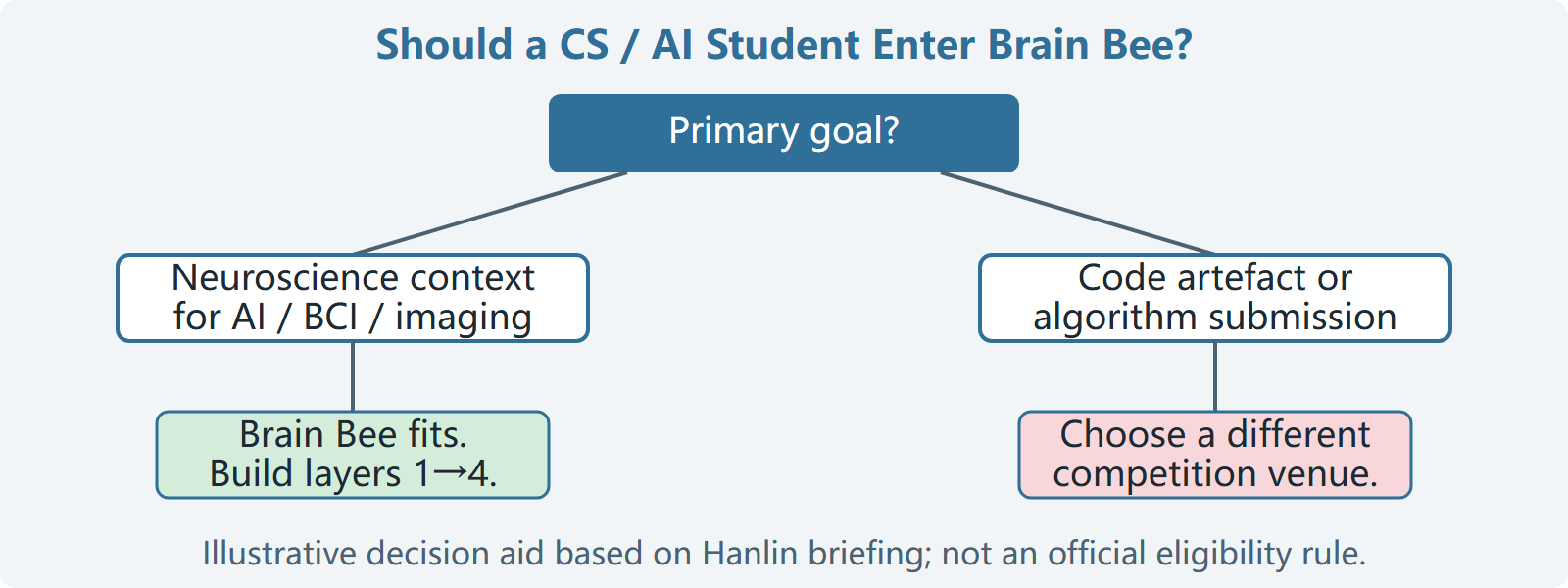
If your goal is to demonstrate a working AI project, China’s Brain Bee is not the venue. If your goal is to understand why a convolutional layer draws loosely on the hierarchical organisation of visual cortex, or what a BCI electrode array is actually reading from motor cortex, the syllabus gives you structured content that a pure CS curriculum rarely covers.
A Decision Rule: Enter or Skip
Use the following comparison to decide quickly. This is not a value judgement on either path; it is a fit check.
| Your primary goal | Brain Bee fit | Better alternative |
|---|---|---|
| Understand biological basis of neural networks and BCI | Strong – syllabus covers both explicitly | — |
| Build and submit an AI project or code artefact | No tested round accepts code | Science fair, hackathon, or research programme |
| Add neuroscience context to a CS/AI application narrative | Moderate – award corroborates interdisciplinary interest | — |
| Practise only algorithm design or competitive programming | Minimal overlap | USACO, IOI-style contests |
| Explore medical imaging or clinical reasoning before university | Strong – image ID and case diagnosis rounds | — |
Students who sit in the first, third or fifth rows will find genuine information gain. Students in rows two and four will spend preparation time on neuroanatomy recall that does not transfer to their target skill. For a broader comparison of neuroscience, biology and psychology competitions, see our earlier guide on Brain Bee vs USABO vs IPsyO.
A Study Order That Builds Toward the AI-Relevant Modules
This article’s editorial recommendation is a layered study sequence rather than jumping straight to BCI chapters. The logic is that imaging and interface questions assume you can name the structure being imaged or the pathway being interfaced. The suggested order is:
- Neuron structure and synaptic transmission. Without ion channels, neurotransmitter release and receptor types, later imaging questions lack context. Our article on neurotransmitters and the synapse walks through one mechanism that appears in four question formats.
- Sensory and motor systems. Vision, hearing, somatosensory and motor pathways give you the “wiring diagram” that BCI and imaging questions reference. See the sensory-systems trace article for receptor-to-cortex pathways.
- Disorders and clinical reasoning. Parkinson’s, Alzheimer’s, epilepsy and neurodevelopmental conditions appear in the case-diagnosis round. The disorders map article links symptom, structure and mechanism for twelve conditions.
- Imaging, BCI and neural-network principles. Only after layers 1–3 can you interpret a CT slice, explain what a deep-brain-stimulation electrode targets, or discuss how a neural-network architecture abstracts cortical hierarchy.
An illustrative example constructed for this article (not a past exam question or real student case): imagine being shown an fMRI activation pattern during a finger-tapping task and asked to identify the primary motor cortex region involved. Answering correctly requires knowing the motor homunculus layout (layer 2) before the imaging modality (layer 4) becomes meaningful.
Editorial self-check for CS students. Before committing to Brain Bee preparation, try this quick diagnostic. (1) Without looking anything up, sketch a basic neuron and label the synapse. (2) Name the lobe that contains primary motor cortex. (3) Explain in one sentence what fMRI actually measures. This is an editorial study aid, not an official placement test or competition requirement.
Where the AI Connection Actually Surfaces in Questions
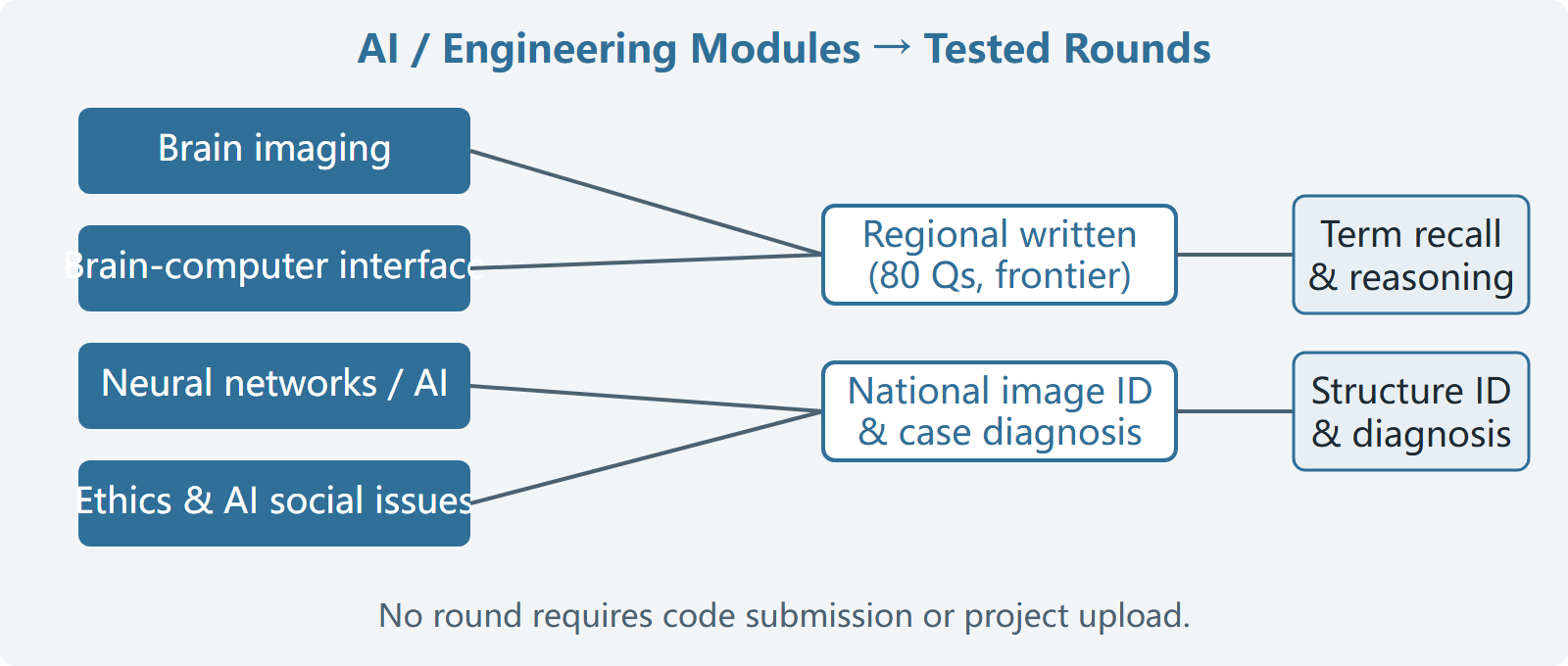
The briefing indicates that national Senior image/specimen identification and regional frontier questions can touch on how real brain signals become algorithms and devices. In practice, this means a regional multiple-choice item might ask which imaging modality best resolves subcortical structures, or a national image-identification station might present an MRI slice and ask you to label the electrode target for deep brain stimulation in Parkinson’s disease. The reasoning is clinical and anatomical; the technology is the context, not the deliverable.
For students preparing alongside a full IB or AP workload, our autumn-start prep calendar shows how to sequence these layers without overloading a single term.
What This Means for Your Preparation Mindset
If you enter, treat the neuroscience fundamentals as the price of admission to the AI-relevant content. In China’s Senior division, the written paper at regional and national level draws on all four syllabus tiers, so skipping neuron structure to jump to BCI chapters leaves gaps that cost marks. The China pathway article explains how regional, national and world rounds test three different skill sets, which helps you allocate revision time proportionally.
Equally, if your school biology or IB/AP course already covers synaptic transmission and basic neuroanatomy, you are not starting from zero. Our analysis of what IB, AP and A-level biology provide—and the three gaps they leave can help you identify exactly which Brain Bee topics your current coursework does not reach.
Frequently Asked Questions
Does any Brain Bee round require me to write code or submit an AI project?
No. According to Hanlin’s 2027 briefing, all China Senior rounds—regional written paper, national written paper, image/specimen identification and case diagnosis—are closed-book, pen-and-paper formats. No round accepts a programming submission, dataset or project artefact.
Which syllabus modules are most relevant to a computer-science or AI student?
Hanlin’s briefing highlights brain imaging, deep brain stimulation, brain-computer interfaces, neural networks and AI principles, plus an ethics section covering AI and wearable-device social issues. These sit within the “brain research and technology” tier of the four-tier outline. The four-tier structure and core formats are confirmed by the national programme source; the specific 2027 module names reflect Hanlin’s organiser briefing.
Can I skip neuroanatomy and focus only on the AI-related modules?
Not effectively. The national Senior image/specimen identification round (13 questions, 26 marks) requires you to name structures on CT or MRI scans, and the written paper draws on all four syllabus tiers. This article’s editorial recommendation is to build from neuron and synapse foundations through sensory/motor systems and disorders before tackling imaging and BCI concepts.
Editorial note: This article is published by an independent educational site and is not affiliated with, endorsed by or operated on behalf of the International Brain Bee organization (thebrainbee.org) or any national Brain Bee organising committee. Syllabus-module mapping and format details attributed to Hanlin’s briefing reflect the organiser information available to Hanlin as of September 2026; readers should verify current-round rules with their regional Brain Bee coordinator before relying on any procedural detail. Competition results may corroborate a student’s academic record but do not guarantee any admissions outcome.