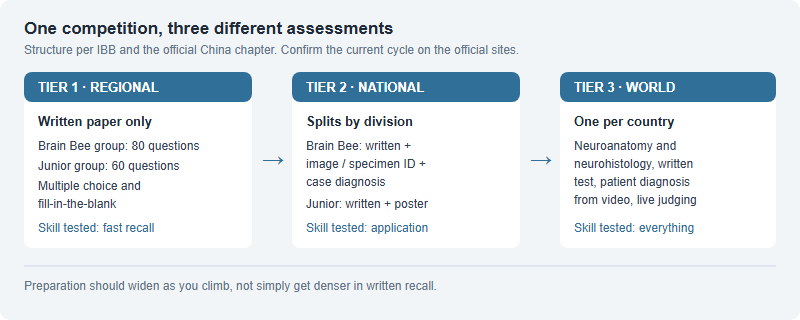
Most students prepare for the Brain Bee as if it were one exam. It is not. The China regional round is a written paper and nothing else; the national round adds specimen identification and case diagnosis for older students, and a science poster for younger ones; the IBB World Championship is a different event again, entered by one champion per country. Three tiers, three shapes.
That structural fact should drive your whole study plan, because a student who trains only for recognition-style questions can pass the regional stage and then meet a national round that asks them to name a structure on an image or reason through a patient case. If you are still working out what the competition is at a basic level, start with our guide to what the Brain Bee is and come back to this pathway piece afterwards.
The three tiers, and why the shape changes at each one
The International Brain Bee (IBB) describes a three-tiered structure: students typically begin at a Local Brain Bee where one is available, top performers advance to their country's National Brain Bee, and each National Brain Bee sends one representative to the IBB World Championship. That last clause is the one people misread. It is not a large international final that anyone can enter by paying a fee — a country sends a single champion, and IBB states that to be eligible for the World Championship a participant must first win their respective national competition.
The practical consequence is that the further up the ladder you go, the fewer people are being assessed and the more the assessment moves away from written recall. A regional paper has to be administered to a large number of students at once, so it is written. A world final with one champion per country can afford tasks that need brains, images, video and a panel of judges. Your preparation should widen in the same direction rather than getting deeper in only one skill.
Tier 1: the regional round is a paper, and it is the whole gate
According to the national programme page published by the official China chapter, both divisions sit a written paper at the regional stage: the Brain Bee group answers 80 questions and the Brain Bee Junior group answers 60, with question types including multiple choice and fill-in-the-blank, predominantly multiple choice. There is no oral component and no specimen work described at this stage.
Two planning points follow. First, the regional round rewards breadth over depth. A paper of that length cannot spend long on any one topic, so a student who has read the whole syllabus once and can recognise terminology will usually outperform a student who has read three chapters extremely closely. Second, fill-in-the-blank items are quietly the hardest part of the paper for students working in a second language, because recognition no longer helps you — you must produce the English term and spell it. That is a distinct skill, and it is trainable.
Treat the regional paper as a coverage test. Read the full syllabus early, then use short, frequent self-testing to convert reading into retrieval. Details of the exact paper for any given cycle — timing, venue arrangements, marking — should be confirmed on the official chapter site rather than assumed from a previous year.
Tier 2: the national round is where the two divisions stop looking alike
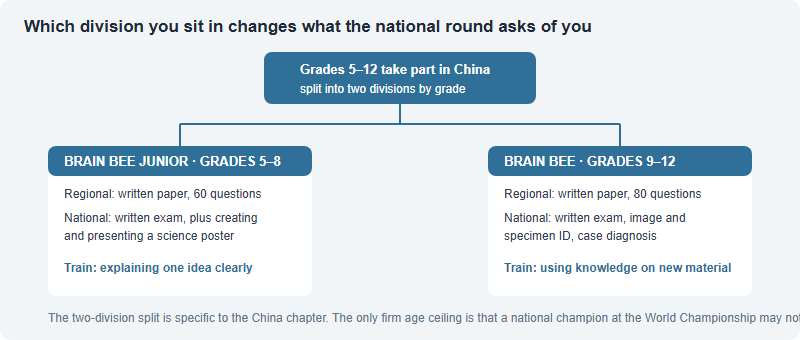
China runs two divisions, and this is a China-specific structure rather than an IBB one: Brain Bee for grades 9 to 12 and Brain Bee Junior for grades 5 to 8. At the regional stage they simply sit papers of different lengths. At the national stage they diverge properly.
The official chapter describes the Brain Bee national round as three components — a written exam, image and specimen identification, and case diagnosis — while the Junior national round is described as two components: a written exam plus creating and presenting a science poster. Those are genuinely different competitions in terms of what a student has to be good at.
| Stage | Brain Bee (grades 9–12) | Brain Bee Junior (grades 5–8) | What it rewards |
|---|---|---|---|
| Regional | Written paper, 80 questions | Written paper, 60 questions | Syllabus coverage, fast recall, spelling of terms |
| National | Written exam + image/specimen identification + case diagnosis | Written exam + science poster creation and presentation | Applying knowledge to images, cases or an explanation task |
| World Championship | One representative per national chapter; neuroanatomy and neurohistology, written test, patient diagnosis from video footage with a written history, and live oral judging on a two-strikes basis | Breadth plus composure under judging | |
If you are in the Junior division, notice what that table is telling you: your national round contains a communication task, not a specimen task. A student who can explain one neuroscience idea clearly, with a well-designed poster and a confident spoken summary, is preparing correctly. Memorising every structure of the brainstem is not the highest-value use of the last month.
If you are in the senior division, the opposite applies. Image and specimen identification and case diagnosis are both transfer tasks — you are being asked to use knowledge on unfamiliar material rather than restate it. That is why students who were comfortable at regional level sometimes stall at national level: nothing about their knowledge got worse, but the question format stopped playing to it.
Tier 3: the World Championship is a separate event with a separate calendar
The World Championship is run by the IBB and held in November in conjunction with the Society for Neuroscience annual meeting. IBB lists the 2026 edition as running virtually from 6 to 11 November, marked tentative, alongside the SfN meeting in Washington, D.C. Because that wording is explicitly tentative and because format has varied between in-person and virtual editions, treat any specific date or delivery mode as something to verify rather than plan a flight around.
At world level the assessment has historically spanned four kinds of task: neuroanatomy and neurohistology worked on real brain material or images; a written test; patient diagnosis, which is presented through video footage and a written history rather than live actor patients; and live oral judging run on a two-strikes-and-out basis. We have written separately on how these pieces fit together, and there is no jeopardy-style buzzer round despite what some summaries online claim.
One more eligibility point that trips families up. In practice the competition runs across grades 5 to 12, roughly ages 10 to 18, split into divisions by grade. The one firm ceiling that is worth memorising is that a national champion competing at the World Championship may not be older than 19. Everything else about age and grade should be read off the official chapter rules for the cycle you are entering.
Where to register, and which chapters are not part of the China chapter
Registration for the China rounds runs through the official China chapter at chinabrainbee.com, operated by the National Brain Bee Organizing Committee. That is the body that sets the regional and national arrangements, and it is where you should confirm dates, eligibility, division placement and entry. Brain Bee has run in China since 2013, and the chapter lists academic partners including Tsinghua University, the University of Hong Kong, Zhejiang University, Fudan University and the Chinese Academy of Sciences.
Two boundaries are worth stating plainly. Hong Kong, Taiwan and Macao operate as separate IBB chapters — they are not administered as part of the China chapter, so a student based there follows a different entry route and a different champion goes forward. And this site is an independent guide: we do not run, administer or select for any round of the Brain Bee, and nothing you read here replaces the official chapter's published rules.
It is also worth quoting the chapter's own framing, because it is the honest one: the chapter describes Brain Bee as an extracurricular interest exploration project that is not linked to admission. Treat a result as evidence of genuine interest in neuroscience, not as a lever on any admissions process.
Planning a season around a shape that changes
A workable sequence for a senior-division student looks like this. Spend the first block reading the syllabus for coverage, because the regional paper is a breadth test. Move the middle block onto retrieval practice and terminology production, since fill-in-the-blank items and the national written exam both punish passive familiarity. Only in the final block should you shift weight onto images, specimens and case reasoning — those are the national-round skills, and drilling them before you have the underlying knowledge produces confident guessing rather than diagnosis.
Junior-division students should follow the same first two blocks and then substitute poster and presentation work for specimen drills. Building one clear poster on a topic you actually find interesting, and rehearsing a spoken explanation of it, is worth more than another twenty flashcards.
For a sense of what that funnel looks like in practice, one de-identified Hanlin cohort in the 2026 China cycle saw 31 students advance from regional rounds to the national round, which then produced 7 first prizes — including second and eighth place in the Junior division and eleventh and thirteenth in the senior division — alongside 11 second prizes and 10 third prizes. Results vary between students and between years, that is one coaching cohort rather than a national statistic, and, as the chapter itself states, none of it is linked to school admission.
The takeaway is structural rather than motivational: if you know the assessment changes shape at each tier, you can change your preparation to match it, instead of arriving at the national round with an excellent set of regional-round skills.
Where do I register for the Brain Bee in China?
Through the official China chapter at chinabrainbee.com, run by the National Brain Bee Organizing Committee. Confirm dates and eligibility there.
Is the regional round only a written paper?
Per the official chapter, yes: 80 questions for the Brain Bee group and 60 for Junior, mainly multiple choice with some fill-in-the-blank.
Do Junior and senior students do the same national round?
No. Junior does a written exam plus a science poster and presentation; the senior division does written, specimen and image ID, and case diagnosis.
How many students go to the World Championship from each country?
One. Each national chapter sends a single representative, and that student must have won their national competition.
This is an independent guide operated by Hanlin Education for China-based international-school students. We are not affiliated with, endorsed by, or sponsored by the International Brain Bee (IBB), and we are not the official Brain Bee China national round; the official China chapter is chinabrainbee.com. Confirm current rules, dates and eligibility on thebrainbee.org and the official chapter site before acting on anything here. Errors reported to us are corrected within 7 working days.