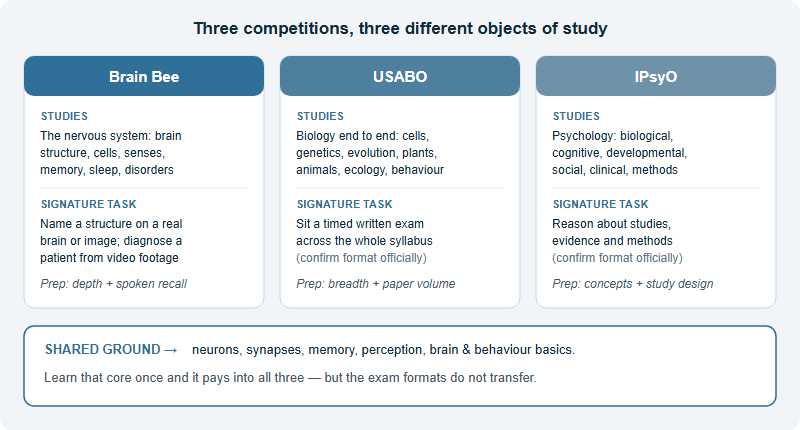
Brain Bee, USABO and IPsyO all look like “science competitions” on an activity list, but they test three different objects. The Brain Bee tests the nervous system, USABO tests biology as a whole subject, and IPsyO tests psychology as a discipline. The Brain Bee is also the only one of the three whose format includes brain specimens, video patient diagnosis and a live oral round.
The one-sentence difference
Most families compare these three by difficulty, which is the wrong axis. Compare them by what you spend your evenings doing, because that is what actually decides whether a student finishes the season.
- Brain Bee — one organ system, studied deeply. You learn the brain: its cells, its gross anatomy, the senses, movement, memory, sleep, development and neurological disease. You are then asked to recognise structures, reason about a patient, and answer out loud.
- USABO — the whole of biology, studied for breadth. Cell biology, genetics and evolution, plant and animal anatomy and physiology, ecology, animal behaviour and taxonomy all sit inside the syllabus. The reward goes to coverage plus exam speed.
- IPsyO — psychology as a research discipline. Biological, cognitive, developmental, social and clinical psychology, plus research methods and statistics. The reward goes to students who enjoy arguing from evidence and study design.
Put crudely: the Brain Bee wants you to know one thing very well, USABO wants you to know many things reliably, and IPsyO wants you to think carefully about how anything is known at all. If you are still working out what the Brain Bee itself is, start with our guide to how the Brain Bee works and then come back to this comparison.
What the Brain Bee asks you to do (the part we can state precisely)
Because this is a Brain Bee guide, we can be specific about the Brain Bee and should be careful about the other two. The Brain Bee runs in three tiers — Local, National and the IBB World Championship, and each national chapter sends exactly one representative to the world final. That single-representative rule is the structural fact that separates the Brain Bee from most exam olympiads: the national round is not a qualifying threshold that a cohort clears together, it is a race for one seat.
At the World Championship the competition has four sections: neuroanatomy and neurohistology on real brains or images; a written test; patient diagnosis from video footage plus a written history; and a live oral judging round in which two wrong answers eliminate a competitor. The world final is held in November, alongside the Society for Neuroscience annual meeting. Most local rounds are based on Brain Facts, published by the Society for Neuroscience and available at brainfacts.org, or Neuroscience: The Science of the Brain; each national round is organised individually, so confirm what your own round sets — for China, through the National Brain Bee Organizing Committee at chinabrainbee.com.
In China, the competition is organised in two divisions — Brain Bee Junior for grades 5–8 and Standard Brain Bee for grades 9–12. That division structure is specific to the China round rather than a feature of the International Brain Bee, so treat it as a China-region fact and confirm the current season on the official channel. In practice this means the Brain Bee is open earlier than most science olympiads: a grade 6 student has a real division to enter rather than being told to wait three years. The only firm ceiling anywhere in the system is that a national champion competing at the World Championship may not be older than 19.
Side by side: scope, task and fit
The honest version of this table separates what we can state from what you must verify. We do not restate USABO or IPsyO format numbers here — question counts, timings, grade bands and award thresholds change and belong to their own organisers.
| Brain Bee | USABO | IPsyO | |
|---|---|---|---|
| Core object | The nervous system | Biology as a whole subject | Psychology as a discipline |
| How you are tested | Four sections at the world final: specimen/image anatomy, written test, video patient diagnosis, live oral round | Written examination; multi-stage national selection | Staged written assessment; check the current structure |
| Route to the top | Local → National → IBB World Championship; one representative per national chapter | National selection ladder toward the international biology olympiad | National/regional stages toward the international round |
| Set text / syllabus | Most local rounds: Brain Facts (Society for Neuroscience, at brainfacts.org) or Neuroscience: The Science of the Brain; each national round sets its own — confirm with the organiser | University-level general biology breadth | Introductory psychology domains plus research methods |
| Entry age | Runs in practice for grades 5–12, split by division (China: Junior 5–8, Standard 9–12); world champion cannot be older than 19 | Confirm with the organiser | Confirm with the organiser |
| Rewards the student who… | Goes deep, memorises visually, and can speak under pressure | Covers a wide syllabus and executes accurately at speed | Enjoys evidence, design and argument |
| Verify details at | thebrainbee.org; official China round at chinabrainbee.com | our USABO guide and the organiser | our psychology olympiad guide and the organiser |
Three student profiles, and the honest match
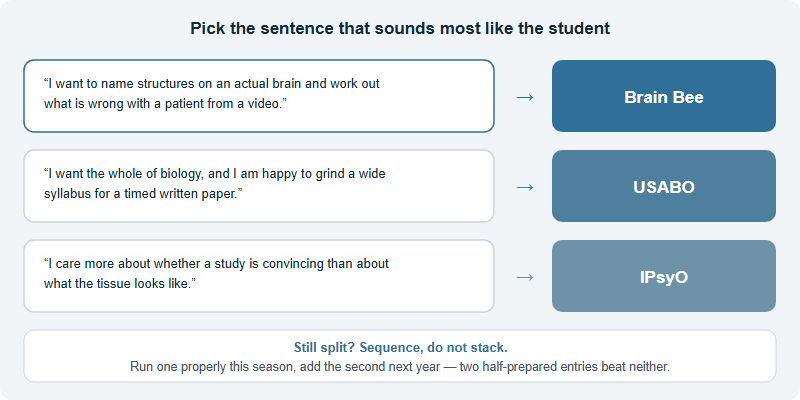
The visual memoriser who likes medicine. This student enjoys labelled diagrams, remembers things spatially, and gets energised by clinical cases rather than by cell-cycle detail. The Brain Bee suits them unusually well, because two of its four sections — specimen anatomy and video patient diagnosis — are exactly that skill. A student like this often underperforms on a broad biology paper simply because breadth punishes them before depth can help.
The systematic finisher. This student works through a textbook end to end, keeps a schedule, and does not mind that ecology and plant physiology feel less exciting than neurons. Biology-wide competition rewards them; a single-organ competition can leave them feeling they have run out of material by December. If a student is genuinely happy covering the whole biology syllabus, do not talk them out of it in favour of the Brain Bee.
The evidence arguer. This student is interested in why a study is or is not convincing, likes statistics more than they admit, and reads about behaviour rather than tissue. Psychology-side competition is the better match, and the Brain Bee will feel to them like anatomy homework with an interesting last chapter.
There is a fourth profile worth naming: the grade 6 to grade 8 student who cannot yet enter the other two. Because the China Brain Bee runs a Junior division for grades 5–8, it is often the first real subject competition available to a middle-school student who is already reading about the brain. That is a timing advantage, not a difficulty discount — the Junior division still expects genuine neuroscience.
Can a student do more than one? Sequence, do not stack
Yes, and many do — but not in the same term. The shared ground between the three is real: neurons, synapses, perception, memory and the biological basis of behaviour appear in all three syllabuses, so a year of serious Brain Bee study genuinely shortens the neuroscience chapters of a biology or psychology syllabus later. What does not transfer is the format. Learning to identify a structure on a specimen does not prepare you for a timed multiple-choice paper, and neither prepares you for speaking an answer aloud in front of a panel.
The practical rule we give students is to protect one calendar. Look at when each competition’s stages fall, decide which one you can prepare for without colliding with your IB or AP exam block, and put the other one in next year’s plan. A student who reaches a national round in one competition has a far stronger story than a student who entered three and finished none.
One more sequencing note specific to the Brain Bee: because the China round splits Junior (grades 5–8) from Standard (grades 9–12), a student who starts in middle school gets two distinct competitive lives rather than one. Students who use the Junior years to build neuroanatomy recall arrive in grade 9 already knowing the material and can spend their senior years on the harder sections rather than on vocabulary.
What a result signals — and what to confirm before you decide
A Brain Bee result signals demonstrated depth in one subject area, tested in unusual ways: it says a student can identify anatomy, hold a clinical case in their head, and answer aloud. A biology olympiad result signals sustained breadth and exam execution. A psychology result signals comfort with evidence and methods. Those are three different sentences on an application, and admissions readers do notice which one you can actually back up in an interview.
What none of them signals is an outcome. No competition result guarantees an admission anywhere, and we do not present any of these three as an admissions route. Nor do we tie competition results to Chinese domestic school admission — they are subject credentials and interest evidence, nothing more.
For transparency about our own vantage point: across the 2026 China national round, students prepared by Hanlin took 7 first prizes — including 2nd and 8th place in the Junior division and 11th and 13th in the Standard (grades 9–12) division — along with 11 second prizes and 10 third prizes, with 31 students advancing from the regional stage. Those figures are de-identified, reported by Hanlin, and reflect one cohort in one season; individual results vary and nothing here predicts what any particular student will achieve. We report them because they are the basis for the pattern we describe above: the students who did best were, almost without exception, the ones who had chosen one competition and given it a full year.
Three things to confirm officially before you commit to any of the three:
- Eligibility for the current season. For the Brain Bee, the China round is run by the National Brain Bee Organizing Committee at chinabrainbee.com — registration and division rules live there, not here; our China region page sets out how the route works before you go and register. Note also that Hong Kong, Taiwan and Macao are listed as separate chapters, not part of the China chapter.
- Dates. Every stage date in every one of these three competitions moves year to year. Confirm on official channels before you build a study plan around a month.
- The format you are actually sitting. The four-section structure described above is the World Championship format. What a local or national stage includes can differ — check what your own round contains before you over-train one section. Our Brain Bee overview explains how the tiers connect.
Frequently asked questions
Is the Brain Bee easier than USABO?
It is narrower, not easier. The Brain Bee covers one organ system in depth and adds specimen anatomy, video diagnosis and a live oral round.
Can a middle-school student enter the Brain Bee?
Yes. In practice it runs for grades 5–12 by division; China runs Brain Bee Junior for grades 5–8 and Standard Brain Bee for grades 9–12.
Should a student do Brain Bee and USABO in the same year?
Usually no. The content overlaps a little, the formats do not. Run one properly this season and add the second next year.
Where do I register for the Brain Bee in China?
Through the official China national round at chinabrainbee.com. This site is an independent guide and does not run or administer that round.
This is an independent English-language Brain Bee guide operated by Hanlin Education for China-based international-school students. It is not affiliated with, endorsed by, or sponsored by the International Brain Bee (IBB), and it is not the official Brain Bee China national round (run by the National Brain Bee Organizing Committee / chinabrainbee.com). Rules, rounds, eligibility, divisions and dates are set by the organisers and change from year to year — always confirm current details on thebrainbee.org and the official China channel before planning around them. Competition results reported here are de-identified, provided by Hanlin, vary by student, and are not a prediction of any outcome. Confirmed errors are corrected within 7 working days.