Every sense in the Brain Bee syllabus runs on the same chain. A receptor cell turns a stimulus into electrical signals, the signal travels a pathway that usually relays in the thalamus, and it arrives at a dedicated area of cortex. Learn that chain once for vision, hearing, touch, taste and smell, note the one big exception, that smell reaches its first cortical area without a thalamic relay, and sensory questions become lookups and lesion puzzles.
What the 2027 outline asks you to know about the senses
The knowledge outline attached to the 2027 Brain Bee China notice lists the senses under brain function. Both groups must know how vision, hearing, taste, smell, and touch and pain are formed, and how the senses can be protected, with preventing short-sightedness as the example. Sensory-system disorders carry an asterisk, meaning Brain Bee Junior, for grades 5–8, does not need them. Pain appears again under brain disease.
| Outline item | Grades 9–12 | Grades 5–8 | Our study target for it |
|---|---|---|---|
| How vision, hearing, taste, smell, and touch and pain are formed | Required | Required | Trace each sense from stimulus to cortex |
| Sensory-system disorders | Required | Not required | Say which link in the chain a disorder breaks |
| Protecting the senses, for example preventing short-sightedness | Required | Required | Explain the risk and the protective habit |
| Pain, in the illness-and-injury list | Required | Required | Describe how pain is signalled and turned down |
| Identifying internal brain structures on images or specimens | Required | Not required | Place the optic chiasm and thalamus on real images |
The notice also says where this is tested. The regional paper on 9 January 2027 is closed book, with one-mark multiple-choice and fill-in questions, 80 for the Brain Bee group and 60 for Junior, drawn mainly from Brain Facts, published by the Society for Neuroscience and available at brainfacts.org. At the national round, grades 9–12 add 13 identification items on specimens or CT and MRI images and 8 case-diagnosis questions. A chain you can run in both directions pays in all three.
One principle holds every sense together
Each sense starts with a different kind of energy, whether light, pressure waves in air, force on the skin, or dissolved and airborne chemicals, and converts it into the same currency: changes in membrane voltage and, eventually, action potentials. That conversion is called transduction, and it happens in specialised receptor cells. After it, the signals all look alike.
So how does the brain tell sight from sound? By the pathway a signal arrives on. Activity in the visual pathway is experienced as seeing however it was triggered, which is why pressing gently on a closed eye can produce a patch of light. Every sense is a receptor, a pathway and a cortical destination, and questions test whether you know which is which. If the competition itself is new to you, our guide to what the Brain Bee is shows where this block sits among the rounds.
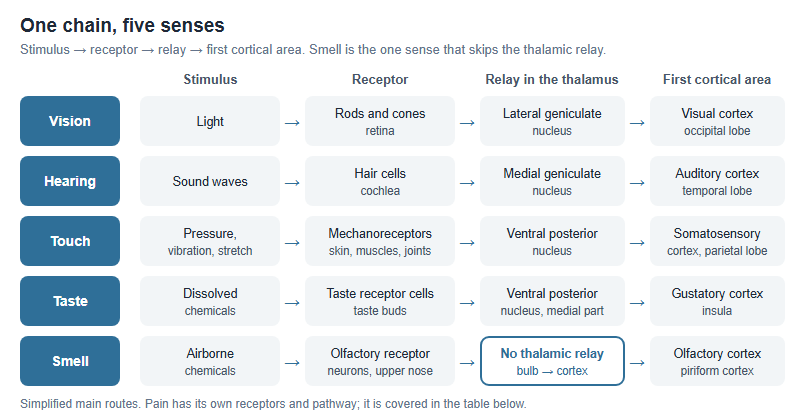
Five senses and pain on one grid
| Sense | Stimulus | Receptor cells, and where they sit | Relay in the thalamus | First cortical area |
|---|---|---|---|---|
| Vision | Light | Rods and cones, in the retina | Lateral geniculate nucleus | Primary visual cortex, occipital lobe |
| Hearing | Pressure waves in air | Hair cells, in the cochlea of the inner ear | Medial geniculate nucleus | Primary auditory cortex, temporal lobe |
| Touch | Pressure, vibration, stretch | Mechanoreceptors, in skin, muscles and joints | Ventral posterior nucleus | Primary somatosensory cortex, postcentral gyrus of the parietal lobe |
| Taste | Dissolved chemicals | Taste receptor cells, in taste buds | Ventral posterior nucleus, medial part | Gustatory cortex, in the insula and nearby frontal operculum |
| Smell | Airborne chemicals | Olfactory receptor neurons, in the lining of the upper nasal cavity | None before the first cortical area; the olfactory bulb projects there directly | Primary olfactory cortex |
| Pain | Stimuli that damage or threaten tissue | Nociceptors, free nerve endings in skin and other tissues | Several thalamic nuclei | Somatosensory cortex, with the insula and anterior cingulate cortex |
In our coaching, the relay column is the one students most often leave blank, and it is what separates a confident pathway answer from a guess. The smell row holds the exception worth stating in one sentence: olfactory signals reach primary olfactory cortex without first passing through the thalamus.
The details questions actually use, sense by sense
Vision.
- Rods work in dim light and do not signal colour; cones work in brighter light and come in three types, most sensitive to short, medium and long wavelengths. Cones are densest in the fovea, the centre of gaze.
- Photoreceptors are depolarised in darkness and hyperpolarise when light arrives, releasing less transmitter: the block's most counterintuitive fact.
- The blind spot is where the optic nerve leaves the eye; there are no photoreceptors there.
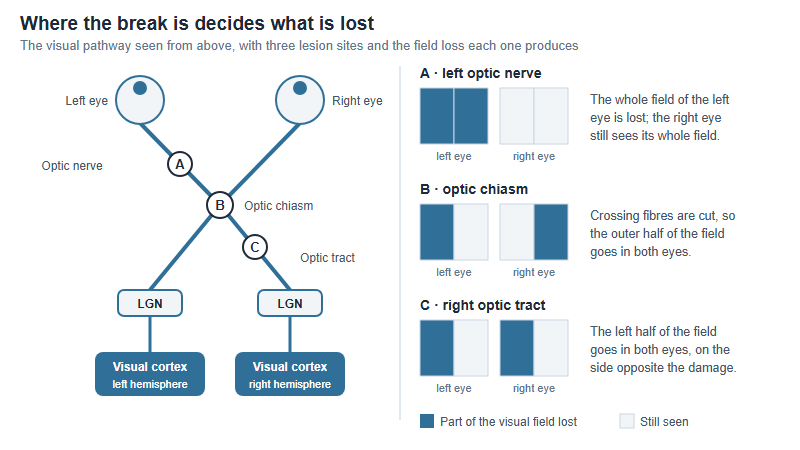
- At the optic chiasm, fibres from the half of each retina nearer the nose cross over, so each hemisphere receives the opposite half of the visual field from both eyes.
- In short-sightedness, or myopia, distant images focus in front of the retina, usually because the eyeball is too long. Studies, including school-based trials in China, link more time outdoors in childhood with fewer children becoming short-sighted, a ready example for the outline's protection item.
Hearing and balance.
- Sound moves the eardrum, the three middle-ear bones pass the vibration to fluid in the cochlea, and hair cells convert the movement into electrical signals when their bundles bend.
- The cochlea is organised by pitch, with high frequencies detected near its base and low frequencies near its apex, and that map is carried up to auditory cortex.
- Conductive hearing loss means sound fails to reach the inner ear; sensorineural loss means hair cells or the auditory nerve are damaged. Loud noise damages hair cells, and in humans lost cochlear hair cells are not naturally replaced.
- Hair cells also serve balance, in the semicircular canals and otolith organs of the inner ear.
Touch and pain.
- Different mechanoreceptors are tuned to different features of contact: Meissner endings to light touch and flutter, Merkel endings to sustained pressure and texture, Pacinian endings to vibration and Ruffini endings to skin stretch.
- Somatosensory cortex holds a body map, the sensory homunculus, in which the lips and fingertips take far more space than the back, because map size follows receptor density, not body size. Touch from one side of the body is represented in the opposite hemisphere.
- Pain arrives on two kinds of fibre: fast, thinly myelinated fibres carry the sharp first pain, and slow, unmyelinated fibres carry the dull or burning pain that follows.
- Gate control theory, proposed by Ronald Melzack and Patrick Wall in 1965, explains why rubbing a knock eases it: non-painful input can reduce pain transmission in the spinal cord. The brain also turns pain down through descending pathways and the body's own opioids, such as endorphins.
Taste and smell.
- There are five basic taste qualities: sweet, sour, salty, bitter and umami. The familiar tongue map, with a separate zone for each, is a myth; all five can be detected wherever there are taste buds, with only small regional differences.
- Much of what people call flavour is actually smell, carried from the back of the mouth up to the nose.
- Humans have several hundred types of olfactory receptor. Each olfactory receptor neuron expresses one type, and an odour is identified by the combination of receptors it activates. These neurons are replaced throughout life, unlike cochlear hair cells.
- Smell has unusually direct links to the amygdala and nearby memory structures, often used to explain why an odour can revive a vivid emotional memory.
How do you use the chain to find a lesion?
The chain earns its most expensive marks when it runs backwards. Given what a person cannot sense, you ask which link must be broken and on which side. That is the reasoning behind national case-diagnosis questions for grades 9–12, and the best way to organise the outline's asterisked sensory disorders: as losses placed on the chain, not a list of names.
| What is lost | Where the chain is broken | Where to look |
|---|---|---|
| All vision in one eye | Before the optic chiasm | That eye's retina or optic nerve |
| The outer half of the visual field in both eyes | At the optic chiasm, where the crossing fibres run | The chiasm itself; pressure from a pituitary tumour is the classic cause |
| The same half of the visual field in both eyes | After the chiasm | Optic tract, lateral geniculate nucleus or visual cortex on the side opposite the lost half |
| Hearing in one ear, with sound through bone heard better than through air | Before the inner ear | Outer or middle ear: a conductive loss |
| Hearing in one ear, with sound through air still heard better than through bone | Inner ear or auditory nerve | Hair cells or the nerve on that side: a sensorineural loss |
| Touch on the right hand and the right side of the face | Cortex, after the pathways have crossed | The hand and face areas of the left postcentral gyrus |
| Smell, after a blow to the head | Before the olfactory bulb | Olfactory nerve fibres passing from the nose to the bulb, which can be torn in head injury |
Two habits make this reliable under time pressure. Describe the loss before naming a site: which eye, which half of the field, which side. Then use what is spared. Each ear sends signals to both hemispheres, so hearing lost in one ear only points to that ear or its nerve, not to one auditory cortex.
A drill that works for every round
- Draw the empty grid from memory. Six rows, five columns, no notes. Fill it, mark it against the syllabus text, and check the relay column first.
- Run it backwards. Give yourself a cortical area and name the sense. Give yourself a loss and name the broken link and its side.
- Place the structures. Grades 9–12 should find the optic chiasm, thalamus, occipital and temporal lobes and postcentral gyrus on real brain images, since national identification items use specimens, CT and MRI.
- Add the Chinese names. Questions are set in Chinese with technical terms in both languages, so add the Chinese name beside each cell once the English is secure.
- Keep two protection examples ready. Myopia and noise-induced hearing loss are the clearest answers to the outline's protection item.
At the World Championship the same knowledge is used across four sections: neuroanatomy and neurohistology on real brains or images, a written test, patient diagnosis from video footage with a written history, and live oral judging in which two wrong answers end your run. Each national chapter sends one representative; the China notice gives that place to the top-scoring first prize in the grades 9–12 group. Our overview of the Brain Bee rounds shows how the tiers connect.
Questions students ask
Which sense does not relay in the thalamus before reaching cortex?
Smell. The olfactory bulb sends signals directly to primary olfactory cortex; vision, hearing, touch and taste relay in the thalamus first.
Why do photoreceptors hyperpolarise in light?
They are depolarised in darkness. Light closes ion channels in their membrane, so the cell hyperpolarises and releases less transmitter.
Is the tongue map of taste zones correct?
No. All five basic tastes, sweet, sour, salty, bitter and umami, can be detected wherever there are taste buds, with only small regional differences.
Do Brain Bee Junior students need to know sensory disorders?
Not under the 2027 outline, which marks sensory-system disorders as not required for Junior. The senses themselves are required.
This is an independent guide operated by Hanlin Education for China-based international-school students. We are not affiliated with, endorsed by, or sponsored by the International Brain Bee (IBB), and we are not the official Brain Bee China national round; entry, rules and the knowledge outline for the China region sit with the National Brain Bee Organizing Committee at chinabrainbee.com. Confirm current details on thebrainbee.org. Any factual error reported to us is corrected within 7 working days.