If you intend to enter the Brain Bee this season, the work starts in the autumn term, not in the new year. The syllabus is a whole book of unfamiliar biology read in a second language, and the students who come unstuck are rarely the ones who lack ability. They are the ones who began in February. What follows is a three-phase calendar built around an autumn start and a real school workload.
What the season looks like, and which dates you actually control
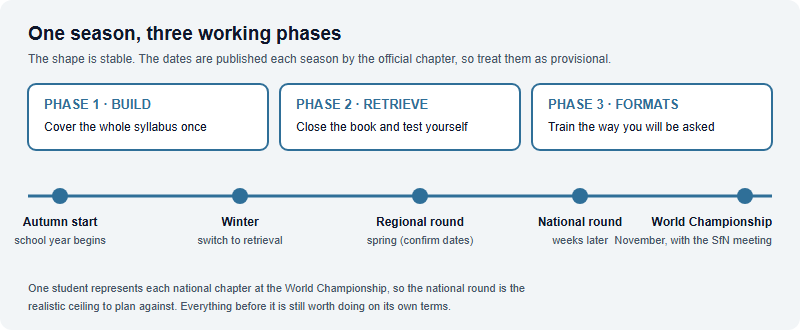
The Brain Bee runs on three tiers: a local or regional round, a national round, and the International Brain Bee World Championship, where each national chapter is represented by exactly one student. That last detail matters more than most students realise when they plan. The World Championship is held in November, alongside the annual meeting of the Society for Neuroscience, which means the international stage sits at the far end of the calendar from the school-year start rather than in the summer.
Inside China, the rounds that most readers of this site will actually sit are the regional and the national. From our own records of recent seasons, the regional round has tended to fall around the end of March with the national round some weeks later in April, but those are our observations rather than a published rule. The National Brain Bee Organizing Committee publishes the season's dates and entry arrangements at chinabrainbee.com, and that is where you should confirm anything you plan around. Hong Kong, Taiwan and Macao run as separate Brain Bee chapters with their own schedules, so students there should follow their own chapter rather than the mainland calendar.
The useful way to think about this is that the shape of the season is stable even when the dates are not. You get roughly two school terms between an autumn start and a spring regional paper. If you have not read the syllabus by the time term two begins, the calendar has already made your decisions for you. If you are new to the competition entirely, our overview of how the Brain Bee is structured is the place to start before you build a schedule around it.
Phase one, autumn: cover the whole syllabus badly rather than half of it well
The single most common planning error is depth-first reading. A student opens the syllabus text, finds the chapter on neurons genuinely interesting, spends six weeks on it, and arrives at the regional paper having never read about sleep, addiction, or neurological disorders at all. A regional paper that has to be sat by a large field is built for breadth, so a gap in coverage costs marks that no amount of depth elsewhere recovers.
So in the autumn term your job is coverage, not mastery. Read Brain Facts, published by the Society for Neuroscience and available at brainfacts.org, or Neuroscience: The Science of the Brain, from the first page to the last, at a pace that finishes before the winter holiday. You are allowed to understand only half of it. What you must not do is skip sections because they look hard. Mark them and move on; Phase two is where the hard sections get repaired.
Two habits make Phase one worth far more than it looks. First, keep a running list of every English term you could not have produced yourself, because terminology is the bottleneck most students discover too late. Second, at the end of each chapter, write three sentences from memory summarising it. Those three sentences take four minutes and they are the raw material for Phase two.
Phase two and three, winter into spring: stop reading, start retrieving, then train the formats
Somewhere around the turn of the year the return on more reading collapses. Re-reading a chapter feels productive because the material looks familiar, but familiarity is not recall, and the paper asks for recall. The winter switch is simple to describe and hard to make yourself do: close the book first, produce the answer, and only then check. Every session you spend reading with the book open after January is a session you have partly wasted.
Phase three, in the weeks before the round, is about format rather than content. This is when you practise producing a term on a blank line rather than recognising it in a list, naming a structure from an image rather than describing it in a sentence, and saying an answer out loud under a clock. Content work does not stop, but it stops being the point. The table below sets out what each phase is actually for and how you know it worked.
| Phase | Roughly when | The one job | A normal week looks like | Checkpoint before you move on |
|---|---|---|---|---|
| 1 · Build | Autumn term | Cover the entire syllabus once, gaps allowed | Two reading blocks, one terminology block | You have turned the last page, and you have a written list of your weak chapters |
| 2 · Retrieve | Winter, from around the new year | Convert reading into recall | One short reading repair block, two self-testing blocks | You can summarise any chapter from memory without opening the book |
| 3 · Formats | The weeks before the round | Train the way the questions are actually asked | Timed question sets, image identification, spoken practice | Blank-line answers and image labels feel routine rather than novel |
| After the regional | Between rounds | Add the harder formats the later rounds can use | Specimen and image work, case reasoning, spoken answers | You are practising the harder formats, not re-reading the book |
Where the hours come from, and what to cut in an exam week
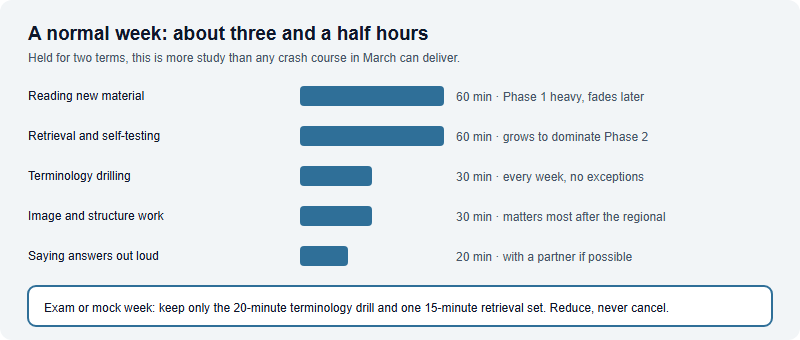
Be honest about the budget. A student carrying IB internal assessments, AP coursework or A-Level modules does not have ten hours a week for a competition, and a plan that assumes otherwise gets abandoned in week three. Three to three and a half hours a week, held consistently across two terms, comfortably beats a heroic fortnight in March. The arithmetic is simple: three hours a week from September to the spring is well over sixty hours of study, which is more than most crash courses deliver.
The rule that protects the plan is that exam weeks get reduced, never cancelled. When mocks land, drop to a twenty-minute terminology drill and one short retrieval set. That is enough to stop the forgetting curve doing its work, and it is small enough that you will actually do it. Students who suspend Brain Bee prep entirely for three weeks of mocks typically lose another two weeks rebuilding what they forgot, so a three-week pause costs five.
If you are starting late, the fix is not to compress the plan but to change it. A student beginning in December cannot read the syllabus at leisure and then test; they have to read and test in the same session, chapter by chapter. A student beginning in February should stop planning to cover everything and instead cover the largest, most examinable blocks properly. Deciding what to abandon is uncomfortable, but it is far better than arriving with a thin layer of everything.
| You are starting in… | What still works | What to give up |
|---|---|---|
| September or October | The full three-phase plan at three hours a week | Nothing; this is the comfortable case |
| December | Read and self-test in the same session, chapter by chapter | The separate leisurely reading pass |
| February | Deep coverage of the biggest syllabus blocks plus hard terminology drilling | Complete coverage, and any expectation of comfort |
| Weeks before the round | Format practice and terminology only | New content entirely; treat this season as a reconnaissance year |
What our own results do and do not tell you about ramp-up
We coach students through this season every year, and the numbers are worth reading carefully rather than as advertising. In the 2026 China national round, students we worked with took seven first prizes, including second and eighth place in the Junior division and eleventh and thirteenth in the Senior division, alongside eleven second prizes and ten third prizes; thirty-one students advanced to the national round from the regionals. These are our own de-identified figures, not official statistics, and results vary from student to student and season to season.
What that spread tells you is mostly about shape rather than success rate. A cohort that produces that many national qualifiers alongside a handful of first prizes is a cohort in which most students did well without reaching the top of the table, which is the normal outcome of a well-run season. It is also a reminder that only one student per national chapter goes to the World Championship, so building your motivation entirely around the international stage sets you up to feel that a strong national result was a failure. Plan for the national round, treat anything beyond it as a bonus, and read our structural overview of the competition if you want to see exactly where each round sits.
One last thing worth saying plainly: a Brain Bee result is a record of what you learned about the nervous system in a year, and it should be planned as such. It is not a lever on any admissions outcome, and no calendar, ours included, changes that.
Questions students ask
When should a complete beginner start preparing?
An autumn start gives you two full terms before the spring rounds. February starts are survivable but force you to abandon parts of the syllabus.
How many hours a week is realistic alongside IB or AP?
About three to three and a half hours in a normal week, dropping to roughly twenty minutes during school exam weeks. Consistency beats volume.
Are the China round dates the same every year?
No. The organising committee publishes the season's dates, so confirm entry and timing at chinabrainbee.com before planning around them.
I study in Hong Kong. Does this calendar apply?
Hong Kong, Taiwan and Macao are separate Brain Bee chapters with their own schedules and entry routes. Follow your own chapter's calendar.
This is an independent guide operated by Hanlin Education for China-based international-school students. We are not affiliated with, endorsed by, or sponsored by the International Brain Bee (IBB), and we are not the official Brain Bee China national round; entry, official rules and season dates sit with the National Brain Bee Organizing Committee at chinabrainbee.com. Confirm current details on thebrainbee.org. Any factual error reported to us is corrected within 7 working days.