
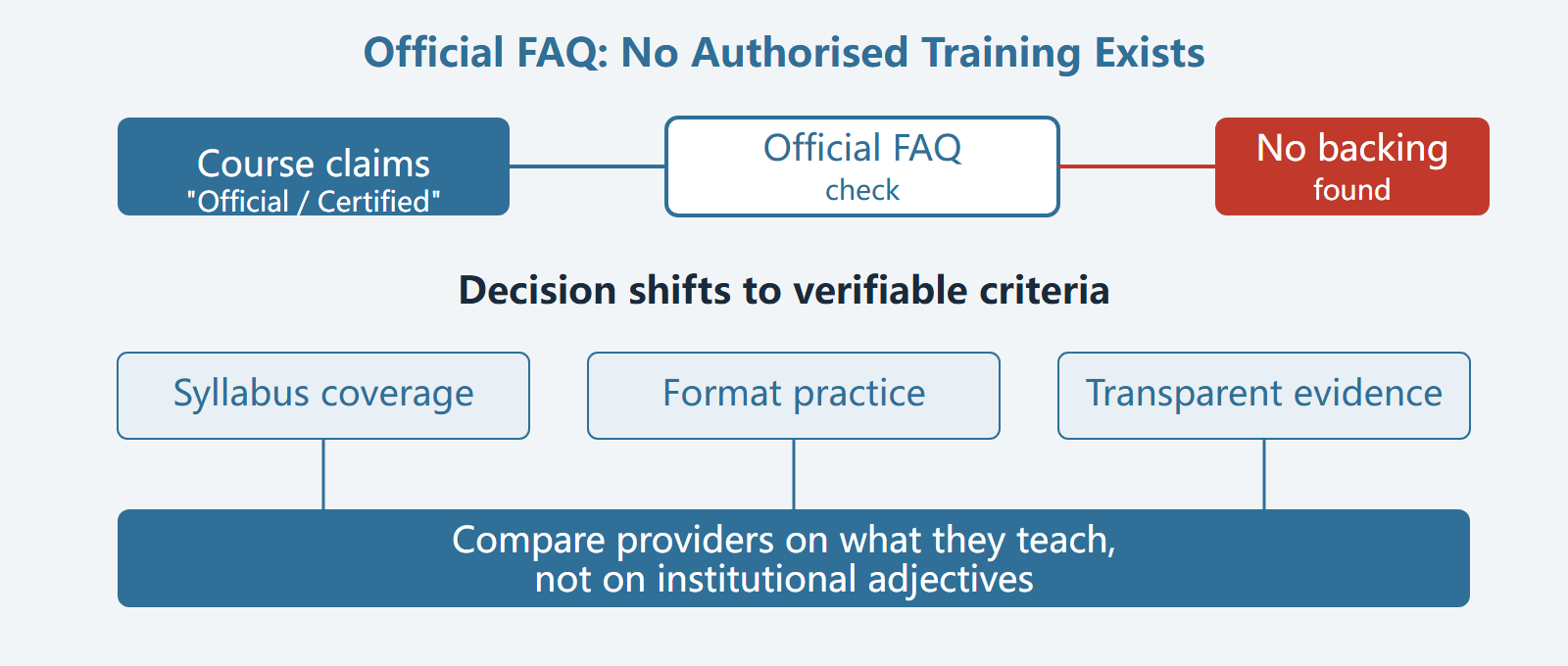
When a Brain Bee preparation course calls itself “official,” “certified,” “designated” or “cooperative,” those words carry an implicit promise of institutional backing. The Brain Bee China national committee FAQ, published at chinabrainbee.com/nationalprogram, states that no such backing exists: the committee does not provide, organise, participate in or authorise any training institution or teacher under those labels. That single statement reshapes how families should compare prep providers—shifting the decision from institutional branding to syllabus coverage, format practice and transparent evidence.
The Official FAQ Statement and Its Scope
The Brain Bee China FAQ, published on the national programme page, states that the national committee does not provide and has never organised or participated in any form of training for the Brain Bee activity. The same statement adds that the committee has never, in any manner, authorised any organisation or individual as an “official,” “certified,” “designated” or “cooperative” training institution or teacher.
The scope of the FAQ language matters. It covers four specific labels—official, certified, designated and cooperative—and applies to both institutions and individual teachers. It also uses the phrase “in any manner,” which closes the loophole of informal endorsements, joint-branding arrangements or loosely worded partnership descriptions. In practical terms, if a course advertisement features any of those four adjectives in connection with Brain Bee preparation, the FAQ gives families grounds to question whether the claim has any committee backing at all.
The same official FAQ (FAQ 4) specifies that the activity publishes a knowledge outline but does not designate a specific textbook. Students may choose materials according to their own needs.
Why “Official” Labels Cannot Be Verified by Buyers
Families evaluating Brain Bee prep face an information asymmetry. The competition organisers publish rules, formats and schedules, but the FAQ makes clear that no training provider holds committee authorisation. Because the committee has never authorised anyone, every “official” label in the marketplace is, at best, a marketing choice rather than a verifiable credential.
This does not mean all prep providers are equivalent in quality. It means the quality signal must come from somewhere other than an institutional stamp. The International Brain Bee organisation describes a three-tiered pathway—local, national, world—but does not list training partners on its public pages. At the China level, the official FAQ closes the door further. The practical consequence is that the buyer’s evaluation framework must be built on observable, checkable criteria rather than trust in a label.
What the Published Formats Actually Require
The Brain Bee China national programme page confirms the competition formats, and those formats provide the most concrete checklist for judging whether a prep course covers what students will actually face. The table below summarises the key components.
| Stage | Division | Components | Key Features |
|---|---|---|---|
| Regional | Junior (Grades 5–8) | Closed-book written test, 60 questions | Multiple choice + fill-in-blank; Chinese text with bilingual terms |
| Regional | Senior (Grades 9–12) | Closed-book written test, 80 questions | Multiple choice + fill-in-blank; Chinese text with bilingual terms |
| National | Junior | Written test (40 Qs, 40 pts) + Team science poster (40 pts) | Poster is 4–5 students, on-day theme, presentation included |
| National | Senior | Written (50 Qs, 50 pts) + Image/specimen ID (13 Qs, 26 pts) + Case diagnosis (8 Qs, 24 pts) | All closed-book; CT/MRI images; video-based clinical cases |
Detailed national-round question counts and mark allocations are drawn from Hanlin’s briefing; the overall format structure (written test, image/specimen identification, case diagnosis, team poster) is confirmed on the official national programme page.
Several features stand out for a family comparing courses. First, every written component uses Chinese-language questions with bilingual professional terms, so prep that only teaches English terminology leaves a gap. Second, the Senior national round includes image and specimen identification worth 26 out of 100 marks, plus case diagnosis worth 24 marks—half the paper tests applied visual and clinical reasoning, not recall alone. Third, the Junior national poster is a team exercise decided on the day, meaning individual content mastery is necessary but not sufficient. A course that prepares students only for multiple-choice recall addresses, at most, the regional round.
For deeper format analysis, see The Brain Bee National Round Is Marked Out of 100: How the Senior Paper Splits and How to Budget Revision and The Brain Bee Junior Team Science Poster: Half the National Marks, Decided on the Day.
A Buyer’s Checklist Built on the Published Formats
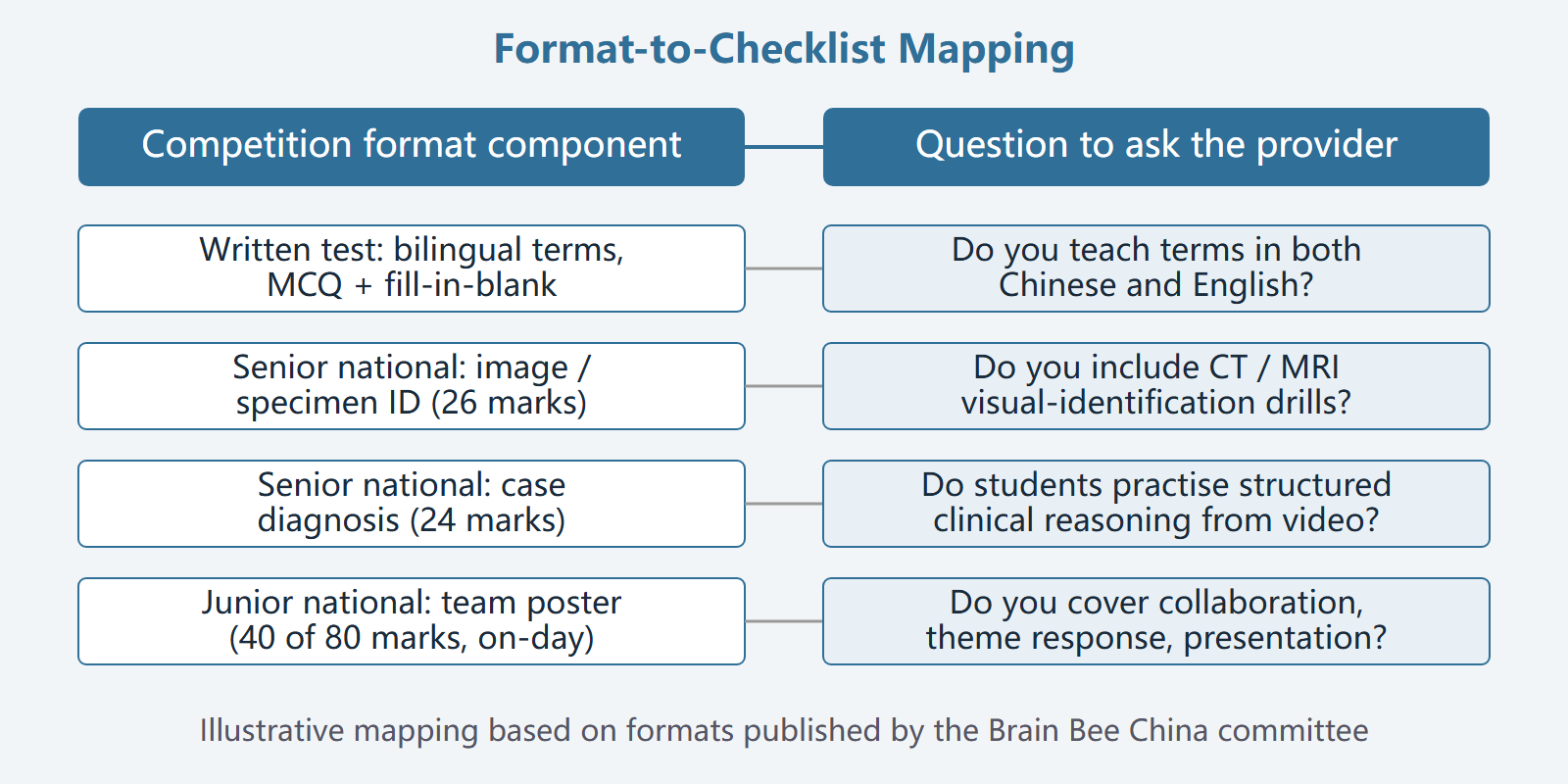
With no authorised-training endorsement to rely on, families need a concrete set of questions. The following checklist draws directly on the format details published by the Brain Bee China committee. Each item corresponds to a specific component of the competition that a prep course should address if it claims to prepare students beyond the regional round.
- Bilingual term coverage. Regional and national written papers present professional terms in both Chinese and English. Does the course teach terminology in both languages, or only one?
- Knowledge-outline alignment. The committee publishes a knowledge outline but designates no specific textbook (FAQ 4). Does the provider map its lessons to that outline, or does it rely on a single proprietary text?
- Senior image and specimen practice. The national Senior paper allocates 26 marks to identifying brain structures in specimens, CT and MRI images. Does the course include visual-identification drills, or is it lecture-only?
- Case-diagnosis reasoning. Another 24 marks at Senior national level test clinical reasoning from patient histories and video. Does the course practise structured case analysis?
- Junior poster preparation. The Junior national round awards 40 of 80 marks to a team poster created and presented on the day. Does the course address collaboration, on-day theme response and presentation skills?
- No designated textbook. Since the committee does not mandate a specific book, a provider that insists on a single “official” text may be adding a marketing layer rather than following a requirement.
Students who want to understand how the written component works across all levels can review The Brain Bee Written Test: How to Train for the One Round That Appears at Every Level. For those building a self-study routine alongside any course, Practising for the Brain Bee Without an Official Question Bank: Testing Yourself in Four Formats offers format-specific strategies.
What Prep Should Not Promise
The reported FAQ and the structure of the competition together define boundaries for honest marketing. Three categories of promise should raise immediate concern.
Guaranteed awards. According to Hanlin’s briefing, the regional round maintains an overall award rate around 40 percent, and national-round advancement is capped at roughly 600 students across both divisions. These numbers mean a large majority of participants do not receive an award or advance. Any course that guarantees a specific medal or national qualification is making a promise the competition structure does not support. For context on what results can and cannot signal, see What a Brain Bee Result Actually Signals — and What It Cannot Do For You.
Guaranteed national qualification. Hanlin’s briefing describes a two-track national qualification system: 400 regional-quota places allocated proportionally by province, and 200 comprehensive-quota places drawn from the remaining national pool. Because allocation depends on provincial participation numbers and individual ranking, no provider can guarantee a specific student will qualify.
Official or authorised status. This returns to the official FAQ. The national committee has never authorised any training provider, so no course can truthfully describe itself as official, certified, designated or cooperative in the Brain Bee context. Families encountering such language should treat it as a marketing claim requiring independent verification, not as a credential.
Judging Quality by Substance, Not Labels
Removing the “official” label from the decision does not mean all courses are interchangeable. It means the evaluation criteria must be substantive. A useful starting point is to ask whether the provider’s syllabus maps to the published knowledge outline, which spans brain foundations, brain function, brain disorders, and brain research and technology. Does the course address all four areas, or does it concentrate on one?
Equally important is the balance between knowledge input and applied practice. The national Senior paper devotes half its marks to image identification and case diagnosis—tasks that require students to apply knowledge under time pressure, not simply recall definitions. A course that ends at “students have learned the material” without structured practice in visual identification, case reasoning and timed conditions addresses only part of what the competition demands.
For students in school curricula such as IB, AP or A-level biology, it is also worth checking how much overlap and how many gaps exist between the school syllabus and the Brain Bee outline. What IB, AP and A-level Biology Give You for the Brain Bee — and the Three Gaps They Do Not Cover maps those boundaries in detail.
Frequently Asked Questions
Does the Brain Bee China national committee endorse any training provider?
No. The Brain Bee China FAQ, published at chinabrainbee.com/nationalprogram, states that the national committee does not provide, organise, participate in or authorise any training institution or teacher as official, certified, designated or cooperative.
Is there a designated textbook for Brain Bee preparation in China?
No. The official FAQ (FAQ 4) on the national programme page specifies that the activity publishes a knowledge outline but does not designate a specific textbook. Students may select materials according to their own needs.
How can I compare Brain Bee prep courses if none is officially authorised?
Focus on observable criteria: whether the syllabus covers the published knowledge outline, whether the course includes practice in the actual competition formats (bilingual written questions, image identification, case diagnosis, team poster), and whether the provider can show transparent evidence of what students will do in class rather than relying on institutional adjectives.
Editorial note: This article is published on an independent information site operated by Hanlin, a coaching provider independent of the Brain Bee organisers. It is not affiliated with, endorsed by or acting on behalf of the International Brain Bee organisation, the Brain Bee China national committee or any competition organiser. The no-training FAQ (FAQ 6) and no-designated-textbook FAQ (FAQ 4) are confirmed on the official Brain Bee China national programme page (chinabrainbee.com/nationalprogram). Detailed numerical figures such as advancement quotas and award rates are drawn from Hanlin’s briefing and should be verified against the committee’s own publications before making decisions. This article addresses a consumer-information question; it does not recommend or endorse any specific prep provider.