
Disorders are the most efficient thing you can study for the Brain Bee, because they cut across more of the competition than almost any other topic. A question about Parkinson's disease tests anatomy, chemistry, symptoms and treatment in a single stem. Learn each condition as a chain from symptom to structure to mechanism, and you cover four topics for the price of one.
Why disorders repay study more than any other block
Look at what the competition asks for. A written paper can ask which neurotransmitter system is depleted in a named condition. A specimen or image task can ask which structure is affected. At the World Championship, one of the four sections is patient diagnosis, worked from video footage and a written history rather than a live actor, which is a disorders question by definition. And in the live oral round, where two wrong answers end your run, a disorder is the classic prompt because it can be asked and answered in one breath.
Compare that with, say, memorising the layers of the cerebellar cortex. Useful, but it earns marks in one place. A disorder earns marks in four. If you are still working out which round contains which task, our overview of the Brain Bee structure lays it out; this article is about the content that runs underneath all of them.
One honest caveat before the content. Coverage of individual disorders differs between the syllabus texts and between editions, and no round publishes a fixed disorder list. Treat what follows as a study organiser built on standard neuroscience, and confirm the current syllabus scope through the official channels rather than assuming this list is the examinable set.
The three-column habit that makes disorders stick
Most students revise disorders as a name plus a fact: "Parkinson's, dopamine". That survives a multiple-choice question and collapses under anything else, because it gives you nothing to reason with when the question is phrased from the patient's side rather than the disease's side.
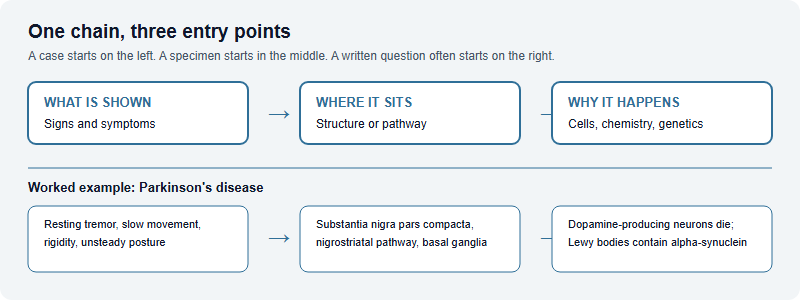
The alternative takes the same amount of time and works far harder. For every condition, write three columns: what the patient shows, where in the nervous system the problem sits, and what has gone wrong at the level of cells or chemistry. Once the chain is in that order you can enter it from any end. A case describes symptoms, so you run left to right. A specimen shows a structure, so you start in the middle. A written question names a transmitter, so you run right to left.
The conditions with the clearest anatomy: movement, vascular, degenerative
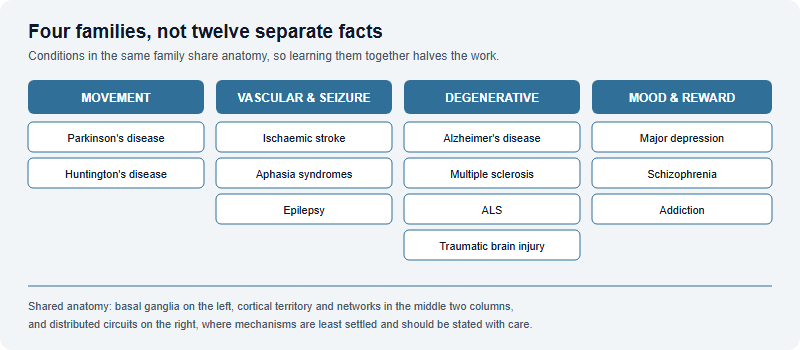
Start with the disorders whose anatomy is unambiguous, because they are the ones that reward the chain method fastest. In Parkinson's disease, dopamine-producing neurons of the substantia nigra pars compacta degenerate, weakening the nigrostriatal input to the basal ganglia and producing slowness of movement, rigidity, resting tremor and postural instability. Levodopa, a dopamine precursor, is the standard drug precisely because it addresses the depleted transmitter, which is a satisfying link between mechanism and treatment that examiners like.
Huntington's disease sits in the same neighbourhood with the opposite movement profile. It is inherited in an autosomal dominant pattern and involves an expanded CAG repeat in the HTT gene; neurons of the striatum, particularly in the caudate nucleus, are lost, and the result is excess involuntary movement, called chorea, rather than poverty of movement. Learning the two together as a contrast is far more durable than learning either alone.
Stroke is the disorder that most rewards knowing your pathways. An ischaemic stroke follows a blocked vessel, a haemorrhagic stroke a burst one, and because the major motor and sensory pathways cross, damage on one side of the brain produces weakness on the opposite side of the body. Language localisation is the classic follow-up: damage in the region associated with Broca's area tends to produce effortful, non-fluent speech with comprehension relatively preserved, while damage around Wernicke's area tends to produce fluent speech that carries little meaning, with comprehension impaired. Epilepsy belongs in this group as well: seizures arise from excessive, abnormally synchronised neuronal firing, focal if they begin in one region and generalised if they involve both hemispheres from the outset, which is why the electroencephalogram is the standard investigation.
The degenerative and demyelinating conditions belong in the same group, because their anatomy is equally definite even though the timescale is slower. Alzheimer's disease is the dementia students meet most often in the syllabus texts and the one students most often describe too vaguely. The pathological hallmarks are extracellular plaques of amyloid-beta and intracellular neurofibrillary tangles of tau protein; early degeneration in the entorhinal cortex and hippocampus is what makes recent, episodic memory the first thing to fail, while older memories and personality persist for longer. The order of symptoms is a direct consequence of the order of the damage, and saying so is what separates a strong answer from a memorised one.
Multiple sclerosis is the demyelinating case. The immune system attacks myelin in the central nervous system, produced there by oligodendrocytes, and demyelinated axons conduct slowly or fail altogether. Because lesions can appear in different places at different times, the symptom list is famously scattered, and optic neuritis is a common early presentation. Amyotrophic lateral sclerosis, by contrast, targets the motor neurons themselves, upper and lower, producing progressive weakness and muscle wasting while sensation and, in the classic picture, much of cognition are relatively spared. Traumatic brain injury completes the group: mechanical force, diffuse damage to axons, and a symptom profile that depends on where the force landed rather than on any single cell type.
Mood, psychosis and reward, handled honestly
The psychiatric conditions need a different tone, and getting that tone right is itself worth marks. Their mechanisms are genuinely less settled than those of Parkinson's or multiple sclerosis, and a candidate who states a single cause with total confidence sounds less informed, not more.
Major depressive disorder is associated with disturbances in monoamine signalling, which is why selective serotonin reuptake inhibitors are a first-line treatment, but the simple "low serotonin" account does not explain the delayed response to treatment and is not regarded as a complete explanation. Schizophrenia is discussed in terms of positive symptoms such as hallucinations and delusions and negative symptoms such as flattened affect and withdrawal; the dopamine hypothesis is supported by the action of drugs that block D2 receptors, while glutamate signalling at NMDA receptors is a major competing strand. Addiction is the cleanest of the three: drugs of abuse converge on the mesolimbic dopamine pathway running from the ventral tegmental area to the nucleus accumbens, and repeated use is associated with weakened prefrontal control over that circuit, which is the mechanism behind the shift from wanting to compulsion.
| Condition | What the patient shows | Where it sits | Mechanism to name |
|---|---|---|---|
| Parkinson's disease | Resting tremor, bradykinesia, rigidity | Substantia nigra, nigrostriatal pathway | Loss of dopaminergic neurons; Lewy bodies |
| Huntington's disease | Chorea, cognitive and mood change | Striatum, especially caudate nucleus | Autosomal dominant CAG repeat expansion |
| Alzheimer's disease | Recent memory loss first | Entorhinal cortex, hippocampus | Amyloid-beta plaques, tau tangles |
| Multiple sclerosis | Scattered, relapsing deficits; optic neuritis | White matter of the CNS | Immune attack on myelin; oligodendrocyte loss |
| Amyotrophic lateral sclerosis | Progressive weakness and wasting | Upper and lower motor neurons | Motor neuron degeneration; sensation spared |
| Ischaemic stroke | Sudden one-sided deficit | Territory of the blocked artery | Occlusion, loss of perfusion, infarction |
| Aphasia after stroke | Non-fluent or fluent speech disturbance | Broca's or Wernicke's area regions | Damage to production versus comprehension networks |
| Epilepsy | Seizures, focal or generalised | Focal onset zone or both hemispheres | Excessive synchronised neuronal discharge |
| Traumatic brain injury | Deficits matching the site of impact | Wherever force was transmitted | Mechanical damage, diffuse axonal injury |
| Major depressive disorder | Low mood, anhedonia, disturbed sleep | Distributed mood circuitry | Monoamine signalling implicated; not fully explained |
| Schizophrenia | Positive and negative symptoms | Dopaminergic and cortical circuits | Dopamine hypothesis; glutamate or NMDA strand |
| Addiction | Compulsive use despite harm | VTA to nucleus accumbens; prefrontal cortex | Mesolimbic dopamine signalling; weakened control |
How to drill this without turning it into a list
The mistake at this point is to reread the table until it looks familiar. Instead, work it in both directions. Cover the left column, read a set of symptoms aloud from a case-style description, and name the structure and the mechanism before checking. Then cover the right column, name a transmitter or a protein, and reconstruct which condition it belongs to and what the patient would look like. Twenty minutes of that beats an hour of reading, because it is the same operation the competition performs on you.
Two refinements are worth adding once the basics hold. First, drill the confusable pairs deliberately: Parkinson's against Huntington's for too little versus too much movement, Broca's against Wernicke's aphasia for production versus comprehension, multiple sclerosis against amyotrophic lateral sclerosis for myelin versus the motor neuron itself. Nearly every expensive mistake in this topic is a swapped pair rather than a blank. Second, practise saying each chain out loud in about twenty seconds, because in a live round you will not have the option of writing it down, and a second wrong answer there ends your run. Our guide to how the rounds are organised explains where that pressure comes from.
Questions students ask
Which disorders are guaranteed to appear?
None are guaranteed. No round publishes a fixed disorder list, so treat this as a study organiser and confirm the syllabus scope through official channels.
How much detail is enough for each condition?
Symptoms, the structure or pathway involved, and one cellular or chemical mechanism. That triple answers most stems without over-reaching.
Should I say "low serotonin causes depression"?
No. Monoamine signalling is implicated and SSRIs act on it, but a single-cause claim is not supported and reads as weaker, not stronger.
Do I need clinical experience to answer case questions?
No. The patient diagnosis section works from video footage and a written history, and rewards reasoning from the syllabus rather than clinical training.
This is an independent guide operated by Hanlin Education for China-based international-school students. We are not affiliated with, endorsed by, or sponsored by the International Brain Bee (IBB), and we are not the official Brain Bee China national round; entry and official rules sit with the National Brain Bee Organizing Committee at chinabrainbee.com. Nothing here is medical advice. Confirm current details on thebrainbee.org. Any factual error reported to us is corrected within 7 working days.