
Short answer: if your school is not a registered Brain Bee base school in China, you can still enter the 2027 season through the official individual registration channel. That window opens on 5 December 2026 and closes on 12 December 2026. The regional round is on 9 January 2027, 10:00–11:30, the regional registration fee reported for the season is 450 RMB per person, and the organising committee assigns your venue after the window closes. The China-region grade bands apply: Junior for grades 5–8, the standard Brain Bee group for grades 9–12. You do not pick your band by how much neuroscience you already know — the grouping follows your grade.
Hanlin’s course briefing of 31 October 2026, citing the 2027 China-region registration notice, sets out two entry routes that run on different clocks but lead to the same paper. What changes is who submits your name and when, not what you sit in January.
Two routes into one regional paper
| Route | Who it is for | Deadline | Who acts | Venue |
|---|---|---|---|---|
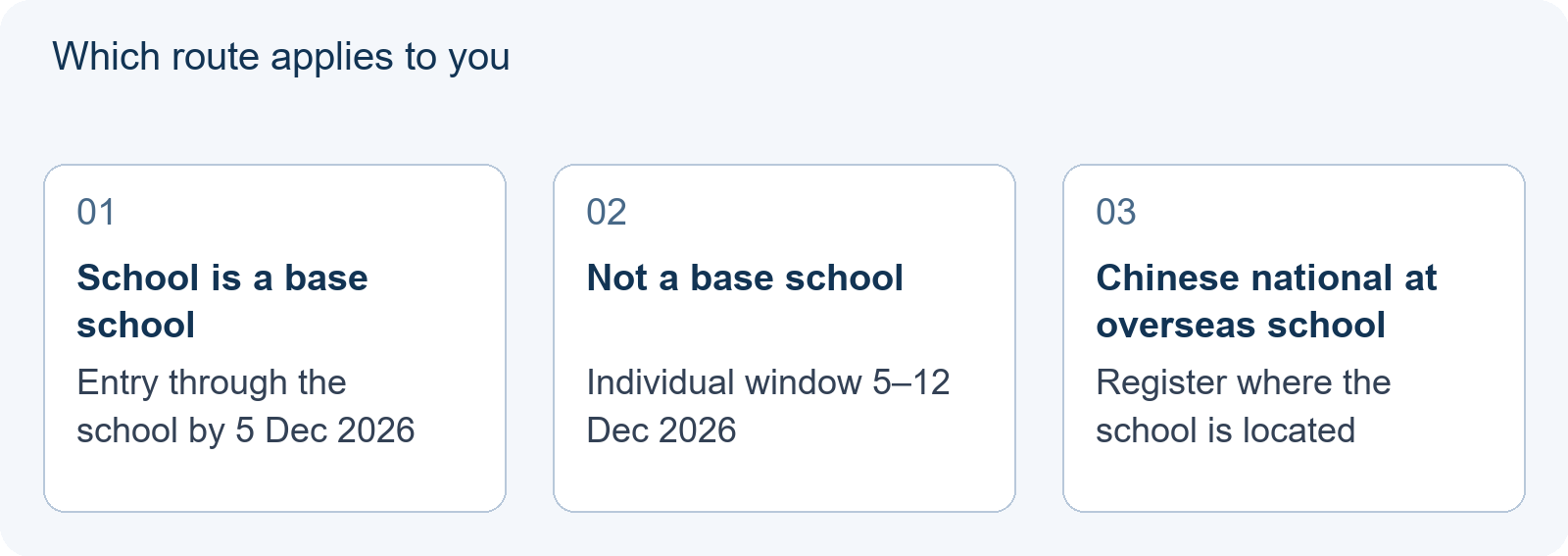
| Base-school entry | Students whose school is a registered base school | 5 December 2026 | Your school’s coordinator submits the entry | Confirm venue details with the school |
| Individual entry | Students whose school is not a base school | 5–12 December 2026 | You or a parent submit the individual form | Assigned by the organising committee after the window closes |
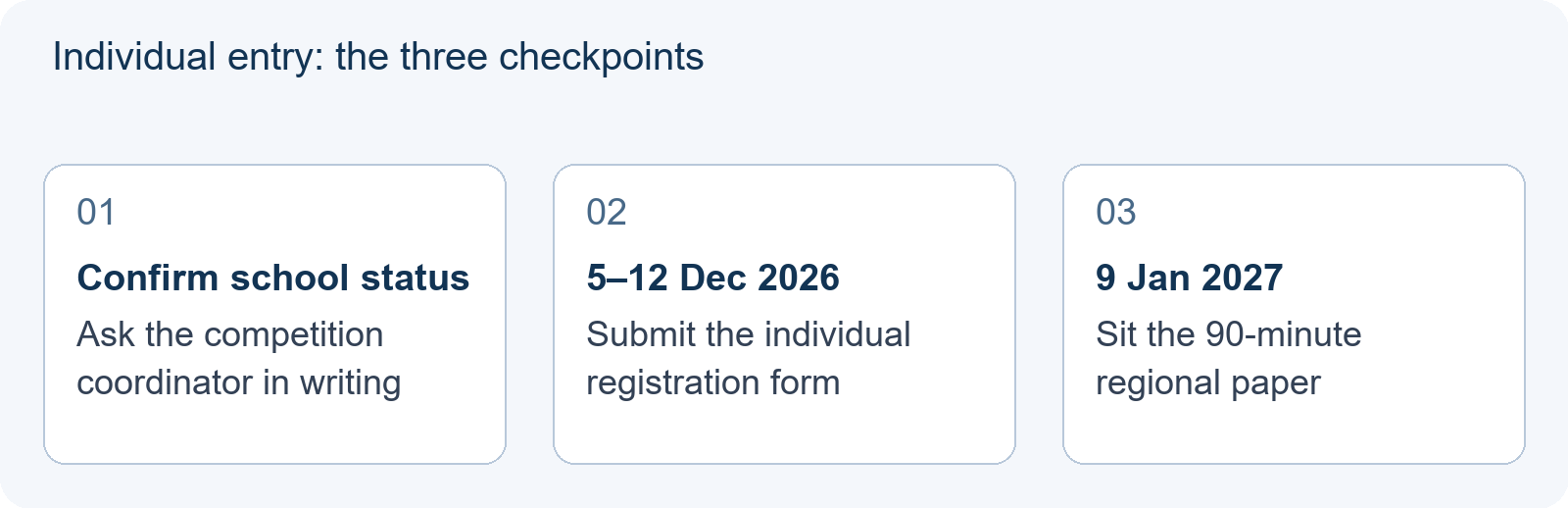
Note the shape of that table. The base-school route closes on the same day the individual route opens. If you spend early December waiting to find out whether your school will enter you, you can lose the individual window entirely. Confirming your school’s status is therefore the first task, not the last.
The dates that decide your plan
| Date | What happens | What you should have ready |
|---|---|---|
| By 5 December 2026 | Base-school registration deadline | Written confirmation of whether your school is a base school |
| 5–12 December 2026 | Individual registration window | Student details, grade, contact details and fee payment |
| After 12 December 2026 | Venue allocation | A travel buffer once your venue is confirmed |
| 9 January 2027, 10:00–11:30 | Regional round | A timing plan for the 90 minutes |
| 13–14 March 2027 | National round | Only relevant if you advance on regional score |
| August 2027 | International round | Not something an individual entrant applies to directly |
The individual registration link is published when the window opens; it is not a permanent form you can fill in early. That single fact is why the checklist below matters more than the study plan in late November.
Are you actually a non-base-school candidate?
Most wasted weeks in this process come from guessing. Work through these four questions in order, and only move to the next when the previous answer is confirmed.
- Has your school entered students before? Ask the teacher who handles external competitions, not the general office. A school can be a base school without advertising it on a noticeboard.
- Has your school confirmed its 2027 status? Base-school status belongs to the school, not to you. A friend’s experience at a different school tells you nothing about your own.
- Are you in grades 5–12? That is the China-region eligibility band. Grades 5–8 sit the Junior paper; grades 9–12 sit the standard paper.
- Are you a Chinese national studying at an overseas school? The China-region notice directs these students to register in the country or region where their school is located. The individual channel described here is not their route.
The last point is often misread as a general nationality rule. It is not. It is a routing instruction for one specific group, and it exists so that a student sitting in another country is not allocated a venue in China they cannot reach.
What to settle before 5 December
Four weeks is enough to remove every administrative uncertainty, which leaves December free for the part that actually scores marks.
- Get the school answer in writing. An email from the coordinator saying the school is not a base school for 2027 is worth more than a verbal ‘I don’t think so’, because it settles the question before the window opens.
- Lock your grade band. Junior for grades 5–8, standard for grades 9–12. The two papers differ in length: 60 questions for Junior, 80 for the standard group, both in 90 minutes.
- Read the paper format before your first practice set. Both groups sit a 90-minute closed-book written paper made of multiple-choice and fill-in questions. Practising in a different format for three weeks is the most common self-inflicted delay.
- Set two calendar reminders, not one. One on 5 December to submit, one on 10 December to check that you have actually submitted and received confirmation.
- Plan the venue day only after allocation. Your test site is assigned by the committee once registration closes, so travel logistics cannot be fixed in November. Keep the second weekend of January flexible instead.
A teaching illustration, not official guidance: a grade 7 student at a school that has never entered confirms with the coordinator on 27 November, submits the individual form on 6 December, receives a venue allocation in late December, and sits the 60-question Junior paper on 9 January. The only thing that made this sequence calm was the 27 November email — every later step was mechanical.
The paper does not change because you registered individually
Individual registrants sit exactly the same regional paper as base-school students. The format reported for the 2027 season is a 90-minute closed-book written test with multiple-choice and fill-in questions: 60 questions and 60 marks for Junior, 80 questions and 80 marks for the standard group. The paper is set in Chinese, with technical terms printed in both Chinese and English, and fill-in answers may be written in Chinese or English, with English abbreviations accepted for technical terms. Students who learned their neuroscience in English should read our Brain Bee China 2027 Papers Are Set in Chinese: A Bilingual Method for Students Who Learned Neuroscience in English rather than assuming the language is the obstacle.
The knowledge scope is the same for both routes as well: brain structure and the nervous system, brain functions such as memory, sleep, emotion, language and sensory processing, brain and nervous system disorders including Alzheimer’s and Parkinson’s disease, and research methods and technology such as brain imaging. The China-region guidance recommends BrainFacts as the base text, advises both groups to read it in full, and describes the regional scope as centred on that book.
Do the timing arithmetic once, early. Ninety minutes is 5,400 seconds. Across 80 questions that is roughly 67 seconds per question; across 60 questions it is 90 seconds. Neither allowance rewards re-reading a stubborn item. Build a first pass that answers everything you know, flags the rest, and returns only at the end.
Where individual registrants lose time
- Waiting for the link before starting to study. The link appears in December; the syllabus does not. Memory, sleep and neurotransmitter basics can be learned in November regardless of your registration status.
- Assuming the venue will be your school. Do not assume it will be, and it may not be close; the committee assigns it. Treat the January date as a fixed appointment you may need to travel to.
- Assuming last year’s status. Base-school arrangements are set for a season, not forever. Ask about 2027 specifically.
- Missing the eight-day window. The individual window covers eight days, from 5 to 12 December inclusive, so a school week and a weekend can pass quickly. It is short enough that a family holiday can swallow it.
- Treating the Chinese paper as a translation problem. Terms appear in both languages. The usual difficulty is linking a term to a structure and a function, not recognising the word.
What this route does not change
Advancement still runs on your regional score. Hanlin’s course briefing describes the national round as roughly 600 places across both groups, with most allocated by regional quota and the remainder by national ranking once regional places are filled. Treat that as an orientation figure for planning, not a promise or a target line, and note that the committee sets the actual numbers. The wider structure is three-tiered: students typically enter a local event, top performers advance to a national event, and each national event sends one representative to the International Brain Bee world championship, according to the International Brain Bee’s own site. The organisation was founded in 1998, and its site reports participation from more than 50 countries.
One structural caution belongs here. The Junior and standard bands are a China-region arrangement for grades 5–8 and 9–12; they are not a global International Brain Bee split. Families comparing Chinese preparation materials with international ones should read our guide to Brain Bee Eligibility, Decoded: Grade Bands, the Age Ceiling That Only Bites at Worlds, and Which Chapter You Belong To before importing either set of assumptions. And because the December window is tight, families who want a wider view of entry logistics should compare it with our Brain Bee Registration 2027: Preparing Your Entry and Study Plan.
The practical conclusion is narrow and useful: non-base-school entry is not a harder route, it is a shorter one. It compresses everything into eight days in December and hands you a venue you did not choose. Everything you can control — the grade band, the format, the reading, the timing drills — can be settled before the window even opens.
General event background is available at Event background.
This is an independent preparation guide, not affiliated with, endorsed by, or sponsored by the International Brain Bee.
Frequently Asked Questions
Can I register individually if my school has never run Brain Bee?
Yes, provided your school is not a base school. The China-region 2027 notice provides a separate individual registration channel that opens on 5 December 2026 and closes on 12 December 2026. The base-school route closes on 5 December, which is the same day the individual window opens, so confirm your school’s status well before then.
Do I choose Junior or the standard group myself?
No. In the China region the grouping follows your grade: grades 5–8 sit the Junior paper of 60 questions, and grades 9–12 sit the standard paper of 80 questions, both in 90 minutes. The notice states that students do not select a group according to their existing neuroscience level. This two-band split is specific to the China region and is not the structure used at International Brain Bee level.
Where will I sit the regional paper if I register individually?
The organising committee allocates the venue after individual registration closes on 12 December 2026. The registration link itself is published when the window opens rather than in advance. Because the venue is assigned rather than chosen, keep the second week of January flexible for travel until your allocation arrives.