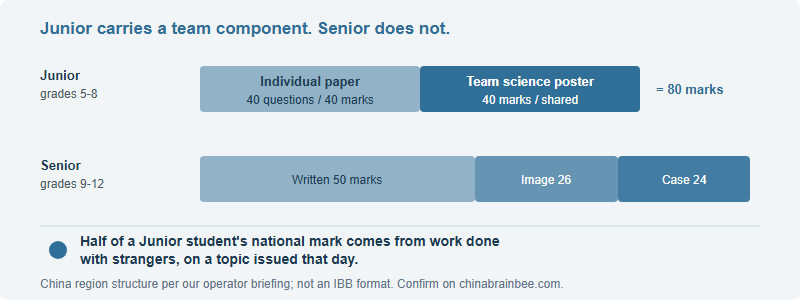
In the China region, the Junior division at the national round does not sit one assessment — it sits two. There is a 40-question individual paper worth 40 marks, and a team science poster worth another 40 marks, built in a group of four to five formed after qualifying, on a topic issued on the day, and presented live. On those figures the poster is half the total. Almost nobody trains for it.
What the poster round actually is
The shape is unusual for an academic competition. Everything else in the Brain Bee is individual: you qualify alone at the regional round, you sit the paper alone, and at the very top only one representative per national chapter goes forward. Then, in the Junior division at the China national round, you are placed in a team with students you may never have met, handed a topic you could not have researched, and asked to produce and present a science poster together. The mark is credited to every member of the team.
Three features of that description deserve emphasis, because each one breaks a habit that serves students well elsewhere:
- Teams form after qualifying. You cannot arrive with a rehearsed group, pre-agreed roles or a shared working style. Whatever process you use has to be explainable to strangers in about a minute.
- The topic is issued on the day. There is nothing to pre-write. No template poster, no memorised script, no prepared figure will survive contact with the actual prompt.
- The mark is shared. Your individual brilliance is worth less than the team producing one coherent argument. A poster with four disconnected good ideas reads worse than a poster with one clear idea carried properly.
Scope note. This structure comes from the operator briefing we work from for the China region. It describes the China region's Junior division, not the International Brain Bee World Championship, and the organiser has not published these component figures on a public page. Divisions, weightings and formats can be revised between seasons. Confirm the current arrangement with the National Brain Bee Organizing Committee at chinabrainbee.com before you build a plan on it.
Why “you cannot pre-write it” changes what preparation means
When a task cannot be pre-written, preparation stops being about content and becomes about process. You are not memorising a poster. You are rehearsing a repeatable way of turning an unfamiliar prompt into one defensible claim, fast, with other people.
That reframing has a practical consequence: the most valuable practice you can do is a timed dry run on a topic you have never seen, with people you do not usually work with. Ask a teacher or a parent to hand you a neuroscience prompt cold — sleep and memory, why teenagers take risks, how a drug changes a synapse — and give yourself a fixed window to produce a poster and a two-minute walkthrough. Do that four times and you will be better prepared than a student who has read twice as many chapters.
Content knowledge still matters, of course. It is what you draw on once the topic appears, and it comes from the syllabus — Brain Facts, published by the Society for Neuroscience and available at brainfacts.org, or Neuroscience: The Science of the Brain. Our overview of the competition and its syllabus explains how those sources fit the wider three-tier structure. But knowledge alone does not produce a poster in a single session; process does.
A same-day build sequence
We do not know how long the working window is, because the organiser sets it and has not published it. So think in proportions of whatever time you are given rather than in minutes. The sequence below is our coaching split, not an official rule.
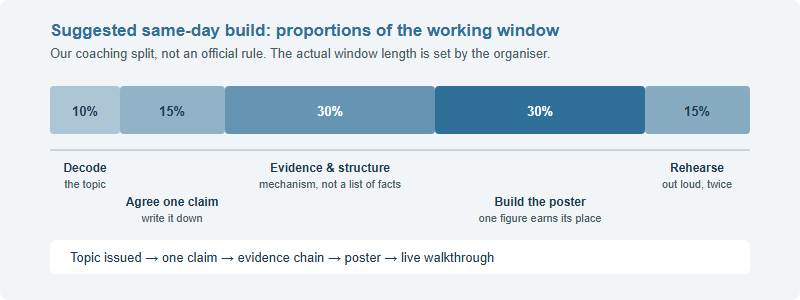
The stage teams skip is the first one. Under time pressure the instinct is to start drawing immediately, which produces a poster that answers a slightly different question from the one asked. Ten per cent of the window spent restating the prompt in your own words — and checking all five of you restated it the same way — is the cheapest insurance available.
Four jobs, not five equal contributors
A team of four or five with no assigned roles will produce four or five parallel efforts. Assign jobs in the first minutes. These are the four we would use, and in a team of five the fifth person doubles on evidence, which is always the bottleneck.
| Job | Owns | Decides | Failure mode if nobody does it |
|---|---|---|---|
| Claim keeper | The single sentence the poster argues | What is in scope and what is cut | The poster becomes a topic summary with no argument, and the judges have nothing to test |
| Evidence lead | The chain from observation to mechanism | Which two or three pieces of support actually earn space | Confident claims with nothing underneath them; the first question collapses the poster |
| Design lead | Layout, the one figure, legibility from two metres | What gets drawn versus written | Dense text nobody can read while a presenter is talking over it |
| Presenter and timekeeper | The spoken walkthrough and the clock | When each stage ends, regardless of whether it feels finished | A near-complete poster with no rehearsal, presented by whoever is least nervous |
Two notes on making this work with strangers. First, propose the roles rather than debating them: “shall I keep time and you two take evidence?” resolves in seconds where an open discussion burns five per cent of your window. Second, be genuinely willing to take the job nobody wants. Timekeeping is unglamorous and it is frequently the difference between a rehearsed poster and an unfinished one.
What transfers from the syllabus, and what does not
Students often assume that because the poster topic is unpredictable, syllabus reading will not help. It helps, but only in a specific way.
- Mechanisms transfer. If you understand how a synapse changes strength, how a signal crosses a gap, or how a sensory pathway reaches cortex, you can build an argument on almost any prompt handed to you. Mechanisms are reusable; individual facts are not.
- Structure names transfer. Being able to name and place the regions involved lets a team be specific rather than vague, and specificity is what a live walkthrough rewards.
- Definitions do not transfer well. A poster that defines six terms and argues nothing tends to look thin next to one that follows a single mechanism from cause to consequence.
- Diagrams you have practised drawing transfer surprisingly well. If you can sketch a neuron, a reflex arc or a simple pathway from memory in under a minute, your team will have a usable figure while others are still deciding what to draw.
Shared marks: what that means for a grade-5 student on a grade-8 team
The Junior division spans grades 5 to 8, which is a wide band — as our introduction to the competition explains, divisions are set by grade rather than by experience — and teams form after qualifying, so a grade-5 student may well end up working with students three years older. Because the poster mark is credited to every member, this cuts both ways, and it is worth being honest about with younger students and their families.
The risk is that a younger student becomes a spectator. The remedy is having a job. A grade-5 student who owns timekeeping, or who has practised drawing one clean diagram from memory, contributes something the team visibly needs. A grade-5 student with no assigned role usually ends up holding a marker.
It is also worth saying what this component is not. A team poster mark reflects one session of group work on an unseen topic, judged live. It says something real about how a student thinks under pressure, and it is not a measure of ability that generalises far beyond that. We treat the Brain Bee as an extracurricular interest activity rather than anything tied to school advancement in China, and we would not encourage any family to treat a result as an admissions instrument.
For context rather than promise: at the 2026 China national round our own students took 7 first prizes — including 2nd and 8th place in the Junior division and 11th and 13th in Senior — plus 11 second prizes and 10 third prizes; separately, 31 students advanced out of the regional round. Those are our own de-identified figures, per Hanlin, and results vary between students and cohorts.
Registration for the Junior division, like every round in the China region, runs through the National Brain Bee Organizing Committee at chinabrainbee.com. We are an independent guide; we do not run the China national round and cannot enter anyone for it.
Frequently asked questions
Can we form our team before the national round?
Not on the structure we work from: teams of four to five are formed after qualifying. Confirm the current arrangement on chinabrainbee.com.
How much of the Junior national mark is the poster?
Forty of eighty marks, alongside a 40-question individual paper. That figure is from our operator briefing, not an official published rule.
Do Senior students also do a team poster?
No. In the China region the Senior division is individual, running a written paper, image identification and case-diagnosis items.
Can we prepare the poster content in advance?
No. The topic is issued on the day, so rehearse the process instead: decode, agree one claim, build, rehearse aloud.
This is an independent guide operated by Hanlin Education for China-based international-school students. We are NOT affiliated with, endorsed by, or sponsored by the International Brain Bee (IBB), and we are not the official Brain Bee China national round; registration runs through the National Brain Bee Organizing Committee at chinabrainbee.com. Confirm current rules, dates and formats on thebrainbee.org. Any error reported to us is corrected within 7 working days.