
There is no complete official Brain Bee question archive you can work through the way you would a maths past-paper archive. That is the single biggest practical difference between preparing for this competition and preparing for a school exam, and it is why so many students revise by rereading. The fix is to become the person who writes the questions. Here is a system for doing that in all four formats the competition uses.
Rereading feels like work and is not practice
The trap is well documented and almost impossible to feel from the inside. When you reread a chapter, every sentence looks familiar, and familiarity registers in the mind as knowledge. It is not. The competition never asks you to recognise a paragraph you have seen before; it asks you to produce a term on a blank line, name a structure on an image, or say an answer out loud while a judge waits. Recognition and production are different skills, and only one of them earns marks.
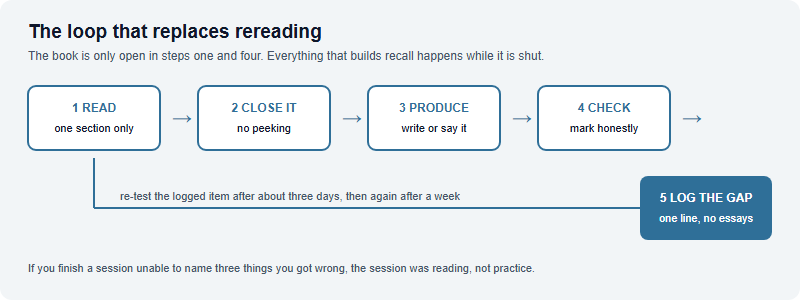
This article assumes you already have a reading routine and covers what happens after the reading. The distinction matters because the two activities look similar on a timetable and behave completely differently. Reading with the book open builds coverage. Retrieval with the book shut builds the thing you will actually need. In the second half of a season, if the book is open, you are probably not practising.
One more reason to build your own questions: writing a question forces you to decide what the examinable point of a paragraph is, which is itself a form of study. Students who do this for a term develop a reliable instinct for which sentences in the syllabus carry a testable fact and which are scene-setting. If you are new to what the rounds contain, our structural overview of the competition is the map; this is the drill.
Turning one paragraph into four questions
The four formats you need to rehearse map onto how the competition actually asks things. Written papers can mix multiple-choice items with items that require you to supply the term yourself. What the China regional and national rounds add beyond that is not published, so confirm your round's format on the official channels. The World Championship uses neuroanatomy and neurohistology on real brains or images, a written test, patient diagnosis from video footage with a written history, and live oral judging in which two wrong answers end your run.
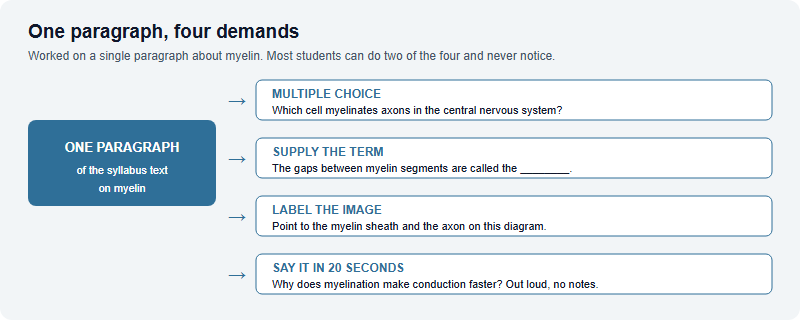
So take any paragraph of the syllabus and make it produce one question of each kind. A paragraph about myelin, for instance, yields a multiple-choice item on which cell myelinates axons in the central nervous system, a blank-line item asking you to name the gaps between myelin segments, an image item asking you to label a myelinated axon, and a spoken item asking you to explain in twenty seconds why myelination speeds conduction. Same paragraph, four different demands, and you will find you can do two of them and not the other two.
Do this deliberately rather than exhaustively. Ten paragraphs turned into forty questions across a week is a serious body of practice material, and unlike commercially produced sets it is aimed exactly at the text you are being examined on. Keep the questions in one file, shuffled, so that you meet them later out of chapter order, which is how they will arrive on the day.
The error log that is worth keeping
Most students who keep an error log abandon it, because they write too much in it. The version that survives has three short columns and takes fifteen seconds per entry: what the question asked, what you produced, and which of four failure types it was. That last column is the point of the whole exercise, because the fix is different for each type.
| Failure type | What it looks like | What it really means | The right fix |
|---|---|---|---|
| Never learned | Blank; the topic feels unfamiliar | A coverage gap, not a memory problem | Go back and read that section; do not drill it yet |
| Knew it, could not produce it | You recognise the answer the moment you see it | The classic recognition-versus-production gap | Blank-line drilling and spelling the term aloud |
| Confused with its pair | You confidently gave the neighbouring term | The two were learned separately, never contrasted | Relearn them side by side with one distinguishing hook |
| Language, not biology | You understood the concept but missed the English term | A terminology problem wearing a science costume | Add the word part to your vocabulary list, not your biology list |
Review the log at a fixed point each week rather than continuously. Re-test everything logged in the last seven days, retire the items you have now produced correctly twice on different days, and promote the persistent ones into a short list you carry into the final weeks. That list, usually thirty to sixty items by spring, is the most valuable revision document you will own, and it is the thing to reread on the morning of a round when there is no time for anything else.
Rehearsing the spoken format, which almost nobody practises
Written practice is easy to organise alone. Spoken practice is not, and it is the format students most consistently neglect, which is unfortunate because at the World Championship the live oral round runs on a two-strikes rule: a second wrong answer ends the round for you. Even at earlier stages, the ability to state an answer cleanly under time pressure is a distinct skill from writing one.
The drill needs a partner, a timer and a hard rule that you answer without preamble. Have them read from your question file at random, give yourself a fixed window, and answer in one sentence with no hedging run-up. Record a few and listen back; almost everyone discovers they spend the first several seconds saying nothing, which is exactly the time you cannot afford. Practising with a classmate who is also entering works better than practising with a teacher, because you will both hear how the other person structures an answer and steal what works.
| Week | Question-building | Retrieval sets | Spoken practice |
|---|---|---|---|
| Week 1 | Fan out 10 paragraphs into 40 questions | Two sets from the current chapter | Ten minutes, one topic, with a partner |
| Week 2 | Fan out 10 more, shuffle everything | Two sets, mixing weeks 1 and 2 | Ten minutes, mixed topics |
| Week 3 | Write image and specimen items only | Two sets plus the week-1 error log | Twenty minutes under a strict clock |
| Week 4 | Rewrite the questions you got wrong twice | One long mixed set, timed | Two-strikes simulation, then swap roles |
Where old questions fit, and what they cannot do
Students always ask about past questions, and the honest answer has two halves. There is no complete official archive to work through, so anyone promising you a definitive set is overstating things. But material does circulate, and having genuine examples in front of you is useful for one specific purpose: calibration. Seeing how a real item is phrased tells you the register, the length and the level of detail expected, which is very hard to infer from a textbook alone.
We keep our own gathered pack of practice items and past questions, assembled over several seasons of coaching students through this competition. It is our compilation rather than an official download, worked solutions do not exist for every year, and it is best used exactly as described above: as calibration material and as raw input for your own question-building, not as a syllabus substitute. The banner at the foot of this site is where to scan if you want us to send it over.
What no question set can do is replace coverage. If your error log is filling up with "never learned" entries, more questions will simply document the problem more thoroughly. Go back to the text, close the gap, and then return to testing. Practice sharpens what you know; it does not install what you do not, and mistaking the two is the most common way a well-intentioned spring collapses. For the wider picture of which round asks for what, our Brain Bee overview is the reference to keep open beside your question file.
Questions students ask
Is there an official Brain Bee question bank?
There is no complete published archive to work through. Build questions from the syllabus text yourself and use circulating examples only for calibration.
How many practice questions should I write a week?
About forty, drawn from ten paragraphs. Quality of coverage matters more than volume, and shuffled review beats chapter order.
Do worked solutions exist for every past question?
No. Solutions are patchy across years, so treat any set as calibration material rather than a complete answer key.
How do I practise the live oral round alone?
Record yourself answering from your question file against a timer. Listening back exposes the silent run-up that costs you time.
This is an independent guide operated by Hanlin Education for China-based international-school students. We are not affiliated with, endorsed by, or sponsored by the International Brain Bee (IBB), and we are not the official Brain Bee China national round; entry and official rules sit with the National Brain Bee Organizing Committee at chinabrainbee.com. Any practice material we provide is our own compilation, not an official release. Confirm current details on thebrainbee.org. Any factual error reported to us is corrected within 7 working days.