Brain Bee Neuroscience Competition Guide: Requirements, Timeline & Prep Strategies

The Brain Bee Neuroscience Competition is not only a platform for exploring the mysteries of the brain but also a valuable background enhancement for students applying to top overseas universities in biology, medicine, neuroscience, and related fields. This article provides a comprehensive overview of the Brain Bee exam content, question types, scoring system, and global test center distribution.

Brain Bee Competition Guidelines

The Brain Bee, officially known as the International Brain Bee, is a global neuroscience competition for middle and high school students, recognized by multiple authoritative institutions.

Compared to traditional biology competitions (such as USABO and BBO), the Brain Bee focuses specifically on neuroscience, emphasizing interdisciplinary skills in medicine, biology, and cognitive science. Participating in the Brain Bee is highly valuable for students applying to programs in Neuroscience, Biology, Pre-med, and Psychology.

Age Requirements

Open to students in grades 5–12, ideal for those interested in life sciences, medicine, psychology, and cognitive science.

Students in grades 9–12 participate in the Brain Bee Senior Division.

Students in grades 5–8 participate in the Brain Bee Junior Division (the Junior division is currently only available in mainland China).

Important Competition Timeline (Based on Previous Years)

Please refer to the official annual schedule for exact dates, as specific timelines are typically released in the fall preceding the spring competition.

Registration Process

1. Designated School Registration

Students attending designated partner schools can register directly through their school and participate in regional events.

2. Registration Fees

The registration fee for regional events is 450 RMB per person.

After the regional events conclude, the organizing committee will announce the list of students advancing to the national event. The registration fee for the national event is 850 RMB per person. The format of the national event is subject to change.

3. Global Test Centers

Test centers are established worldwide to accommodate international participants. Students should check the official website for the nearest authorized testing location.

01 Regular Courses: Systematic Improvement for Junior & Senior Divisions

Training programs are available for both the Brain Bee Junior Division (grades 5–8) and the Brain Bee Senior Division (grades 9–12), offering foundational and advanced classes.

The curriculum spans approximately 50 hours (Senior) and 30 hours (Junior), covering everything from foundational concepts to clinical applications, and from brain anatomy to neurological disorders. This structured approach helps students gradually build a comprehensive neuroscience knowledge system.

Sample Course Schedule (Partial Reference)

  • Highlights of the Long-Term Program:
  • Regular weekly study sessions to steadily master core concepts.
  • Integration of case studies and experimental operations to enhance comprehension and practical application.
  • The Senior Division focuses on in-depth explanations of high-difficulty questions and past competition papers. The Junior Division is tailored for beginners, seamlessly bridging with IGCSE/Brain Bee content to build a strong scientific thinking foundation.

02 Summer Courses: Short-Term Intensive Improvement

The summer program is specifically designed for students who need to quickly establish a solid foundation in neuroscience, with a total of approximately 30 instructional hours. The curriculum is intensive and systematic, covering core neuroscience concepts.

  • Highlights of the Summer Program:
  • Fast-paced schedule with comprehensive coverage of key knowledge points.
  • Clear, logical instruction with highly interactive teaching methods.
  • Rapidly builds essential exam-taking skills for the Brain Bee.

03 Value-Added Services: Review & Practice Coaching

To help students aim for top awards and truly internalize the learned material, dedicated supplementary services are provided:

  1. Review Large-Class Sessions
    • 10 Hours for Brain Bee Senior Division (grades 9–12)
    • 10 Hours for Brain Bee Junior Division (grades 5–8)
    • Classes begin 1–2 months before the exam to conduct a final review of core concepts and common pitfalls.
  2. Brain Bee Practice Coaching Room (Senior Division Exclusive)
    • Schedule: Approximately 3 months before the exam, once a week, 2 hours per session.
    • Session 1 (60 minutes): Timed practice tests simulating real competition conditions.
    • Session 2 (60 minutes): Instructor Q&A and extended concept explanations.
  • Highlights of Supplementary Services:
  • Strengthens memory retention and knowledge application skills.
  • Simulates real exam environments to improve answering speed and accuracy.
  • Immediate instructor feedback to address and eliminate weak areas.

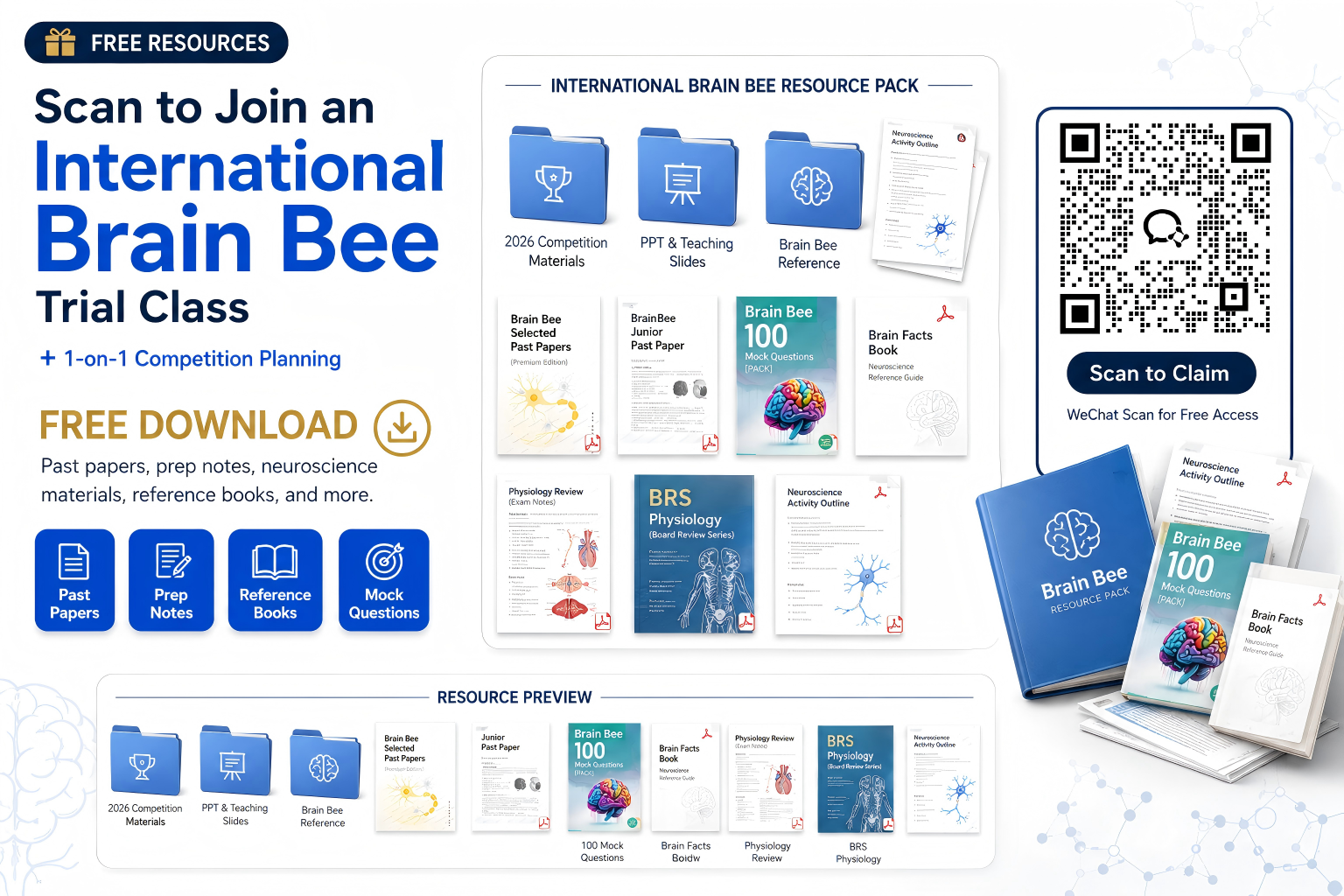
Get FREE Brain Bee Preparation Materials

Scan the QR code below to access free practice papers, study guides, and past competition materials. Start preparing today!
推荐

Brain Bee Competition Guide 2027: Schedule, Eligibility & Preparation

As the only competition in the field of biological brain science, the Brain Bee competition is highly regarded. Here is a comprehensive introduction to the Brain Bee, including competition dates, eligible grades, and preparation guidelines. Students and parents in grades 5-11 planning to participate in the 2027 Brain Bee should take note. This competition plays a foundational role in the development of medicine, biology, brain science, neuroscience, artificial intelligence, and cognitive science, and is recognized as one of the top three global biology competitions.

Key Topics Covered:

  • Brain Bee Competition Overview
  • Value and Recognition of the Brain Bee
  • Competition Schedule
  • Eligible Grades
  • Preparation Guidelines

PART 01: Brain Bee Competition Overview

The Brain Bee is an extracurricular exploration activity for teenagers worldwide and stands as the only international academic competition dedicated to brain science. Originating in the United States, it aims to encourage young students to understand and study the human brain, potentially inspiring future careers in foundational brain research, prevention and treatment of brain and mental disorders, and brain-inspired research.

Image source: Official Brain Bee website introduction

The competition was introduced to China in 2013. Many students first encountered the field of brain science through this event, which subsequently guided them to pursue academic and career paths in biology, psychology, medicine, neuroscience, and artificial intelligence.

Grade Divisions:

  • Grades 5-8: Participate in the Brain Bee Junior Division.
  • Grades 9-12: Participate in the Brain Bee Senior/Regular Division.

PART 02: Value and Recognition of the Brain Bee

  1. Authoritative Organization: Jointly hosted by prestigious institutions including the American Psychological Association (APA), Federation of European Neuroscience Societies (FENS), Society for Neuroscience (SfN), International Brain Research Organization (IBRO), and the Alzheimer's Association.
  2. Unique Focus: It is the only international competition for middle and high school students specifically focused on brain science.
  3. International Recognition: Top universities such as MIT, Harvard, Cambridge, and Oxford list the Brain Bee as a recommended academic activity for students pursuing biomedical and neuroscience tracks.
  4. Domestic Recognition: Leading Chinese institutions like Tsinghua University, Peking University, and the University of Hong Kong Faculty of Medicine recognize Brain Bee awards in their Strong Foundation Plan, Comprehensive Evaluation, and Diversified Excellence programs.
  5. Academic Excellence: Regarded as a "gold-standard" competition that demonstrates a student's learning interest, deep learning capabilities, and passion for scientific research.
  6. Career Alignment: Highly suitable for students targeting majors in biology, neuroscience, psychology, artificial intelligence (brain-computer interfaces), clinical medicine, and pre-med tracks.

PART 03: Competition Schedule

The Brain Bee regional exams are held annually in March, with testing centers available across the country (specific locations can be found on the official website: www.chinabrainbee.com).

Students are also permitted to register individually. Using the 2026 competition schedule as an example:

  • Registration through Partner Schools: September 2025 – January 25, 2026
  • Individual Registration (via Official Website): January 26, 2026 – February 1, 2026

PART 04: Preparation Guidelines

Are there reliable training programs for the Brain Bee competition? How do students register for courses? How should beginners prepare? While specialized courses exist, effective preparation typically involves studying the official Brain Bee textbook, reviewing past exam papers, and mastering core concepts in neuroanatomy, cognitive psychology, and cellular neuroscience. Students are encouraged to form study groups, utilize online academic resources, and practice consistently to build a strong foundation for the competition.


Get FREE Brain Bee Preparation Materials

Scan the QR code below to access free practice papers, study guides, and past competition materials. Start preparing today!
推荐

Brain Bee Neuroscience Competition: Complete Guide & 2027 Preparation Strategy

The Brain Bee Neuroscience Competition is the only neuroscience-specific competition globally for students in grades 5–12. Co-hosted by six authoritative organizations, including the American Psychological Association and the Federation of European Neuroscience Societies, it spans over 50 countries and 200 chapters. Widely recognized as a "golden springboard" for biology, medicine, and AI pathways, it holds exceptionally high value for college admissions.

Value and Division Structure of the Brain Bee Competition

Why the Brain Bee Competition Matters

  • Global Recognition: Participated in by students from over 50 countries, it is highly recognized by biology, medicine, psychology, and AI programs in the US, UK, Australia, and Canada.
  • College Application Boost: National-level awards serve as strong endorsements for Top 30 undergraduate programs and US high school summer camps. International awards become standout highlights for direct applications to Ivy League schools, Oxford, and Cambridge.
  • Skill Development: Trains spatial reasoning, clinical logic, academic English proficiency, and scientific research thinking.

Competition Divisions and Eligibility

  • Junior Division (Grades 5–8): Open to beginners with zero prior experience. Focuses on cultivating interest in neuroscience and building foundational knowledge.
  • Senior Division (Grades 9–12): Aligns with AP/IB Biology and introductory neuroscience. Provides a significant advantage for students pursuing medicine, biology, psychology, or AI (brain-computer interfaces).

Competition Schedule and Advancement Pathway

Regional Competition (March annually)

A 90-minute closed-book written exam. The Junior division features 60 questions, while the Senior division features 80 questions. The format includes multiple-choice and fill-in-the-blank questions, with bilingual (Chinese/English) test papers available.

National Competition (April annually)

The Senior division includes a written exam, specimen identification, and clinical case diagnosis. The Junior division consists of a written exam and a team poster presentation.

International Competition (August annually)

A high-intensity, multi-stage competition conducted entirely in English. It is typically held concurrently with an international neuroscience academic conference. The content covers highly advanced theoretical knowledge, complex clinical case analyses, and evaluations of cutting-edge research methodologies.

Award Structure

  • Regional Level: First, second, and third prizes are awarded, with an overall award rate of approximately 40%.
  • National Level: First, second, and third national prizes are awarded based on total score rankings, maintaining an overall award rate of around 40%.
  • International Level: The Chinese representative is selected from the highest-scoring First Prize winner at the National Competition.

Preparation Strategy and Timeline

Senior Division (Grades 9–12) Preparation Plan

  • Phase 1: Foundation Building (Now – July) Thoroughly study the official textbook Brain Facts. Memorize brain structures and basic neuron concepts, and master diagram identification. Focus on fundamentals rather than overly complex problems.
  • Phase 2: Tackling Key Challenges (August – September) Concentrate on two mandatory topics: neurophysiology and neurological disorders. Clarify the relationships between brain regions, their functions, and associated pathologies.
  • Phase 3: Practice and Score Improvement (October – December) Work through past papers from the last five years. Practice identifying brain slices and MRI images daily, and systematically address weak areas revealed by incorrect answers.
  • Phase 4: Regional Competition Sprint (January – Mid-February) Take full-length, timed mock exams. Memorize high-frequency test points and focus on securing advancement to the National Competition.
  • Phase 5: National Competition Intensive Training (Late February – March) Focus on three core challenges: specimen identification, neuroimaging, and clinical case diagnosis. Conduct full-scale mock exams under real test conditions.

Junior Division (Grades 5–8) Preparation Plan

  • Phase 1: Now – July Read the simplified textbook version. Memorize basic brain functions, sleep cycles, and emotional regulation concepts for an easy and engaging start.
  • Phase 2: August – December Practice foundational multiple-choice questions while simultaneously brainstorming and outlining content for the National Competition poster.
  • Phase 3: January – March 2027 Intensive written exam practice combined with finalizing the poster design. Aim for top awards.

Get FREE Brain Bee Preparation Materials

Scan the QR code below to access free practice papers, study guides, and past competition materials. Start preparing today!

推荐

Brain Bee Neuroscience Competition: A Complete Guide for Beginners

Heard that the Brain Bee Neuroscience Competition is highly prestigious, but can you participate without a biology background or prior competition experience? Absolutely! The Brain Bee is designed for students in grades 5–12. It is beginner-friendly, features bilingual questions, and is one of the most popular international competitions for getting started in neuroscience. This article will break down the registration process, exam content, and frequently asked questions to help you fully understand this rising star in academic background enhancement.

Brain Bee Neuroscience Competition Overview

Originating in the United States, the Brain Bee Neuroscience Competition is a global extracurricular challenge for youth. Its mission is to encourage students to explore and study the human brain, inspiring future careers in related fields to improve human health and quality of life.

The competition is jointly organized by top-tier institutions including the American Psychological Association (APA), the Federation of European Neuroscience Societies (FENS), the Society for Neuroscience (SfN), the Dana Foundation, and the International Brain Research Organization (IBRO).

The Brain Bee entered China in 2013. Starting in 2017, a Junior division was added to accommodate students in grades 5–8.

Key Competition Details

  • Suitable Students: Grades 5–12, particularly those planning to apply for undergraduate majors in biology, neuroscience, medicine, psychology, chemistry, computer science, or artificial intelligence.
  • Divisions: Brain Bee Division (Grades 9–12) / Brain Bee Junior Division (Grades 5–8).
  • Competition Structure: A three-tier progressive format: Regional, National, and International.
  • Language: Questions are presented in Chinese. Answers may be submitted in either Chinese or English.
  • Awards: Both the Regional and National rounds in China offer First, Second, and Third Prizes. The overall award rate is approximately 40% of participants.

Registration Guide

Registration typically opens in the autumn (late September to October). There are two registration methods:

  1. Base School Registration (Recommended): If your school is an official Brain Bee partner base school, you can register directly through your school advisor. The deadline is usually in mid-to-late January.
  2. Individual Registration: If your school is not a partner school, the organizing committee will open a brief individual registration window shortly before the regional round (typically late January to early February). You can register via the official website and will be assigned a testing center.

Official Website: http://www.chinabrainbee.com/

Note: Specific dates and registration notices for the new season are usually published on the official website and the competition's official social media channels. It is recommended to monitor these platforms in advance.

Exam Content & Syllabus

The China region of the Brain Bee focuses on the fundamentals of brain and neuroscience. The scope of knowledge for the regional and national rounds differs slightly.

Five Core Knowledge Modules

  1. Brain Fundamentals: Brain anatomy (frontal lobe, temporal lobe, hippocampus, amygdala, etc.), neuron structure, action potentials and synaptic transmission, neurotransmitters, brain development, and neuroplasticity.
  2. Brain Functions: Sensory systems (visual, auditory, olfactory, gustatory, and somatosensory pathways), learning and memory, language, motor control, sleep, emotion and motivation, and basic life functions (respiration and heart rate regulation).
  3. Brain Disorders: Neurodegenerative diseases (Alzheimer’s, Parkinson’s), psychiatric conditions (depression, anxiety, schizophrenia), developmental disorders (autism, ADHD), brain injuries, and addiction.
  4. Brain Research: Neuroimaging techniques (fMRI, EEG, PET, etc.), brain-computer interfaces, optogenetics, neural networks and AI principles, and neuroethics.
  5. Brain Enhancement: The positive impact of exercise, mindfulness meditation, and nutrition on brain health.

Preparation & Training Advice

To effectively prepare for the Brain Bee, structured training programs are highly recommended. Courses are typically categorized into long-term foundational tracks, intensive improvement classes, and final sprint sessions. These programs are designed around the latest competition trends and high-frequency testing points to provide customized, efficient study plans.

Curriculum & Instruction: Instructors typically hold master’s or doctoral degrees in STEM fields from prestigious universities. They possess in-depth research experience in neuroscience and extensive teaching backgrounds, ensuring high-quality academic guidance.


Get FREE Brain Bee Preparation Materials

Scan the QR code below to access free practice papers, study guides, and past competition materials. Start preparing today!

推荐

Brain Bee Competition Guide: Rules, Schedule & Expert Prep Strategies

I am Amanda, currently studying in the international department of a public high school in a tier-one city. I recently participated in the Brain Bee competition and achieved excellent results. In this article, I will introduce the Brain Bee competition and share my preparation experience.

Brain Bee Competition Overview

The Brain Bee International Brain Bee Championship originated in the United States as an extracurricular academic challenge for youth worldwide. It is co-hosted by the American Psychological Association (APA), the Federation of European Neuroscience Societies (FENS), the Society for Neuroscience (SfN), the Dana Foundation, the International Brain Research Organization (IBRO), and the Alzheimer's Association.

The competition aims to encourage students to explore and study the human brain, inspiring them to pursue future studies and careers in biology, medicine, psychology, chemistry, computer science, artificial intelligence, and related fields to improve human health and quality of life. Since entering China in 2013, it has gained widespread popularity among schools, students, and parents, nurturing a large number of outstanding students with a strong interest and aptitude in neuroscience.

Why I Participated

I chose to participate because Brain Bee is the most representative and prestigious competition in the field of neuroscience. Many of my seniors achieved outstanding results in this competition, which significantly strengthened their university applications. Additionally, my school has a dedicated neuroscience club, and the club president encouraged me to join. Preparing alongside my peers not only helped me build friendships but also helped me discover my genuine passion for neuroscience, motivating me to continue competing.

Competition Scale & Award Difficulty

Regional Awards

Awards are determined based on student rankings within each participating region (province, municipality, or autonomous region). First, second, and third prizes are awarded for both the Senior and Junior divisions in each region. The overall award rate is maintained at approximately 40%.

National Quota Allocation

The total number of participants at the national level is maintained at around 450 students (including both Senior and Junior divisions). Of these, 300 spots are allocated as regional quotas, distributed proportionally to each region based on actual participation numbers. Students advance to the national round based on their ranking within their respective regions. The remaining 150 spots are comprehensive quotas, awarded to the highest-scoring students nationwide after the regional qualifiers are finalized. The quota distribution between the Senior and Junior divisions is determined proportionally based on total regional registrations.

National Awards

National awards are determined by the cumulative total score across all competition rounds. First, second, and third prizes are awarded for both the Senior and Junior divisions, with an overall award rate of approximately 40%. Additionally, organizational awards are granted to schools based on their students' overall participation and performance.

From my personal experience, winning an award is highly selective and directly correlates with dedicated preparation. Students who invest serious time and effort consistently achieve strong results, while those who do not commit fully generally see lower outcomes.

Recommendations, Eligibility & Requirements

The competition is open to students in grades 5 through 12. To ensure fairness, participants are divided into age-appropriate divisions. The primary requirement is a genuine interest in neuroscience, the perseverance to thoroughly study the official reference materials, and a passion for exploring brain science.

Competition Rules & Schedule

Brain Bee is an individual competition open to a wide range of students. It is divided into two divisions: Grades 5–8 (Brain Bee Junior) and Grades 9–12 (Brain Bee Senior).

  • Registration Period: September 28, 2025 – January 25, 2026 (for designated base schools); January 26, 2026 – February 1, 2026 (for individual registrations).
  • Regional Event: March 21, 2026.
  • National Event: April 18–19, 2026 (specific format will be announced after the regional round concludes).
  • International Event: August 2026.

The competition follows a three-tier progression: Regional → National → International.

The Role of Brain Bee in College Applications

Brain Bee is widely recognized as a premier competition for students applying to Neuroscience, Philosophy-Neuroscience-Psychology (PNP), and Natural Sciences programs. Many of my peers and seniors applying to these fields have participated in this competition. Studying for Brain Bee also reinforces key concepts in psychology and biology, providing valuable preparation for IB, A-Level, and AP Biology and Psychology exams. Furthermore, the competition serves as an excellent litmus test to determine whether your passion for neuroscience can withstand rigorous academic demands, as pursuing this field requires significant dedication.

Key Characteristics of Brain Bee

Introductory Gateway

First and foremost, it serves as an accessible entry point into neuroscience. Before diving deep, I was advised by seniors to start with Brain Facts, the official introductory textbook. This book provides a comprehensive overview of the field, allowing beginners to grasp fundamental concepts and build a solid foundation for future exploration.

Interest-Driven

Secondly, sustained interest is crucial. Neuroscience requires a foundational understanding of biochemistry and physiology, along with the memorization of fixed anatomical knowledge, such as the four lobes of the cerebral cortex and their functions, as well as specific anatomical landmarks. These concepts are frequently tested. Mastering them requires patience and a genuine curiosity about the subject.

Key Focus Areas & Challenges

Focus Areas: The core of preparation involves systematically memorizing the official reference books. Since there are multiple texts, I recommend starting with foundational materials before progressing to advanced topics. For the national round, which includes a video diagnosis component, I suggest watching real clinical case videos on YouTube to familiarize yourself with actual neurological conditions. Additionally, reviewing past exam papers is essential to understand how theoretical knowledge is applied in practice, as questions often test application rather than rote memorization.

Challenges: The main difficulty lies in mastering specialized terminology and complex anatomical structures. I highly recommend supplementing textbook diagrams with online resources. For example, searching for clear illustrations of action potential thresholds or detailed brain anatomy online can greatly enhance understanding. Discussing concepts with peers and exploring relevant mechanisms on Google Scholar or PubMed can also provide deeper insights.

Recommended Prep Resources

  • Brain Facts: Covers the most fundamental and essential neuroscience concepts. It is highly beginner-friendly and avoids the intimidation of massive textbooks. It comprehensively covers the basics of brain science, making it the top recommendation for newcomers. However, it lacks advanced depth and may not reflect the very latest research.
  • Introduction to Cognitive Neuroscience (Shen Zheng, Fang Fang, Yang Jiongjiong, Peking University Press, 2010): More detailed than Brain Facts and available in Chinese, making it more accessible for native Chinese speakers. However, it is not a beginner-level text and contains more complex concepts that require careful study and memorization.
  • Other Introductory University Textbooks: Such as Neuroscience: Exploring the Brain by Mark F. Bear, Barry W. Connors, and Michael A. Paradiso. Similar to the previous book, it moves beyond basic concepts. While originally in English, Chinese translated versions are available online for flexible study.
  • Crash Course: The neuroscience-related episodes provide excellent supplementary video content.
  • YouTube: Channels and videos focusing on Brain Bee and neuroscience (e.g., topics on Ritalin, Blink reflexes, etc.). Pay special attention to the latest developments in your specific areas of interest to supplement your textbook knowledge.

Additional Tips & Insights

During my preparation, I joined a school club that met weekly in a dedicated classroom. We took turns presenting different sections of the material, which proved to be a highly efficient study method. I strongly recommend starting or joining a neuroscience study group at your school, as collaborative preparation significantly boosts motivation and comprehension.

For challenging topics, create personalized study notes. Since everyone struggles with different concepts, tailor your notes to focus only on the material you find difficult to memorize or understand. Write these on small flashcards for quick review right before the exam. As my own notes demonstrate, incorporating clear diagrams and illustrations will make your revision materials much more effective.

Finally, I wish all students the best of luck in the Brain Bee competition and hope you achieve outstanding results!


Get FREE Brain Bee Preparation Materials

Scan the QR code below to access free practice papers, study guides, and past competition materials. Start preparing today!

推荐

2026 Brain Science Innovation Challenge: Complete Guide, Rules & Preparation Resources

The brain, the most complex and mysterious organ in the human body, still holds countless unsolved mysteries. From movement, perception, and sleep to language, memory, and emotion, every human behavior is governed by it. Challenging conditions such as Alzheimer’s disease, depression, autism, and Parkinson’s disease are also closely linked to the brain and nervous system. Even today’s booming artificial intelligence draws heavily on inspiration from brain science. For this reason, the Brain Bee competition series was created—spanning biology, chemistry, psychology, medicine, neuroscience, public health, artificial intelligence, and even philosophy, it opens a door for young students to explore the infinite possibilities of the human brain.

Since 2020, the Brain Bee China region has annually launched the Brain Science Innovation Challenge (Brain Challenge). This initiative encourages participants to transform brain science knowledge into practical solutions that address real-world problems, whether through academic research, clinical applications, or market innovation.

Currently, many countries, including China, have prioritized brain science and brain-inspired research as major strategic scientific initiatives. Decoding the brain, conquering neurological diseases, and developing brain-computer interfaces are becoming the new frontiers of future technology. The Brain Science Innovation Challenge actively aligns with this strategic layout, dedicated to cultivating the next generation of innovators.

The 2026 Brain Science Innovation Challenge has officially launched. We welcome interested individuals and teams from both domestic and international backgrounds to register. The competition will be held on August 15–16, 2026. We look forward to your creativity and action!

Part 1: 2026 Brain Science Innovation Challenge

In the international competition landscape of biomedicine and public health, the Brain Challenge stands out with its unique "Academic + Practice" dual-drive model. It cultivates three core competencies—research innovation, commercial translation, and teamwork—which precisely align with the selection criteria of top-tier universities.

01 Competition Schedule

  • Registration Deadline: July 31, 2026
  • Competition Dates: August 15–16, 2026

02 Basic Information

  • Eligibility: Currently enrolled high school and college students
  • Registration Method: Team-based participation; members may freely form teams to register
  • Team Composition: 3–5 members per team, designed to foster collaboration and leadership
  • Interdisciplinary Integration: Covers three tracks: Research, Business, and Public Welfare, balancing academic rigor with social value
  • Subject Breadth: Encompasses cutting-edge topics from brain disease research to brain-inspired technological applications

03 Project Categories & Tracks

Each team must submit one brain science innovation proposal. The proposal must be application-oriented, addressing a specific real-world problem in the field of brain science with a scientific, effective, and practical solution. Each team may choose to participate in one of the following tracks:

Research Track

  • Focuses on foundational brain science research, including but not limited to innovative research proposals on brain function, brain disease prevention and treatment, and brain-inspired studies.

Business Track

  • Focuses on translating brain science research into commercial market solutions, including but not limited to products or services in brain science research, brain disease prevention and treatment, and brain function enhancement.

Public Welfare Track

  • Includes but is not limited to public welfare projects that promote public awareness of mental health and brain disease prevention, as well as initiatives that support care and rehabilitation participation for brain disease patients.

A team's project may only be submitted to one of the above tracks for evaluation.

04 How to Participate

  • Register through the official Brain Bee channels. The registration deadline is July 31, 2026.
  • Teams will conduct research and/or implementation of their project proposals to develop final deliverables.
  • Participate in the 2026 Brain Science Innovation Challenge, featuring online presentations and Q&A defenses.
  • Contact: For any further questions, please email the official Brain Challenge team at brainchallenge@chinabrainbee.com. Additional information will be published on the official website www.chinabrainbee.com and the Brain Bee official channels.

05 Submission Requirements & Evaluation Criteria

Each team must submit a final project summary (strictly limited to one A4 page) and a presentation PPT (maximum 20 slides). Submissions may be in either Chinese or English (submission instructions will be provided separately).

Teams will deliver an online presentation of their project proposal, with a time limit of 8 minutes. Following the presentation, judges will conduct a live Q&A session. Based on the judges' scoring, First, Second, and Third Prizes will be awarded in each track.

Evaluation Criteria

  • Relevance: The proposal must offer a targeted solution to a significant current problem or challenge in brain science.
  • Scientific Rigor: The proposal must be supported by established brain science theories or research findings.
  • Practicality: The proposal must demonstrate strong feasibility and operational potential. Business track projects will be evaluated on market value, while public welfare track projects will be assessed on social impact.

Part 2: Brain Challenge Awards

01 Category Awards

The competition is divided into three tracks: Research, Business, and Public Welfare. Awards are evaluated independently for each track.

  • First Prize: Several awarded per track. Projects must demonstrate exceptional performance in relevance, scientific rigor, and practicality, typically meeting a high score threshold (e.g., starting score ≥ 80).
  • Second Prize: Several awarded per track. The starting score threshold is generally ≥ 75.
  • Third Prize: Several awarded per track. The starting score threshold is generally ≥ 60.

02 Additional Awards

  • Team Award: Based on the overall performance of students from participating schools, several team awards may be granted to recognize schools or organizations with outstanding participation.
  • Special Awards: In certain years, special awards such as the "Innovation Award" or "Social Impact Award" may be introduced to recognize projects that excel in specific areas.

Part 3: Official Preparation Resources & Recommended Reading

01 Brain Facts

Recommendation Rating: ★★★★★

This 200+ page book uses accessible language to thoroughly explain foundational knowledge in neuroanatomy, cognitive functions, and common brain diseases. It features rich, easy-to-understand illustrations.

02 Introduction to Cognitive Neuroscience

Recommendation Rating: ★★★★★

Systematically explains the neural mechanisms behind cognitive functions such as perception, attention, and memory. The content is more professional and in-depth than introductory textbooks.

03 Neuroscience: Exploring the Brain

Recommendation Rating: ★★★★★

Spanning nearly 800 pages, this book provides a comprehensive yet accessible exploration of the complete knowledge system, ranging from individual neurons to higher-order cognitive functions.

Frequently Asked Questions

1. Can we form a team across different schools, cities, or countries? Yes, cross-regional and international teams are allowed.

2. If our project contains both research and business elements, which track should we choose? The three tracks (Research, Business, and Public Welfare) do not have rigid boundaries. Students should select the track that best aligns with their project's primary focus. For example, a Research track proposal can mention commercial potential, and a Business track proposal can detail its underlying research innovations.

3. If a team member cannot attend the presentation, will it affect our final score? We encourage all registered team members to participate fully and divide tasks reasonably. However, the absence of one or more members during the presentation will not negatively impact the final evaluation.

4. What kind of project qualifies for the competition? Projects must aim to solve practical problems in brain science and be innovation/application-oriented. Simply repeating existing concepts, principles, experiments, procedures, or products is not acceptable. There are no other restrictions on project types across tracks. Evaluation is based on relevance, scientific rigor, and practicality. Importantly, all projects must be independently completed by students; plagiarism or third-party ghostwriting is strictly prohibited.

5. Should the PPT and presentation be in English or Chinese? Both the PPT and the oral presentation can be in either Chinese or English. Submissions or presentations in other languages are not accepted.

6. Do we need to conduct experiments or provide a physical product? No, experiments or physical prototypes are not required. However, if your project has already entered the implementation phase, please demonstrate or explain this in your proposal.

7. I cannot find teammates. Can the organizers assist with team formation? We recommend forming your own team first. If you are still looking for teammates close to the deadline, you may email the organizing committee at brainchallenge@chinabrainbee.com after July 28 for assistance.


Get FREE Brain Bee Preparation Materials

Scan the QR code below to access free practice papers, study guides, and past competition materials. Start preparing today!

推荐

Brain Bee Competition 2026: Complete Guide, Eligibility & Preparation Strategies

The 2026 Brain Bee Regional Competition is approaching, with the exam scheduled for March 21. What exactly is the Brain Bee competition? Which students should participate? The Brain Bee holds exceptionally high academic value in the fields of biology and neuroscience, making it an ideal extracurricular activity for middle and high school students interested in medicine, biology, neuroscience, cognitive science, and artificial intelligence. This guide covers everything you need to know to prepare effectively.

Article Overview:

  • What is the Brain Bee?
  • What are the benefits of participating?
  • What are the eligibility requirements?
  • How to prepare for the Brain Bee? (Exam content & preparation strategies)

PART 01: What is the Brain Bee?

The Brain Bee Competition, officially known as the Brain Bee Brain Science Competition, originated in the United States and is a global extracurricular knowledge exploration event for teenagers. The competition features a progressive structure, advancing from regional to national, and finally to the international level.

The Brain Bee was introduced to China in 2013. It actively aligns with national brain science development strategies, with the core mission of "popularizing brain science knowledge and cultivating future brain science talent." It has significantly contributed to fostering independent innovation talent in the neuroscience sector. (Test centers for the Chinese division are established in numerous schools across various provinces nationwide.)

PART 02: What are the Benefits of Participating?

The Brain Bee is the only international competition for middle and high school students globally that focuses exclusively on brain science. It is jointly hosted by the American Psychological Association (APA), the Federation of European Neuroscience Societies (FENS), the Society for Neuroscience (SfN), the International Brain Research Organization (IBRO), and the Alzheimer's Association.

The competition aims to encourage participants to understand and study the human brain, while cultivating their interest and capabilities in future careers related to fundamental brain research, the prevention and treatment of brain and mental disorders, and brain-inspired computing.

For primary and secondary school students interested in biology, psychology, medicine, neuroscience, and artificial intelligence, the Brain Bee provides a valuable platform to nurture their interests and demonstrate their academic abilities. It significantly strengthens applications for international students targeting relevant majors at overseas universities.

Past participants have consistently been outstanding students with a strong passion for these disciplines. Competitors from the Chinese division hail from top schools across the country, including Jinan Foreign Language School, Nanjing Foreign Language School, High School Affiliated to Northeast Normal University, The High School Affiliated to Renmin University of China, and The High School Affiliated to Beijing Normal University. Many alumni are now studying at world-renowned universities such as Johns Hopkins University, Stanford University, University of Pennsylvania, Duke University, Columbia University, and Caltech.

(Note: The Brain Bee is an extracurricular interest exploration program and is not linked to domestic middle or high school admissions.)

PART 03: What are the Eligibility Requirements?

The Brain Bee is open to students in grades 5 through 12, divided into two distinct divisions:

  • Grades 9-12: Brain Bee (Senior Division)
  • Grades 5-8: Brain Bee (Junior Division)

*Chinese students currently enrolled in overseas schools should register and participate in their host country or region.

PART 04: How to Prepare for the Brain Bee Competition?

Key Dates for 2026

  • Regional Competition: March 21, 2026, 10:00 AM - 11:30 AM (Saturday)
  • National Competition: April 18-19, 2026 (Saturday & Sunday)
  • International Competition: August 2026

Below are answers to frequently asked questions from students and parents with no prior competition experience:

1. I have zero background in brain science. Is it still possible to participate?

Yes, absolutely. Nearly all participating students begin their preparation from scratch.

2. Does the Brain Bee overlap with current school subjects?

Yes. Brain science shares significant conceptual overlap with biology and psychology topics covered in standard middle school curricula.

3. How should I prepare?

The competition primarily focuses on the exploratory and applied aspects of brain science. Students should thoroughly master the relevant knowledge and learn to apply it flexibly to solve problems.

4. Are there specific required textbooks?

The competition provides a defined syllabus but does not mandate a specific textbook. Participants can select study materials that best suit their learning style. The official book Brain Facts is highly recommended and available for free download.

5. How much time is needed for preparation?

Preparation time varies by individual. Students should allocate time based on their personal schedule to systematically study and explore brain science concepts.


Get FREE Brain Bee Preparation Materials

Scan the QR code below to access free practice papers, study guides, and past competition materials. Start preparing today!

推荐

The Ultimate Guide to the 2026 Brain Bee Competition: Format, Syllabus & Registration

The 2026 Brain Bee Brain Science Competition, launching in March 2026, is a highly favored extracurricular challenge for students intending to pursue majors in biology, medicine, psychology, and related fields.

Preparing for this competition helps students solidify their academic foundation and sharpen their logical thinking. Furthermore, an outstanding competition result can add a significant highlight to college applications and enhance overall competitiveness.

Below, we provide a comprehensive guide to understanding what Brain Bee is, what the competition entails, and how to register.

What is Brain Bee?

The Brain Bee International Brain Science Competition is an extracurricular challenge for teenagers worldwide. It aims to encourage students to explore and study the human brain, inspiring future careers in fundamental brain research, the prevention and treatment of neurological and psychiatric disorders, and brain-inspired computing.

The competition is designed for students interested in biology, medicine, psychology, neuroscience, cognitive science, chemistry, computer science, artificial intelligence, and related disciplines. Currently, students from over 50 countries and regions participate globally.

The event is jointly organized by the American Psychological Association, the Federation of European Neuroscience Societies, the Society for Neuroscience, the International Brain Research Organization, and the Alzheimer's Association.

Source: Brain Bee Official Website

Brain Bee Competition Details

1. Eligibility

  • Brain Bee: Students in Grades 9-12
  • Brain Bee (Junior): Students in Grades 5-8

2. Schedule

  • Regional Activity: March 21, 2026, 10:00 AM - 11:30 AM (Saturday)
  • National Activity: April 18-19, 2026 (Saturday & Sunday)
  • International Activity: August 2026

3. Competition Content

Centered on foundational knowledge related to the brain, the competition encourages inquiry-based learning. The tested content primarily covers brain structure, brain function, and brain diseases.

Knowledge Syllabus

Knowledge Syllabus

The Brain Bee competition syllabus covers key knowledge points related to brain structure, brain function, brain diseases, and more.

Source: Brain Bee Official Website

Recommended Reference Materials

➤ Core Material:

Brain Facts is highly recommended. Both the Brain Bee and Brain Bee Junior divisions should read the entire book. The Regional Activity primarily tests content from this publication.

➤ Supplementary Materials:

Introduction to Cognitive Neuroscience (edited by Shen Zheng, Fang Fang, Yang Jiongjiong, et al., Peking University Press, 2025 edition). Brain Bee participants are advised to read relevant chapters.

Other introductory neuroscience/brain science textbooks, such as Neuroscience: Exploring the Brain by Mark F. Bear, Barry W. Connors, and Michael A. Paradiso. Brain Bee participants are advised to read relevant chapters.

4. Competition Format

The competition follows a three-tier progression model:

Activity Format: Three-Tier Model

Regional Activity → National Activity → International Activity

I. Regional Activity

The Regional Activity uses a unified exam paper and is conducted simultaneously at designated testing centers.

  • Brain Bee Division: 80 questions in total
  • Brain Bee Junior Division: 60 questions in total

Exam Format: Closed-book (Multiple-choice + Fill-in-the-blank, 1 point per question)

All questions are presented in Chinese, with professional terminology provided in both Chinese and English.

  • Multiple-choice: Fill in the correct option letter.
  • Fill-in-the-blank: Answers may be written in Chinese or English. Professional terms may be abbreviated in English.

II. National Activity

Brain Bee Division

The competition consists of three segments: Written Exam, Image/Specimen Identification, and Case Diagnosis.

  • Written Exam: Includes fill-in-the-blank and multiple-choice questions. 1 point per question, 50 questions total, worth 50 points.
  • Image/Specimen Identification: Identify relevant brain structures from specimens or medical imaging (CT, MRI, etc.). 2 points per question, 13 questions total, worth 26 points.
  • Case Diagnosis: Analyze and diagnose patient conditions based on provided case information. 3 points per major question, 8 questions total, worth 24 points.

All three segments are closed-book. Questions are in Chinese, with professional terminology provided in both Chinese and English. Non-multiple-choice questions may be answered in Chinese or English, and professional terms may use English abbreviations.

Brain Bee (Junior) Division

The competition consists of two segments: Written Exam and Scientific Poster Creation.

  • Written Exam: Individual participation. Includes fill-in-the-blank and multiple-choice questions. 1 point per question, 40 questions total, worth 40 points. This segment is closed-book. Questions are in Chinese, with professional terminology in both languages. Fill-in-the-blank answers may be in Chinese or English, with English abbreviations allowed for technical terms.
  • Scientific Poster: Team participation. This segment is worth 40 points. After the National Activity shortlist is announced, students may form teams (4-5 members per team) with peers from their own or other schools who have also advanced to the National level. Teams will create a poster and deliver a presentation on a designated theme within a specified time limit. Reference materials are permitted during creation. The poster score is applied to each team member's final total (e.g., if the team scores 35, each member receives 35 points for this segment). Posters and presentations may be conducted in Chinese or English.

III. International Activity

Each country or region may send one student to represent them at the International Activity.

The highest-scoring First Prize winner from the National Activity Brain Bee Division (Grades 9-12) will earn the qualification to represent China at the 2026 Brain Bee International Activity. Participating students will also be invited to attend the organizers' academic annual conference.

Registration Process

  • Regional Activity: Registration is handled through designated base schools. Students attending a base school can register directly through their school and participate in the Regional Activity. The registration deadline is January 25, 2026.
  • Individual Registration: If a student's school is not a designated base school, they can register through the individual student registration channel from January 26 to February 1, 2026. After registration closes, the organizing committee will arrange the testing venue.

Get FREE Brain Bee Preparation Materials

Scan the QR code below to access free practice papers, study guides, and past competition materials. Start preparing today!

推荐

Brain Bee Brain Science Competition: A Beginner-Friendly Guide for Grades 5-12

As summer approaches, many parents are searching for international biology competitions suitable for upper elementary students. Ideally, these competitions should be beginner-friendly and help cultivate a child's interest in biology.

The Brain Bee Brain Science Competition is perfectly tailored for elementary students entering the field. With its dedicated Junior Division, it serves as an excellent opportunity to enhance future academic applications and build a strong extracurricular profile.

I. Introduction to the Brain Bee Brain Science Competition

Originating in the United States and co-hosted by several internationally recognized institutions, the Brain Bee has been dedicated to the field of neuroscience for over 20 years. It spans more than 40 countries and attracts over 100,000 students annually. Since entering China in 2013, the competition has helped young learners connect with cutting-edge biological sciences, offering both strong academic rigor and high recognition.

Core Features of the Brain Bee Competition

Scientific Division Structure:
The competition is divided into the Junior Division (Grades 5-8) and the Senior Division (Grades 9-12). This structure aligns with the knowledge base of different academic stages, ensuring younger students are not overwhelmed while allowing older students to delve deeper.

Content Alignment:
The curriculum covers five major modules, including brain fundamentals and brain functions. The Junior Division focuses on foundational concepts, while the Senior Division balances depth and cutting-edge topics (such as brain-computer interfaces). Questions are presented in Chinese with bilingual terminology annotations, significantly lowering the entry barrier.

High-Quality & Widely Recognized Awards:
The award rate for both the Brain Bee regional and national competitions reaches 40%. Certificates are recognized by top universities domestically and internationally. Top performers in the Senior Division can advance to the international finals, providing a significant boost for college applications and academic background enhancement.

II. How to Plan for Brain Bee at Different Stages?

The core advantage of Brain Bee is its "younger-student-friendly, zero-basis accessible" approach. It aligns with current trends in biology education and adapts to the learning pace of different grade levels. Whether for domestic academic advancement or international application background enhancement, it is a highly cost-effective choice. Parents are encouraged to let their children begin their neuroscience exploration journey in elementary school.

Grades 3-5: Introductory Stage
Core Objective: Cultivate an interest in brain science, accumulate foundational knowledge, and lay the groundwork for future competition participation.

Grades 5-8: Junior Division
Core Objective: Match the competition's difficulty level, aim for regional and national awards, and build a systematic knowledge framework.

Grades 9-12: Senior Division
Core Objective: Master advanced knowledge points, adapt to the multi-stage assessments of the national competition, aim for first prize, and qualify for the international finals.

Brain Bee Knowledge Point Summary

Module 1: Brain Fundamentals

Module 2: Brain Functions

Module 3: Brain Disorders

Module 4: Brain Research & Technology


Get FREE Brain Bee Preparation Materials

Scan the QR code below to access free practice papers, study guides, and past competition materials. Start preparing today!

推荐

Brain Bee Neuroscience Competition Guide: Dates, Format & Divisions

Open to all students in grades 5–12! The highly prestigious Brain Bee Neuroscience Competition is beginner-friendly and serves as an excellent tool for building academic profiles in biology, psychology, and medicine. Featuring a three-tier progression (Regional → National → International), this guide clearly outlines the exam dates, content, and divisions for the Brain Bee Regional and National competitions to keep your preparation on track.

01 Brain Bee Neuroscience Competition Introduction

Brain Bee is the only international neuroscience olympiad for youth worldwide, jointly hosted by six top-tier institutions including the American Psychological Association (APA), the Federation of European Neuroscience Societies (FENS), and the International Brain Research Organization (IBRO). Its academic value includes:

Overseas Study (Highly Recognized by Ivy League & G5 Universities)

  • A premier competition dedicated to neuroscience, medicine, psychology, and cognitive AI, offering a specialized track that surpasses general biology competitions.
  • Highly recognized by MIT, Harvard, Cambridge, and Johns Hopkins University. National awards significantly increase early decision interview acceptance rates.

Long-Term Academic Value

Seamlessly aligns with IB/AP Biology and Psychology curricula, building a complete academic portfolio for medical and neuroscience pathways.

Competition Schedule:

  • Base School Registration: December 2026 – January 25, 2027
  • Individual Registration: January 26 – February 1, 2027 (Non-base schools)
  • Regional Competition: March 2027 (90 minutes, closed-book written exam)
  • National Competition: April 2027 (For qualifiers)
  • International Competition: August 2027 (Top scorers from the National First Prize represent China)

Division Selection:

Junior Division (Lower Grades): Grades 5–8. Difficulty: ★★☆☆☆. Focuses on brain structure, basic functions, the five senses, and simple disorders. Preparation using the foundational sections of Brain Facts is sufficient.

Brain Bee Division (Upper Grades): Grades 9–12. Difficulty: ★★★★☆. Approaches introductory undergraduate neuroscience. Covers neurotransmitters, neural circuits, mechanisms of brain diseases, imaging diagnostics, and cutting-edge research.

Competition Format:

Regional Competition

Format: Closed-book written exam, 90 minutes, bilingual.

Question Count & Scoring:

Brain Bee Division: 80 questions (Multiple Choice + Fill-in-the-blank), 80 points total.

Question Breakdown:

  • Multiple Choice (~50–60 questions):
    • Basic (~60%): Direct textbook recall, e.g., "What is the largest lobe of the brain?" "Where is cerebrospinal fluid produced?"
    • Intermediate (~30%): Simple application/differentiation, e.g., "Which neurotransmitter below is associated with inhibition?"
    • Advanced (~10%): Detail-oriented + cross-section integration, e.g., "Which of the following is NOT a role of the hippocampus in memory consolidation?"
  • Fill-in-the-blank (~20–30 questions): Focuses on terminology, anatomical structures, and numerical values, e.g., "The synaptic cleft is approximately ____ nm wide." "The axon terminals of motor neurons release ____." Common pitfalls include spelling and precise terminology (e.g., "amygdala" must be spelled correctly).

Junior Division: 60 questions, 60 points total. Almost entirely basic recall questions with straightforward options. Fill-in-the-blanks typically require 1–2 keywords.

Advancement: Approximately the top 40% of students per province advance to the National Competition. For the Brain Bee Division, a score of ≥45 is typically required.

National Competition

1. Brain Bee Division (100 points total)

  • Written Exam (50 points): 50 multiple-choice/fill-in questions, 60 minutes. Covers neurotransmitters, brain imaging, etc.
  • Specimen/Imaging Identification (26 points): 13 sets of CT/MRI scans requiring brain region labeling (e.g., hippocampus).
  • Case Diagnosis (24 points): 8 clinical cases requiring analysis of conditions like Parkinson's disease, epilepsy, etc.

2. Junior Division (80 points total)

  • Written Exam (40 points): 40 foundational questions on brain lobe functions and basic anatomy.
  • Science Poster (40 points): Teams of 4–5 students create and present a poster on-site. Scoring: Scientific Accuracy 60%, Visual Design 30%, Presentation 10%.

Get FREE Brain Bee Preparation Materials

Scan the QR code below to access free practice papers, study guides, and past competition materials. Start preparing today!

推荐
Online Consultation
Online Consultation