The Brain Bee Neuroscience Competition is the only neuroscience-specific competition globally for students in grades 5–12. Co-hosted by six authoritative organizations, including the American Psychological Association and the Federation of European Neuroscience Societies, it spans over 50 countries and 200 chapters. Widely recognized as a "golden springboard" for biology, medicine, and AI pathways, it holds exceptionally high value for college admissions.
Value and Division Structure of the Brain Bee Competition
Why the Brain Bee Competition Matters
- Global Recognition: Participated in by students from over 50 countries, it is highly recognized by biology, medicine, psychology, and AI programs in the US, UK, Australia, and Canada.
- College Application Boost: National-level awards serve as strong endorsements for Top 30 undergraduate programs and US high school summer camps. International awards become standout highlights for direct applications to Ivy League schools, Oxford, and Cambridge.
- Skill Development: Trains spatial reasoning, clinical logic, academic English proficiency, and scientific research thinking.
Competition Divisions and Eligibility
- Junior Division (Grades 5–8): Open to beginners with zero prior experience. Focuses on cultivating interest in neuroscience and building foundational knowledge.
- Senior Division (Grades 9–12): Aligns with AP/IB Biology and introductory neuroscience. Provides a significant advantage for students pursuing medicine, biology, psychology, or AI (brain-computer interfaces).
Competition Schedule and Advancement Pathway
Regional Competition (March annually)
A 90-minute closed-book written exam. The Junior division features 60 questions, while the Senior division features 80 questions. The format includes multiple-choice and fill-in-the-blank questions, with bilingual (Chinese/English) test papers available.
National Competition (April annually)
The Senior division includes a written exam, specimen identification, and clinical case diagnosis. The Junior division consists of a written exam and a team poster presentation.
International Competition (August annually)
A high-intensity, multi-stage competition conducted entirely in English. It is typically held concurrently with an international neuroscience academic conference. The content covers highly advanced theoretical knowledge, complex clinical case analyses, and evaluations of cutting-edge research methodologies.
Award Structure
- Regional Level: First, second, and third prizes are awarded, with an overall award rate of approximately 40%.
- National Level: First, second, and third national prizes are awarded based on total score rankings, maintaining an overall award rate of around 40%.
- International Level: The Chinese representative is selected from the highest-scoring First Prize winner at the National Competition.
Preparation Strategy and Timeline
Senior Division (Grades 9–12) Preparation Plan
- Phase 1: Foundation Building (Now – July) Thoroughly study the official textbook Brain Facts. Memorize brain structures and basic neuron concepts, and master diagram identification. Focus on fundamentals rather than overly complex problems.
- Phase 2: Tackling Key Challenges (August – September) Concentrate on two mandatory topics: neurophysiology and neurological disorders. Clarify the relationships between brain regions, their functions, and associated pathologies.
- Phase 3: Practice and Score Improvement (October – December) Work through past papers from the last five years. Practice identifying brain slices and MRI images daily, and systematically address weak areas revealed by incorrect answers.
- Phase 4: Regional Competition Sprint (January – Mid-February) Take full-length, timed mock exams. Memorize high-frequency test points and focus on securing advancement to the National Competition.
- Phase 5: National Competition Intensive Training (Late February – March) Focus on three core challenges: specimen identification, neuroimaging, and clinical case diagnosis. Conduct full-scale mock exams under real test conditions.
Junior Division (Grades 5–8) Preparation Plan
- Phase 1: Now – July Read the simplified textbook version. Memorize basic brain functions, sleep cycles, and emotional regulation concepts for an easy and engaging start.
- Phase 2: August – December Practice foundational multiple-choice questions while simultaneously brainstorming and outlining content for the National Competition poster.
- Phase 3: January – March 2027 Intensive written exam practice combined with finalizing the poster design. Aim for top awards.
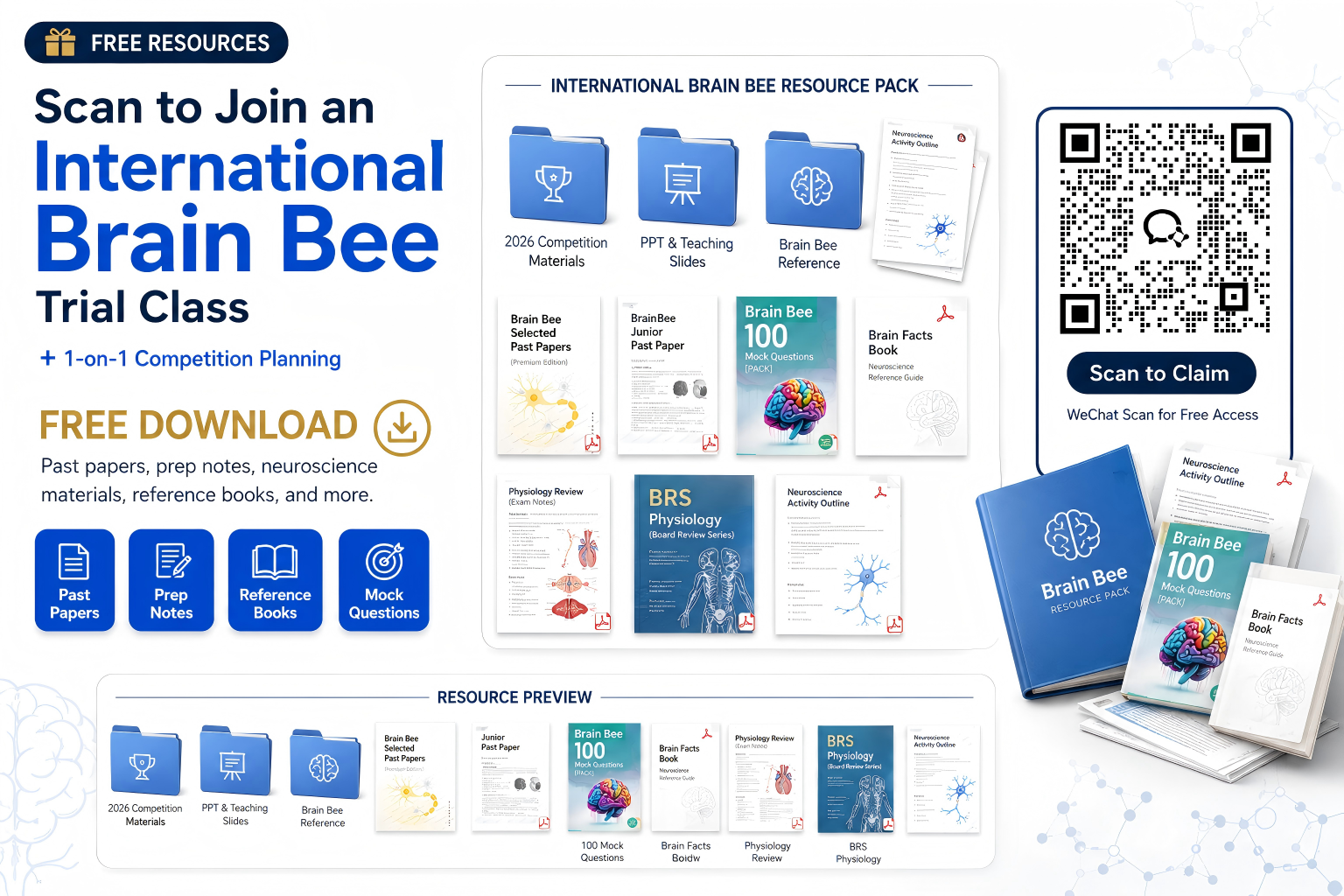
Get FREE Brain Bee Preparation Materials
Scan the QR code below to access free practice papers, study guides, and past competition materials. Start preparing today!