The brain, the most complex and mysterious organ in the human body, still holds countless unsolved mysteries. From movement, perception, and sleep to language, memory, and emotion, every human behavior is governed by it. Challenging conditions such as Alzheimer’s disease, depression, autism, and Parkinson’s disease are also closely linked to the brain and nervous system. Even today’s booming artificial intelligence draws heavily on inspiration from brain science. For this reason, the Brain Bee competition series was created—spanning biology, chemistry, psychology, medicine, neuroscience, public health, artificial intelligence, and even philosophy, it opens a door for young students to explore the infinite possibilities of the human brain.
Since 2020, the Brain Bee China region has annually launched the Brain Science Innovation Challenge (Brain Challenge). This initiative encourages participants to transform brain science knowledge into practical solutions that address real-world problems, whether through academic research, clinical applications, or market innovation.
Currently, many countries, including China, have prioritized brain science and brain-inspired research as major strategic scientific initiatives. Decoding the brain, conquering neurological diseases, and developing brain-computer interfaces are becoming the new frontiers of future technology. The Brain Science Innovation Challenge actively aligns with this strategic layout, dedicated to cultivating the next generation of innovators.
The 2026 Brain Science Innovation Challenge has officially launched. We welcome interested individuals and teams from both domestic and international backgrounds to register. The competition will be held on August 15–16, 2026. We look forward to your creativity and action!
Part 1: 2026 Brain Science Innovation Challenge
In the international competition landscape of biomedicine and public health, the Brain Challenge stands out with its unique "Academic + Practice" dual-drive model. It cultivates three core competencies—research innovation, commercial translation, and teamwork—which precisely align with the selection criteria of top-tier universities.
01 Competition Schedule
- Registration Deadline: July 31, 2026
- Competition Dates: August 15–16, 2026
02 Basic Information
- Eligibility: Currently enrolled high school and college students
- Registration Method: Team-based participation; members may freely form teams to register
- Team Composition: 3–5 members per team, designed to foster collaboration and leadership
- Interdisciplinary Integration: Covers three tracks: Research, Business, and Public Welfare, balancing academic rigor with social value
- Subject Breadth: Encompasses cutting-edge topics from brain disease research to brain-inspired technological applications
03 Project Categories & Tracks
Each team must submit one brain science innovation proposal. The proposal must be application-oriented, addressing a specific real-world problem in the field of brain science with a scientific, effective, and practical solution. Each team may choose to participate in one of the following tracks:
Research Track
- Focuses on foundational brain science research, including but not limited to innovative research proposals on brain function, brain disease prevention and treatment, and brain-inspired studies.
Business Track
- Focuses on translating brain science research into commercial market solutions, including but not limited to products or services in brain science research, brain disease prevention and treatment, and brain function enhancement.
Public Welfare Track
- Includes but is not limited to public welfare projects that promote public awareness of mental health and brain disease prevention, as well as initiatives that support care and rehabilitation participation for brain disease patients.
A team's project may only be submitted to one of the above tracks for evaluation.
04 How to Participate
- Register through the official Brain Bee channels. The registration deadline is July 31, 2026.
- Teams will conduct research and/or implementation of their project proposals to develop final deliverables.
- Participate in the 2026 Brain Science Innovation Challenge, featuring online presentations and Q&A defenses.
- Contact: For any further questions, please email the official Brain Challenge team at brainchallenge@chinabrainbee.com. Additional information will be published on the official website www.chinabrainbee.com and the Brain Bee official channels.
05 Submission Requirements & Evaluation Criteria
Each team must submit a final project summary (strictly limited to one A4 page) and a presentation PPT (maximum 20 slides). Submissions may be in either Chinese or English (submission instructions will be provided separately).
Teams will deliver an online presentation of their project proposal, with a time limit of 8 minutes. Following the presentation, judges will conduct a live Q&A session. Based on the judges' scoring, First, Second, and Third Prizes will be awarded in each track.
Evaluation Criteria
- Relevance: The proposal must offer a targeted solution to a significant current problem or challenge in brain science.
- Scientific Rigor: The proposal must be supported by established brain science theories or research findings.
- Practicality: The proposal must demonstrate strong feasibility and operational potential. Business track projects will be evaluated on market value, while public welfare track projects will be assessed on social impact.
Part 2: Brain Challenge Awards
01 Category Awards
The competition is divided into three tracks: Research, Business, and Public Welfare. Awards are evaluated independently for each track.
- First Prize: Several awarded per track. Projects must demonstrate exceptional performance in relevance, scientific rigor, and practicality, typically meeting a high score threshold (e.g., starting score ≥ 80).
- Second Prize: Several awarded per track. The starting score threshold is generally ≥ 75.
- Third Prize: Several awarded per track. The starting score threshold is generally ≥ 60.
02 Additional Awards
- Team Award: Based on the overall performance of students from participating schools, several team awards may be granted to recognize schools or organizations with outstanding participation.
- Special Awards: In certain years, special awards such as the "Innovation Award" or "Social Impact Award" may be introduced to recognize projects that excel in specific areas.
Part 3: Official Preparation Resources & Recommended Reading
01 Brain Facts
Recommendation Rating: ★★★★★
This 200+ page book uses accessible language to thoroughly explain foundational knowledge in neuroanatomy, cognitive functions, and common brain diseases. It features rich, easy-to-understand illustrations.
02 Introduction to Cognitive Neuroscience
Recommendation Rating: ★★★★★
Systematically explains the neural mechanisms behind cognitive functions such as perception, attention, and memory. The content is more professional and in-depth than introductory textbooks.
03 Neuroscience: Exploring the Brain
Recommendation Rating: ★★★★★
Spanning nearly 800 pages, this book provides a comprehensive yet accessible exploration of the complete knowledge system, ranging from individual neurons to higher-order cognitive functions.
Frequently Asked Questions
1. Can we form a team across different schools, cities, or countries? Yes, cross-regional and international teams are allowed.
2. If our project contains both research and business elements, which track should we choose? The three tracks (Research, Business, and Public Welfare) do not have rigid boundaries. Students should select the track that best aligns with their project's primary focus. For example, a Research track proposal can mention commercial potential, and a Business track proposal can detail its underlying research innovations.
3. If a team member cannot attend the presentation, will it affect our final score? We encourage all registered team members to participate fully and divide tasks reasonably. However, the absence of one or more members during the presentation will not negatively impact the final evaluation.
4. What kind of project qualifies for the competition? Projects must aim to solve practical problems in brain science and be innovation/application-oriented. Simply repeating existing concepts, principles, experiments, procedures, or products is not acceptable. There are no other restrictions on project types across tracks. Evaluation is based on relevance, scientific rigor, and practicality. Importantly, all projects must be independently completed by students; plagiarism or third-party ghostwriting is strictly prohibited.
5. Should the PPT and presentation be in English or Chinese? Both the PPT and the oral presentation can be in either Chinese or English. Submissions or presentations in other languages are not accepted.
6. Do we need to conduct experiments or provide a physical product? No, experiments or physical prototypes are not required. However, if your project has already entered the implementation phase, please demonstrate or explain this in your proposal.
7. I cannot find teammates. Can the organizers assist with team formation? We recommend forming your own team first. If you are still looking for teammates close to the deadline, you may email the organizing committee at brainchallenge@chinabrainbee.com after July 28 for assistance.
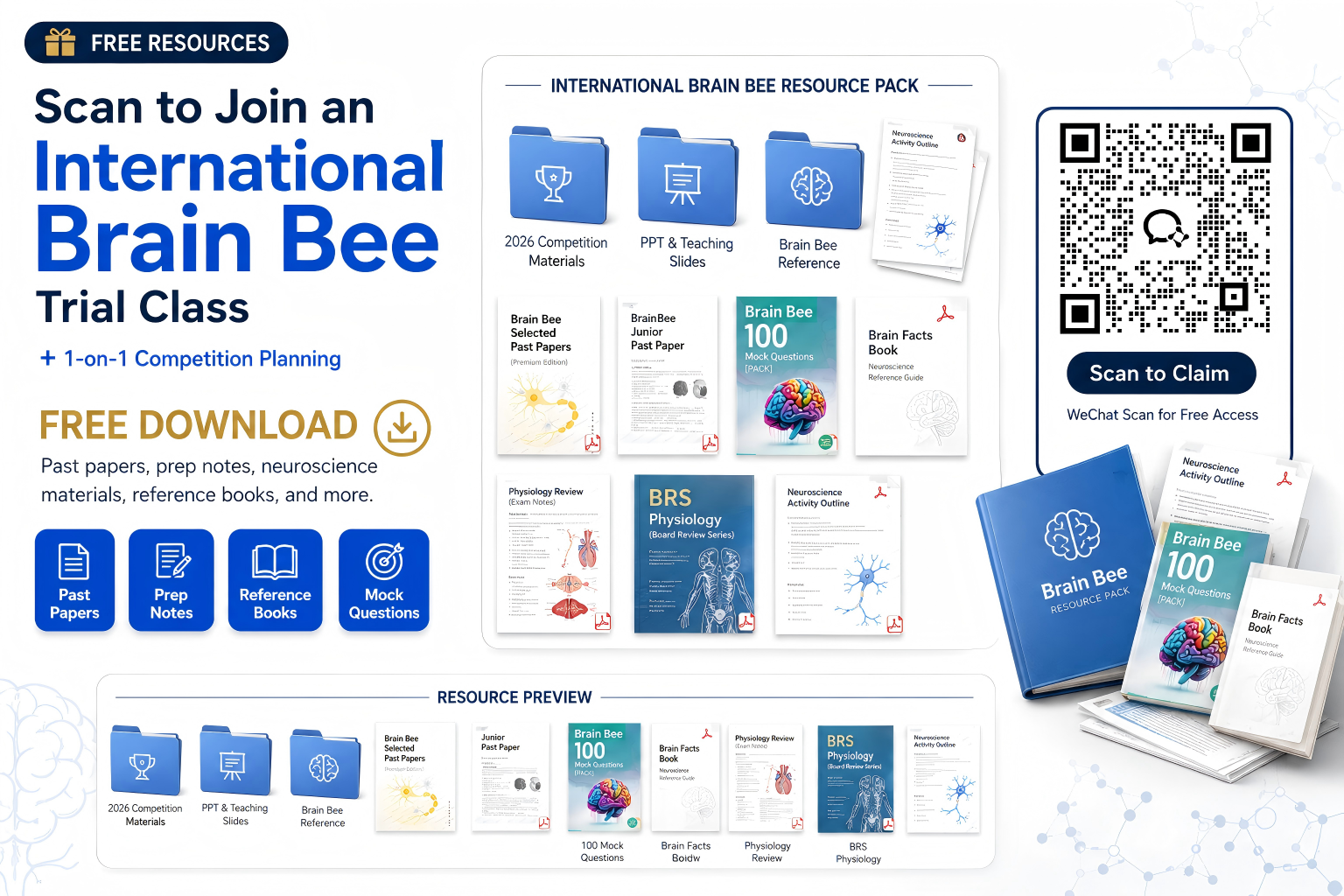
Get FREE Brain Bee Preparation Materials
Scan the QR code below to access free practice papers, study guides, and past competition materials. Start preparing today!