Heard that the Brain Bee Neuroscience Competition is highly prestigious, but can you participate without a biology background or prior competition experience? Absolutely! The Brain Bee is designed for students in grades 5–12. It is beginner-friendly, features bilingual questions, and is one of the most popular international competitions for getting started in neuroscience. This article will break down the registration process, exam content, and frequently asked questions to help you fully understand this rising star in academic background enhancement.
Brain Bee Neuroscience Competition Overview
Originating in the United States, the Brain Bee Neuroscience Competition is a global extracurricular challenge for youth. Its mission is to encourage students to explore and study the human brain, inspiring future careers in related fields to improve human health and quality of life.
The competition is jointly organized by top-tier institutions including the American Psychological Association (APA), the Federation of European Neuroscience Societies (FENS), the Society for Neuroscience (SfN), the Dana Foundation, and the International Brain Research Organization (IBRO).
The Brain Bee entered China in 2013. Starting in 2017, a Junior division was added to accommodate students in grades 5–8.
Key Competition Details
- Suitable Students: Grades 5–12, particularly those planning to apply for undergraduate majors in biology, neuroscience, medicine, psychology, chemistry, computer science, or artificial intelligence.
- Divisions: Brain Bee Division (Grades 9–12) / Brain Bee Junior Division (Grades 5–8).
- Competition Structure: A three-tier progressive format: Regional, National, and International.
- Language: Questions are presented in Chinese. Answers may be submitted in either Chinese or English.
- Awards: Both the Regional and National rounds in China offer First, Second, and Third Prizes. The overall award rate is approximately 40% of participants.
Registration Guide
Registration typically opens in the autumn (late September to October). There are two registration methods:
- Base School Registration (Recommended): If your school is an official Brain Bee partner base school, you can register directly through your school advisor. The deadline is usually in mid-to-late January.
- Individual Registration: If your school is not a partner school, the organizing committee will open a brief individual registration window shortly before the regional round (typically late January to early February). You can register via the official website and will be assigned a testing center.
Official Website: http://www.chinabrainbee.com/
Note: Specific dates and registration notices for the new season are usually published on the official website and the competition's official social media channels. It is recommended to monitor these platforms in advance.
Exam Content & Syllabus
The China region of the Brain Bee focuses on the fundamentals of brain and neuroscience. The scope of knowledge for the regional and national rounds differs slightly.
Five Core Knowledge Modules
- Brain Fundamentals: Brain anatomy (frontal lobe, temporal lobe, hippocampus, amygdala, etc.), neuron structure, action potentials and synaptic transmission, neurotransmitters, brain development, and neuroplasticity.
- Brain Functions: Sensory systems (visual, auditory, olfactory, gustatory, and somatosensory pathways), learning and memory, language, motor control, sleep, emotion and motivation, and basic life functions (respiration and heart rate regulation).
- Brain Disorders: Neurodegenerative diseases (Alzheimer’s, Parkinson’s), psychiatric conditions (depression, anxiety, schizophrenia), developmental disorders (autism, ADHD), brain injuries, and addiction.
- Brain Research: Neuroimaging techniques (fMRI, EEG, PET, etc.), brain-computer interfaces, optogenetics, neural networks and AI principles, and neuroethics.
- Brain Enhancement: The positive impact of exercise, mindfulness meditation, and nutrition on brain health.
Preparation & Training Advice
To effectively prepare for the Brain Bee, structured training programs are highly recommended. Courses are typically categorized into long-term foundational tracks, intensive improvement classes, and final sprint sessions. These programs are designed around the latest competition trends and high-frequency testing points to provide customized, efficient study plans.
Curriculum & Instruction: Instructors typically hold master’s or doctoral degrees in STEM fields from prestigious universities. They possess in-depth research experience in neuroscience and extensive teaching backgrounds, ensuring high-quality academic guidance.
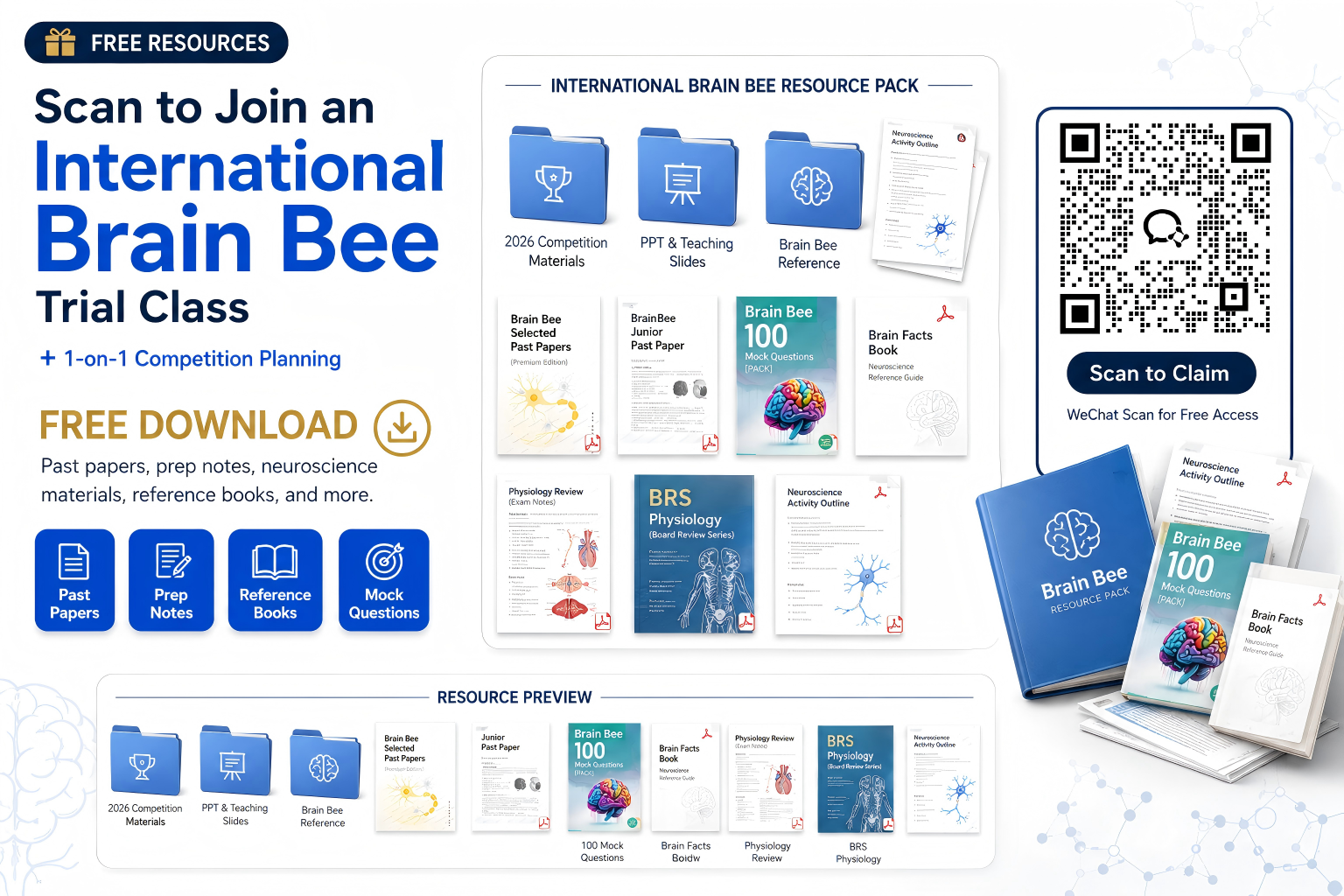
Get FREE Brain Bee Preparation Materials
Scan the QR code below to access free practice papers, study guides, and past competition materials. Start preparing today!