
The 2026 Brain Bee Brain Science Competition, launching in March 2026, is a highly favored extracurricular challenge for students intending to pursue majors in biology, medicine, psychology, and related fields.
Preparing for this competition helps students solidify their academic foundation and sharpen their logical thinking. Furthermore, an outstanding competition result can add a significant highlight to college applications and enhance overall competitiveness.
Below, we provide a comprehensive guide to understanding what Brain Bee is, what the competition entails, and how to register.
What is Brain Bee?
The Brain Bee International Brain Science Competition is an extracurricular challenge for teenagers worldwide. It aims to encourage students to explore and study the human brain, inspiring future careers in fundamental brain research, the prevention and treatment of neurological and psychiatric disorders, and brain-inspired computing.
The competition is designed for students interested in biology, medicine, psychology, neuroscience, cognitive science, chemistry, computer science, artificial intelligence, and related disciplines. Currently, students from over 50 countries and regions participate globally.
The event is jointly organized by the American Psychological Association, the Federation of European Neuroscience Societies, the Society for Neuroscience, the International Brain Research Organization, and the Alzheimer's Association.
Source: Brain Bee Official Website
Brain Bee Competition Details
1. Eligibility
- Brain Bee: Students in Grades 9-12
- Brain Bee (Junior): Students in Grades 5-8
2. Schedule
- Regional Activity: March 21, 2026, 10:00 AM - 11:30 AM (Saturday)
- National Activity: April 18-19, 2026 (Saturday & Sunday)
- International Activity: August 2026
3. Competition Content
Centered on foundational knowledge related to the brain, the competition encourages inquiry-based learning. The tested content primarily covers brain structure, brain function, and brain diseases.
Knowledge Syllabus
Knowledge Syllabus
The Brain Bee competition syllabus covers key knowledge points related to brain structure, brain function, brain diseases, and more.
Source: Brain Bee Official Website
Recommended Reference Materials
➤ Core Material:
Brain Facts is highly recommended. Both the Brain Bee and Brain Bee Junior divisions should read the entire book. The Regional Activity primarily tests content from this publication.
➤ Supplementary Materials:
Introduction to Cognitive Neuroscience (edited by Shen Zheng, Fang Fang, Yang Jiongjiong, et al., Peking University Press, 2025 edition). Brain Bee participants are advised to read relevant chapters.
Other introductory neuroscience/brain science textbooks, such as Neuroscience: Exploring the Brain by Mark F. Bear, Barry W. Connors, and Michael A. Paradiso. Brain Bee participants are advised to read relevant chapters.
4. Competition Format
The competition follows a three-tier progression model:
Activity Format: Three-Tier Model
Regional Activity → National Activity → International Activity
I. Regional Activity
The Regional Activity uses a unified exam paper and is conducted simultaneously at designated testing centers.
- Brain Bee Division: 80 questions in total
- Brain Bee Junior Division: 60 questions in total
Exam Format: Closed-book (Multiple-choice + Fill-in-the-blank, 1 point per question)
All questions are presented in Chinese, with professional terminology provided in both Chinese and English.
- Multiple-choice: Fill in the correct option letter.
- Fill-in-the-blank: Answers may be written in Chinese or English. Professional terms may be abbreviated in English.
II. National Activity
Brain Bee Division
The competition consists of three segments: Written Exam, Image/Specimen Identification, and Case Diagnosis.
- Written Exam: Includes fill-in-the-blank and multiple-choice questions. 1 point per question, 50 questions total, worth 50 points.
- Image/Specimen Identification: Identify relevant brain structures from specimens or medical imaging (CT, MRI, etc.). 2 points per question, 13 questions total, worth 26 points.
- Case Diagnosis: Analyze and diagnose patient conditions based on provided case information. 3 points per major question, 8 questions total, worth 24 points.
All three segments are closed-book. Questions are in Chinese, with professional terminology provided in both Chinese and English. Non-multiple-choice questions may be answered in Chinese or English, and professional terms may use English abbreviations.
Brain Bee (Junior) Division
The competition consists of two segments: Written Exam and Scientific Poster Creation.
- Written Exam: Individual participation. Includes fill-in-the-blank and multiple-choice questions. 1 point per question, 40 questions total, worth 40 points. This segment is closed-book. Questions are in Chinese, with professional terminology in both languages. Fill-in-the-blank answers may be in Chinese or English, with English abbreviations allowed for technical terms.
- Scientific Poster: Team participation. This segment is worth 40 points. After the National Activity shortlist is announced, students may form teams (4-5 members per team) with peers from their own or other schools who have also advanced to the National level. Teams will create a poster and deliver a presentation on a designated theme within a specified time limit. Reference materials are permitted during creation. The poster score is applied to each team member's final total (e.g., if the team scores 35, each member receives 35 points for this segment). Posters and presentations may be conducted in Chinese or English.
III. International Activity
Each country or region may send one student to represent them at the International Activity.
The highest-scoring First Prize winner from the National Activity Brain Bee Division (Grades 9-12) will earn the qualification to represent China at the 2026 Brain Bee International Activity. Participating students will also be invited to attend the organizers' academic annual conference.
Registration Process
- Regional Activity: Registration is handled through designated base schools. Students attending a base school can register directly through their school and participate in the Regional Activity. The registration deadline is January 25, 2026.
- Individual Registration: If a student's school is not a designated base school, they can register through the individual student registration channel from January 26 to February 1, 2026. After registration closes, the organizing committee will arrange the testing venue.
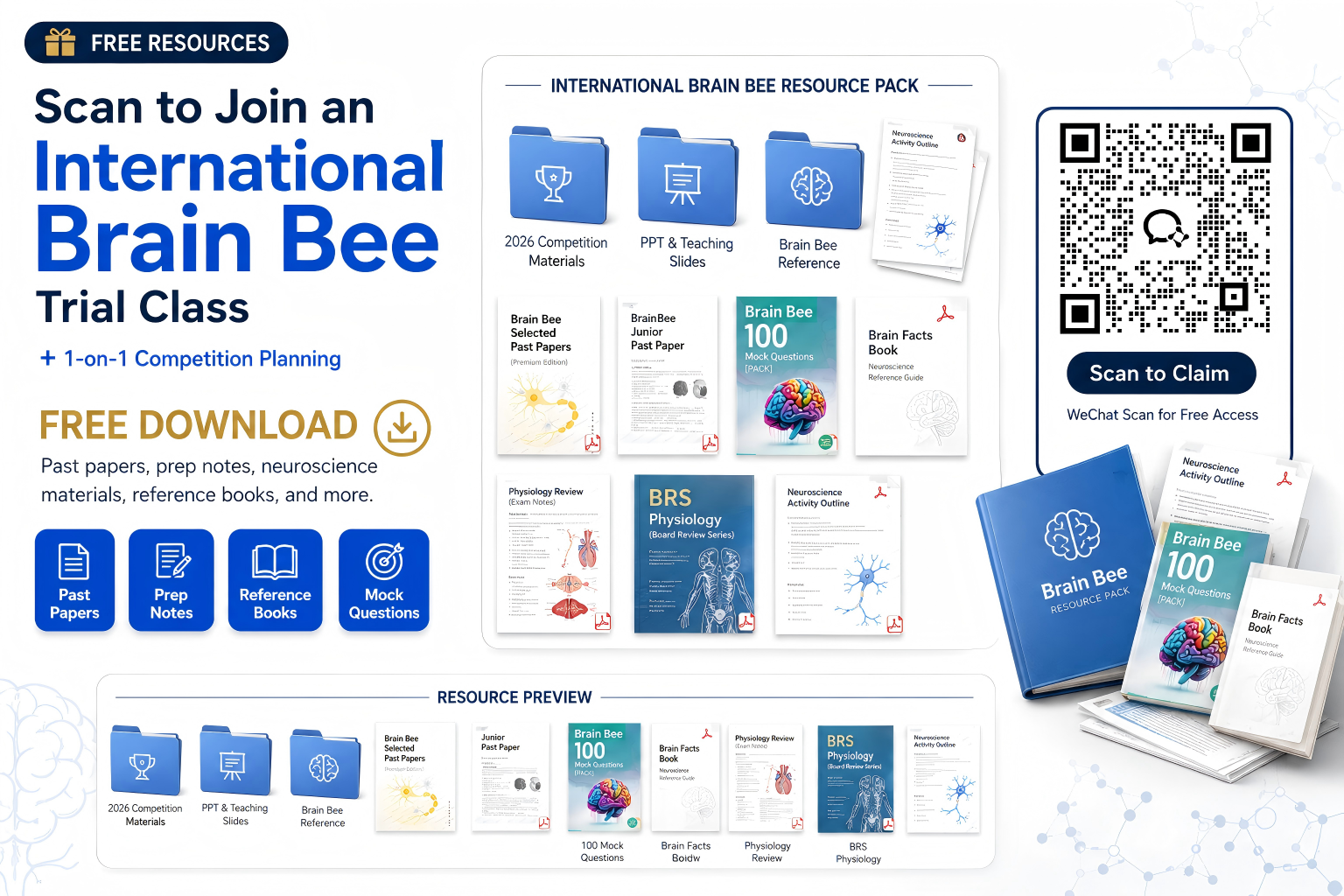
Get FREE Brain Bee Preparation Materials
Scan the QR code below to access free practice papers, study guides, and past competition materials. Start preparing today!