Open to all students in grades 5–12! The highly prestigious Brain Bee Neuroscience Competition is beginner-friendly and serves as an excellent tool for building academic profiles in biology, psychology, and medicine. Featuring a three-tier progression (Regional → National → International), this guide clearly outlines the exam dates, content, and divisions for the Brain Bee Regional and National competitions to keep your preparation on track.
01 Brain Bee Neuroscience Competition Introduction
Brain Bee is the only international neuroscience olympiad for youth worldwide, jointly hosted by six top-tier institutions including the American Psychological Association (APA), the Federation of European Neuroscience Societies (FENS), and the International Brain Research Organization (IBRO). Its academic value includes:
Overseas Study (Highly Recognized by Ivy League & G5 Universities)
- A premier competition dedicated to neuroscience, medicine, psychology, and cognitive AI, offering a specialized track that surpasses general biology competitions.
- Highly recognized by MIT, Harvard, Cambridge, and Johns Hopkins University. National awards significantly increase early decision interview acceptance rates.
Long-Term Academic Value
Seamlessly aligns with IB/AP Biology and Psychology curricula, building a complete academic portfolio for medical and neuroscience pathways.
Competition Schedule:
- Base School Registration: December 2026 – January 25, 2027
- Individual Registration: January 26 – February 1, 2027 (Non-base schools)
- Regional Competition: March 2027 (90 minutes, closed-book written exam)
- National Competition: April 2027 (For qualifiers)
- International Competition: August 2027 (Top scorers from the National First Prize represent China)
Division Selection:
Junior Division (Lower Grades): Grades 5–8. Difficulty: ★★☆☆☆. Focuses on brain structure, basic functions, the five senses, and simple disorders. Preparation using the foundational sections of Brain Facts is sufficient.
Brain Bee Division (Upper Grades): Grades 9–12. Difficulty: ★★★★☆. Approaches introductory undergraduate neuroscience. Covers neurotransmitters, neural circuits, mechanisms of brain diseases, imaging diagnostics, and cutting-edge research.
Competition Format:
Regional Competition
Format: Closed-book written exam, 90 minutes, bilingual.
Question Count & Scoring:
Brain Bee Division: 80 questions (Multiple Choice + Fill-in-the-blank), 80 points total.
Question Breakdown:
- Multiple Choice (~50–60 questions):
- Basic (~60%): Direct textbook recall, e.g., "What is the largest lobe of the brain?" "Where is cerebrospinal fluid produced?"
- Intermediate (~30%): Simple application/differentiation, e.g., "Which neurotransmitter below is associated with inhibition?"
- Advanced (~10%): Detail-oriented + cross-section integration, e.g., "Which of the following is NOT a role of the hippocampus in memory consolidation?"
- Fill-in-the-blank (~20–30 questions): Focuses on terminology, anatomical structures, and numerical values, e.g., "The synaptic cleft is approximately ____ nm wide." "The axon terminals of motor neurons release ____." Common pitfalls include spelling and precise terminology (e.g., "amygdala" must be spelled correctly).
Junior Division: 60 questions, 60 points total. Almost entirely basic recall questions with straightforward options. Fill-in-the-blanks typically require 1–2 keywords.
Advancement: Approximately the top 40% of students per province advance to the National Competition. For the Brain Bee Division, a score of ≥45 is typically required.
National Competition
1. Brain Bee Division (100 points total)
- Written Exam (50 points): 50 multiple-choice/fill-in questions, 60 minutes. Covers neurotransmitters, brain imaging, etc.
- Specimen/Imaging Identification (26 points): 13 sets of CT/MRI scans requiring brain region labeling (e.g., hippocampus).
- Case Diagnosis (24 points): 8 clinical cases requiring analysis of conditions like Parkinson's disease, epilepsy, etc.
2. Junior Division (80 points total)
- Written Exam (40 points): 40 foundational questions on brain lobe functions and basic anatomy.
- Science Poster (40 points): Teams of 4–5 students create and present a poster on-site. Scoring: Scientific Accuracy 60%, Visual Design 30%, Presentation 10%.
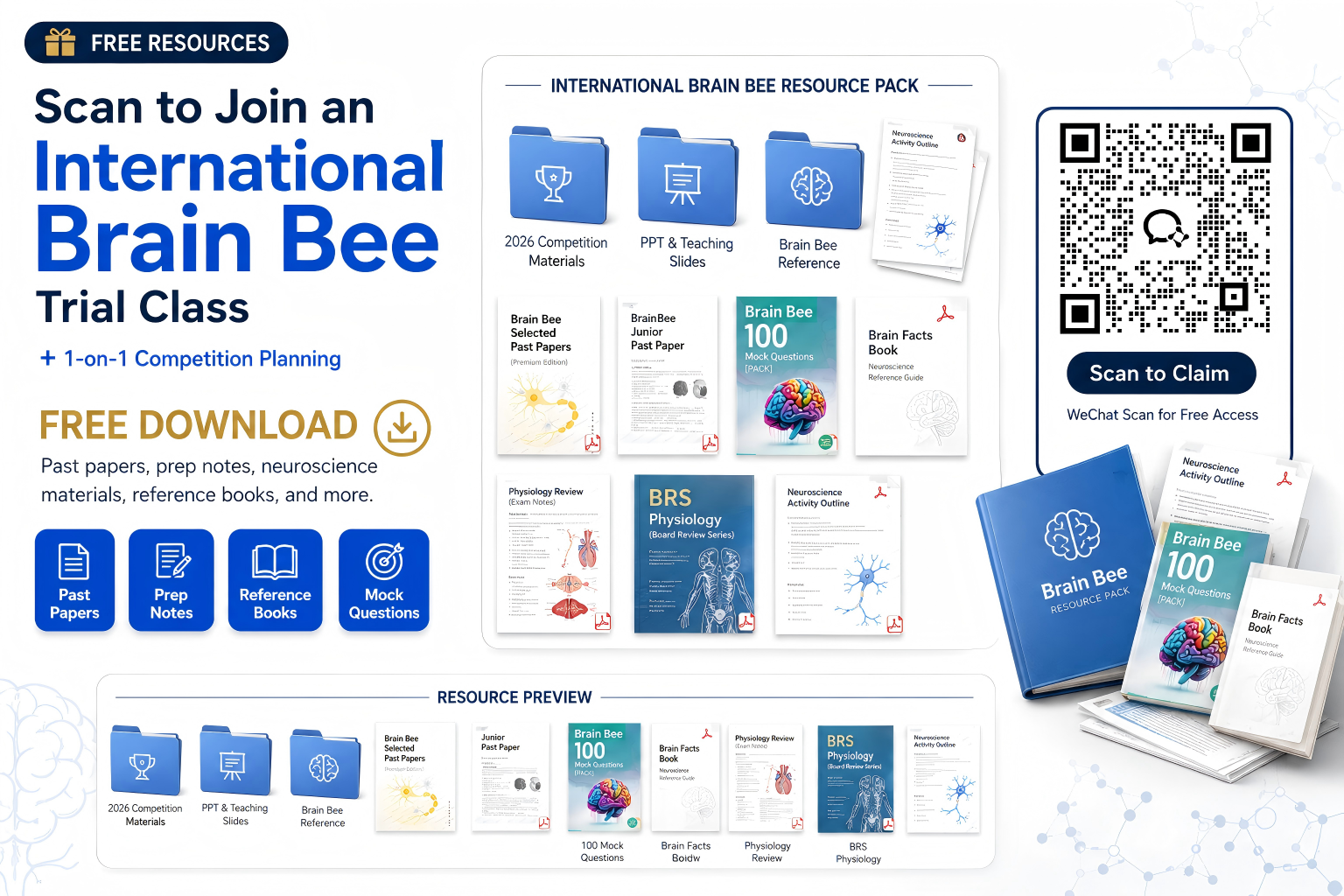
Get FREE Brain Bee Preparation Materials
Scan the QR code below to access free practice papers, study guides, and past competition materials. Start preparing today!