
The Brain Bee rewards a study group more than most science competitions do, for a structural reason: three of its four assessment formats need another human being. Someone has to hold the answer, run the clock and decide whether what you just said was right. A group of four to eight, meeting once a week for forty-five minutes, can cover the syllabus and rehearse every format in a single school term.
This is a playbook rather than a content guide. It sets out who does what, what to agree in the first meeting, a twelve-week block structure, a session template you can run without a teacher present, and an honest account of what a group cannot do for you. It is written for the student who has been asked to start a club and for the teacher who has been asked to supervise one.
Why this competition rewards a group more than most
The World Championship is assessed in four sections: neuroanatomy and neurohistology worked on real brains or on images; a written test; patient diagnosis built from video footage together with a written history; and live oral judging, in which two wrong answers end your run. Look at what each format needs from a practice partner.
- Live oral. You cannot rehearse this alone in any meaningful way. Somebody must ask the question, start the clock, listen to the answer and rule on it. Practising in your head skips the part that actually fails on the day, which is speaking a technical answer aloud in English under time pressure.
- Patient diagnosis. The reasoning only works if you do not already know the answer. In a group, one member prepares the case and holds the conclusion; everyone else reasons forward from the presentation without hindsight contaminating the process.
- Neuroanatomy and histology. Identification is a recognition skill built through repetition with immediate correction. A partner correcting you within two seconds beats checking a book two minutes later.
- Written test. This is the one round that genuinely suits solo work, which is why it should occupy less of your shared time than students instinctively give it.
There is a second, less obvious benefit. Explaining a mechanism to a peer exposes gaps that rereading conceals, because the listener asks the question your own notes never asked. That is why the session template below puts a teach-back at the centre rather than a lecture. If your group is still assembling the basic map of tiers and formats, our guide to what the Brain Bee is is a reasonable common text for the first meeting.
Roles and rules: what to settle in week zero
In our experience most school study groups fail for organisational reasons, not academic ones. They fail because nobody owns the questions, so every session becomes an unstructured discussion, and attendance decays. Assign four rotating roles in the first meeting and the problem largely disappears.
| Role | What the person actually does | Time it costs outside the session | Why the group breaks without it |
|---|---|---|---|
| Convenor | Books the room, sends the reminder, starts on time, ends on time | Ten minutes a week | Sessions drift later and shorter until they stop happening |
| Question-setter (rotates weekly) | Prepares fifteen questions on last week’s material plus one case for the diagnosis drill | Forty minutes a week | Without prepared questions the session becomes conversation, which feels productive and is not |
| Judge and timekeeper (rotates) | Runs the oral drill strictly: asks, times, rules right or wrong, applies two strikes | None; done live | A soft judge teaches the group that a vague answer passes. It does not pass at the real thing |
| Glossary keeper | Maintains one shared English term list; adds every term nobody could pronounce or define | Fifteen minutes a week | English technical vocabulary is a separate skill from content and is otherwise never practised deliberately |
Four rules are worth agreeing in the same meeting, in writing, because each of them prevents a specific failure mode we see repeatedly:
- One anchor text. The syllabus books are Brain Facts, published by the Society for Neuroscience and available at brainfacts.org, or Neuroscience: The Science of the Brain. A group that reads different sources ends up arguing about wording instead of learning content.
- No borrowed question banks. Do not prepare from another competition’s papers. Biology-olympiad and psychology-olympiad materials have different scope, different depth and different answer conventions, and importing their numbers into a Brain Bee answer imports errors.
- Registration is not the group’s job to interpret. Entry for the China region runs through the official chapter at chinabrainbee.com. The group prepares; it does not advise anybody on eligibility. Confirm rules on the official site.
- Unanswered questions get written down. Every session ends with a list of what nobody could answer. That list, not the syllabus contents page, sets the next session’s reading.
A twelve-week block plan
Twelve weekly sessions is roughly one school term and is enough, provided the blocks change character as they go. The mistake we see most often is running twelve identical content sessions and then meeting the formats for the first time on competition day.
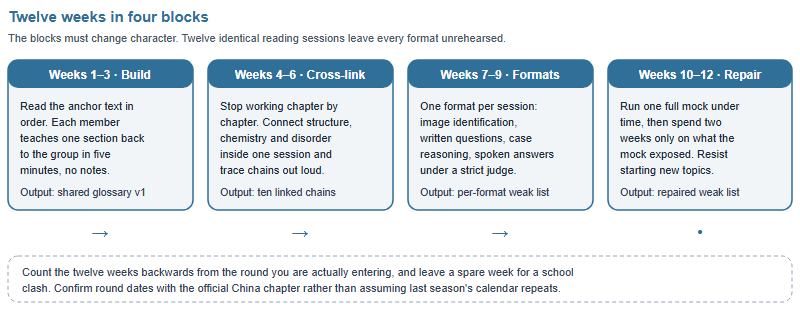
The single most valuable design feature here is that each block hands something concrete to the next. The build block produces a glossary; the cross-link block produces chains; the format block produces a list of which format each member is weakest in; the repair block works only on that list. Groups without those handovers tend to re-cover comfortable material, because comfortable material is more pleasant to revise in company.
The forty-five minute session template
Forty-five minutes is realistic for a lunchtime or an after-school slot, and it is long enough if the shape is fixed. Fix it once and the group stops spending the first ten minutes deciding what to do.
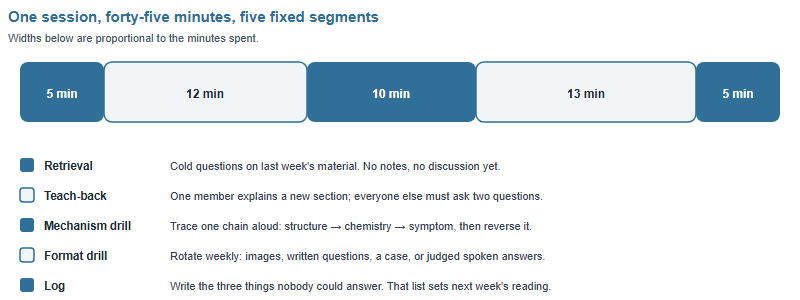
Two segments deserve defending, because they are the ones a tired group cuts first. The opening five minutes of cold retrieval feel unproductive: nobody has read anything since last week and the answers are poor. That discomfort is the point. Retrieval practice under mild difficulty is one of the most reliably effective study techniques there is, and it is also, conveniently, a direct rehearsal of being asked something aloud with no warning. The closing five-minute log is what converts a pleasant session into a syllabus: without it, the group reads whatever the next chapter happens to be rather than whatever it cannot do.
For the format drill, rotate deliberately rather than by preference. Groups gravitate towards written questions because they are the easiest to prepare and the least socially exposing. That is precisely backwards: written work is the one format that survives being done alone at home.
What a group cannot do for you
Being honest about the limits keeps a group healthy, and there are four worth stating in the first meeting.
The assessment is individual. You revise together and you are assessed alone. This matters most in the live oral round, where the two-strikes structure means the group habit of finishing each other’s sentences becomes an active handicap. Judge strictly in practice for exactly this reason.
Only one representative goes to the World Championship. Each national chapter sends exactly one person. A group with several strong members should decide early how it will handle that arithmetic, because the alternative is discovering it under pressure. In practice the healthiest framing we have seen is that the group is preparing everyone for their own best result at whichever tier they reach, not producing one champion with a support crew.
Divisions differ, so drills should split. In China the competition runs as Brain Bee Junior for grades 5 to 8 and Standard Brain Bee for grades 9 to 12, a divisional structure specific to the China region. A mixed-age group can share content sessions productively, but format drills should split by division. Note also that Hong Kong, Taiwan and Macao operate as separate chapters, so students there follow their own chapter’s arrangements.
The group is not the registrar. Entry, eligibility questions and dates go to the official chapter at chinabrainbee.com. Neither a school club nor a coaching provider, including us, can vary those rules.
On what group preparation actually produces: across the 2026 China national round, per our own records and de-identified, students we coached took 7 first prizes — including 2nd and 8th in the Junior division and 11th and 13th in Senior — alongside 11 second prizes and 10 third prizes, with 31 students advancing from the regional stage. Results vary by cohort and by student, and those figures describe outcomes rather than promise them. The pattern we would draw a coach’s attention to is narrower and more useful: from working with these cohorts, the students who improved most between regional and national stage were rarely the ones who read most, and usually the ones who had been made to answer out loud, on the clock, in front of someone willing to say no.
A last note for students weighing whether a term of lunchtimes is worth it. A competition result is one item in an application, and an admissions reader treats it the way any careful reader treats a claim — by checking it against everything else in the file. A neuroscience result reads as credible when the transcript shows the sciences going well, when the activity list shows the interest predates the competition, and when the essays can describe what the student actually did. Several consistent signals corroborate each other; a single isolated award has less to work with. That is the honest case for a study group: it produces the sustained, documented, year-long activity that makes the rest of the file believable. It is not a guarantee of anything, and nobody should sell it as one. Our article on what a result signals covers that ground in more depth, and the competition overview sets out the tiers a group is preparing for.
Frequently asked questions
How many people make a workable study group?
Four to eight. Enough for teach-backs and mock judging, small enough that everybody speaks inside a forty-five minute session.
Should Junior and Senior students train together?
Share content sessions, split format drills. China runs Brain Bee Junior for grades 5 to 8 and Standard Brain Bee for grades 9 to 12.
Who handles registration for a school group?
Registration runs through the official China chapter at chinabrainbee.com, not through a school club, a coaching provider or this site.
Can a group really prepare for the oral round?
Yes, and it is the round groups help most: somebody must ask, time and judge while you answer aloud, alone.
This is an independent guide operated by Hanlin Education for China-based international-school students. It is not affiliated with, endorsed by, or sponsored by the International Brain Bee (IBB), and it is not the official Brain Bee China national round; registration for the China region runs through the official chapter at chinabrainbee.com. Confirm current rules, formats and dates on thebrainbee.org. Errors reported to the editorial desk are corrected within 7 working days.