
Memory, plasticity and development are the Brain Bee topics where list-learning fails hardest. Every other cluster can be partly survived by recall; this one is built out of chains, where each step causes the next. The good news is that there are only about four chains worth mastering, and once you can run each of them backwards as well as forwards, the questions stop being unpredictable.
There is a second reason to take this cluster seriously. It is the part of the syllabus that describes the brain you are revising with. Pruning, myelination, consolidation and the spacing of practice are not abstract exam content — they are the machinery behind whether your revision works at all. Students who study this section properly tend to change how they study everything else, which is an unusual return on a few hours of reading.
Why this cluster behaves differently from the rest of the syllabus
Most of the syllabus is organised by object. A structure has a location, a name and a function. A transmitter has a source, a receptor and a role. You can hold those as facts and retrieve them one at a time. Memory and plasticity are organised by process instead: a sequence of events in which removing any middle step makes the rest incoherent.
That structure has direct consequences for how the material is assessed. Across the four World Championship sections — neuroanatomy and neurohistology on real brains or images, a written test, patient diagnosis from video footage with a written history, and live oral judging where two wrong answers end your run — a chain topic tends to be entered from the middle. You are given a consequence and asked for the cause, or given a lesion and asked what is preserved. If your revision only ever ran the chain in one direction, the middle entry point is where you stall.
A short worked contrast makes the point. Asked “what does the hippocampus do?”, a list-learner answers “memory” and stops. Asked “a patient can no longer form new memories of events but can still learn a new motor skill — what does that tell you?”, the same student has nothing to say, even though the second question uses the same fact. If you are still building the map of what the competition covers and how the rounds fit together, our guide to what the Brain Bee is is the place to start; this article assumes you already have that frame.
Memory is not one system
The first chain is a taxonomy. Memory divides into forms that rely on different structures, which is why brain damage can remove one kind while leaving another intact. This is the single most productive table in the cluster because it turns almost any amnesia question into a lookup.
| Type of memory | What it holds | Structures most associated with it | The question style it generates |
|---|---|---|---|
| Episodic (declarative) | Events you can consciously recall and describe | Hippocampus and surrounding medial temporal lobe | Cannot form new memories of events after an injury |
| Semantic (declarative) | Facts and general knowledge | Medial temporal structures for acquisition; widely distributed cortex for storage | Facts learned long before an injury survive it |
| Procedural (non-declarative) | Skills and habits performed without describing them | Basal ganglia and cerebellum | A patient improves at a skill while denying having practised it |
| Classical conditioning | Learned associations, including learned fear | Amygdala for fear conditioning; cerebellum for eyeblink conditioning | Emotional learning preserved when conscious recall is lost |
| Working memory | Information held and manipulated over seconds | Prefrontal cortex with parietal regions | Holding a sequence long enough to act on it |
The classic case behind the first and third rows is the patient known for decades as H.M., later identified as Henry Molaison, who underwent bilateral removal of medial temporal lobe tissue and was left with a severe inability to form new declarative memories. He could nonetheless improve at motor tasks such as mirror drawing across sessions while reporting no memory of having done them before. That single dissociation established that declarative and procedural memory are separable systems, and it is worth being able to state it in two sentences.
Two clarifications that regularly cost marks. First, the hippocampus is not a warehouse: it is involved in forming and organising declarative memories, while long-term storage is distributed across cortex. Second, “short-term memory” and “working memory” are not interchangeable in careful usage — working memory implies active manipulation, not just brief holding. Precision of that kind is exactly what an oral follow-up probes.
Long-term potentiation: the mechanism chain to learn cold
If one mechanism in this cluster is worth learning at full resolution, it is long-term potentiation, the lasting strengthening of a synapse after intense use. It ties the memory taxonomy above to the chemistry of the synapse below, and it is a favourite because every link in it is checkable.
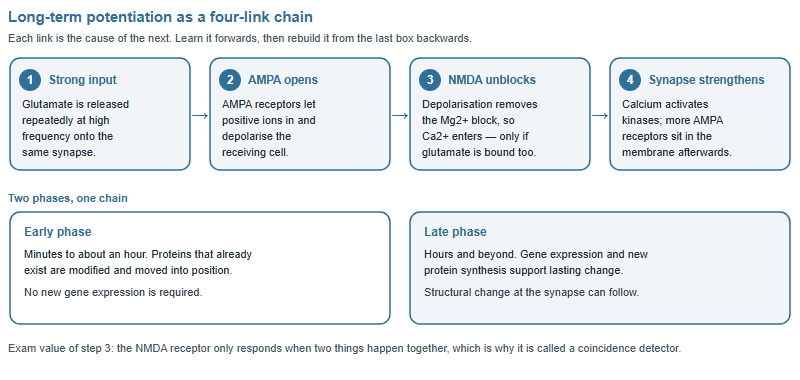
Step three is where the marks concentrate. The NMDA receptor requires two conditions at once: glutamate must be bound, and the receiving cell must already be depolarised enough to displace the magnesium ion sitting in the channel. Only then does calcium flow in. That double requirement is why the receptor is described as a coincidence detector, and it is the cellular version of the old summary that cells which fire together wire together. If an oral judge asks you why weak stimulation does not produce potentiation, the answer is contained entirely in that sentence.
Two accompanying points are worth holding. Synapses can also be weakened, not only strengthened — long-term depression is the counterpart process, and a syllabus answer that treats plasticity as a one-way ratchet is incomplete. And potentiation is a property of synapses, demonstrated most famously in the hippocampus; calling it “memory” is a shortcut. The careful formulation is that it is a leading cellular model of how memories may be stored, which is a different and more defensible claim.
Consolidation, sleep and the revision you are already doing
A memory that has just formed is not yet stable. Consolidation is the process by which it becomes more durable, and it operates at two scales. At the synapse, the late phase described above locks in changes over hours. At the systems level, memories that initially depend on the hippocampus become progressively more dependent on distributed cortical networks over much longer periods, which is why very old memories can survive damage that destroys the ability to make new ones.
Sleep is heavily implicated in this process. Evidence in animals shows patterns of activity recorded during learning being replayed during subsequent sleep, and studies in humans link sleep after learning to better retention than an equivalent period awake. State this as evidence rather than as certainty, and distinguish the well-supported general claim from the more specific and more contested claims about which sleep stage does what.
The practical corollary follows directly from the mechanisms above, which is unusual and useful:
- Spacing. The same total study time distributed across several days produces better long-term retention than the same time massed into one session. This is one of the most reliably reproduced findings in the study of learning.
- Retrieval. Testing yourself is not merely a measurement of learning; the act of retrieval itself improves later retention more than rereading does.
- Sleep after learning. Cutting sleep to add revision hours trades a process the syllabus describes as important against hours whose value is already declining.
Say that carefully in an answer and you have done something a memorised list cannot do: used the mechanism to predict behaviour. That is the move this whole cluster rewards.
The developing brain, including the one you are revising with
Development is the fourth chain, and it runs across a lifetime rather than a synapse. The sequence is broadly consistent: cells are generated, they migrate to position, they differentiate, axons find their targets, synapses form in excess, and then activity determines which connections are kept.
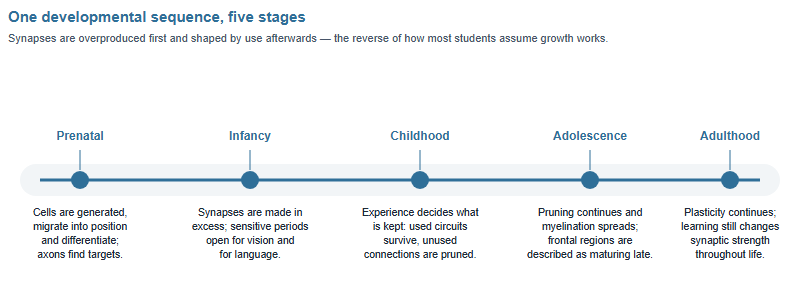
Two ideas from this timeline recur constantly. The first is the sensitive or critical period: a window during which normal input is required for a system to develop normally. The classic demonstration comes from work on the visual system, in which depriving one eye of patterned input early in life produced lasting changes in how cortical cells responded, while the same deprivation later had far less effect. Language acquisition is the human example most often cited alongside it. The second idea is that pruning is normal and necessary. Losing connections is not damage; it is how a general-purpose network becomes a specialised one.
The adolescent section deserves its own caution, because it is where popular writing runs ahead of the evidence. What is commonly described in the syllabus literature is that synaptic pruning and myelination continue into the twenties, and that frontal regions supporting planning and impulse control show a comparatively protracted developmental course relative to limbic regions involved in reward. That is a statement about developmental timing. It does not license sweeping claims that teenagers cannot reason, and an answer that says the careful version and flags the limit reads better than one that repeats the headline.
A related question is worth knowing how to handle: does the adult human brain make new neurons? Adult neurogenesis in the hippocampus is well established in several other species and remains genuinely debated in humans, with respected studies pointing in different directions. The strong answer is not to pick a side but to describe the disagreement and what would settle it. In our coaching experience, students who can say where the evidence stops handle these questions better.
A ten-day drill that suits this cluster, and which differs from how you would revise anatomy:
- Days 1–3. Write each of the four chains as arrows on a single line, from memory, then check against the syllabus book and repair the gaps rather than rewriting the whole thing.
- Days 4–6. Run every chain backwards. Given more AMPA receptors in the membrane, what happened three steps earlier? Given intact skill learning with lost event memory, which structures are spared?
- Days 7–8. Practise the hedged answers out loud: adult neurogenesis, sleep stages, the adolescent frontal cortex. Saying “the evidence supports X, and Y is contested” fluently in English is a skill in its own right.
- Days 9–10. Mixed retrieval with the rest of the syllabus, so that a plasticity question can arrive without warning between two anatomy questions — which is how it will arrive on the day. Our competition overview sets out the round structure if you want to model the sequencing realistically.
Round formats and dates vary by tier and by year, and the China region runs its own regional and national arrangements with registration through the official chapter at chinabrainbee.com. Confirm anything year-specific on the official site rather than from a study guide, including ours.
Frequently asked questions
Why is the NMDA receptor called a coincidence detector?
It opens only when glutamate is bound and the cell is already depolarised, so it signals that two events happened together.
Do humans grow new neurons as adults?
Adult neurogenesis in the human hippocampus is still debated. Describe what the evidence shows and note the disagreement rather than picking a side.
Is the adolescent brain material really examinable?
Development and plasticity are standard syllabus content. Check the current scope on the official site rather than assuming last season’s emphasis.
How should I revise a mechanism chain?
Write it as arrows, then rebuild it from memory backwards. If you can run the chain in reverse, you understand it.
This is an independent guide operated by Hanlin Education for China-based international-school students. It is not affiliated with, endorsed by, or sponsored by the International Brain Bee (IBB), and it is not the official Brain Bee China national round; registration for the China region runs through the official chapter at chinabrainbee.com. Confirm current rules, formats and dates on thebrainbee.org. Errors reported to the editorial desk are corrected within 7 working days.