If you had only ten study sessions before a Brain Bee round, three of them should go on the synapse. Neurotransmitter systems sit underneath nearly everything else the competition asks: structures, disorders, drugs and case histories all resolve into one chemical signal crossing one gap. Learn the six-step mechanism once, hang seven systems on it, and the same knowledge answers questions in four different formats.
Most students meet neurotransmitters as a vocabulary list — dopamine, serotonin, GABA — each with a one-word job attached. That list is worth a mark or two and no more. What earns marks consistently is the layer underneath the list: a sequence of events that is identical at every chemical synapse in the nervous system, with a small number of variables that change from one transmitter to the next. Once the sequence is automatic, a question about a toxin, a drug, a disease or a receptor all become the same question asked from different starting points.
Why the synapse earns more than any other single topic
The World Championship is assessed in four sections, and transmitter knowledge surfaces in all four. There is neuroanatomy and neurohistology, worked on real brains or on images. There is a written test. There is patient diagnosis, built from video footage together with a written history rather than a live actor playing a patient. And there is live oral judging, where two wrong answers end your run.
- Neuroanatomy and histology. Structures are frequently defined by what their cells release or receive. Naming the substantia nigra is one level of answer; saying what its neurons make and where they project is another.
- Written test. Receptor families, synthesis routes and clearance mechanisms are compact, unambiguous and easy to write clean questions about — exactly the profile of a written-test item.
- Patient diagnosis. A described deficit has to be pushed back to a mechanism. The chain runs symptom to structure to chemistry, and the chemistry is usually the last link you are asked to supply.
- Live oral. Follow-up questions in an oral setting tend to go one step deeper than the first answer. “Which transmitter?” is followed by “made from what?” or “cleared how?” — and the students who fall at the second question knew the list, not the sequence.
The Chinese rounds run their own formats at regional and national level, and each national chapter organises entry locally; registration for the China region runs through the official chapter at chinabrainbee.com. If you have not yet mapped how the tiers connect, start with our guide to what the Brain Bee is, then come back to content. Confirm any year-specific detail on the official site rather than on a study blog.
The seven systems worth knowing cold
Seven systems carry most of the load. Learn them as a grid rather than as a list — where the molecule comes from, how it talks to the next cell, what it does, and one hook that keeps reappearing.
| System | Where it comes from | Receptor style | Typical role | Hook that keeps returning |
|---|---|---|---|---|
| Glutamate | Widely distributed; the main excitatory transmitter of the brain | Ionotropic AMPA and NMDA, plus metabotropic mGluR | Fast excitation; the substrate of synaptic change | NMDA receptors need glutamate and an already-depolarised cell |
| GABA | Interneurons throughout the brain; the main inhibitory transmitter | Ionotropic GABA-A (a chloride channel); metabotropic GABA-B | Damping, timing, keeping excitation in check | Benzodiazepines and many sedatives act at GABA-A |
| Acetylcholine | Neuromuscular junction, autonomic nervous system, basal forebrain projections | Nicotinic (ionotropic) and muscarinic (metabotropic) | Muscle contraction, arousal, attention | Broken down in the cleft by acetylcholinesterase instead of being recovered intact |
| Dopamine | Substantia nigra and ventral tegmental area | All metabotropic (D1-like and D2-like families) | Movement, motivation, reward learning | Loss of the nigrostriatal projection in Parkinson disease |
| Serotonin | Raphe nuclei of the brainstem | Mostly metabotropic; 5-HT3 is the ionotropic exception | Mood, sleep, appetite, gut signalling | SSRIs block the serotonin transporter, so the molecule lingers in the cleft |
| Norepinephrine | Locus coeruleus | Metabotropic adrenergic receptors | Arousal, vigilance, the stress response | Shares a synthesis pathway with dopamine, so the two are often asked together |
| Opioid peptides | Made in the cell body and transported to the terminal | Metabotropic opioid receptors | Pain modulation | Peptides are not made locally at the terminal, unlike the small molecules above |
Three more are worth a line each. Glycine is a second inhibitory transmitter, prominent in the spinal cord and brainstem. Adenosine is a modulator that accumulates with wakefulness — caffeine works by blocking its receptors, which is why the connection between coffee and alertness is a receptor story rather than a stimulant one. Nitric oxide breaks the pattern entirely: a gas, not stored in vesicles, able to travel backwards from the receiving cell to the sending one. The exception is worth knowing because it tests whether you learned a rule or a mechanism.
One mechanism, six steps, six places something can interfere
Here is the sequence that does not change. Learn it as six numbered steps, then attach one classic interference point to each. The interference points are what turn a memorised list into something you can reason with, because almost every pharmacology question in this syllabus is really the question “which step is this acting on?”
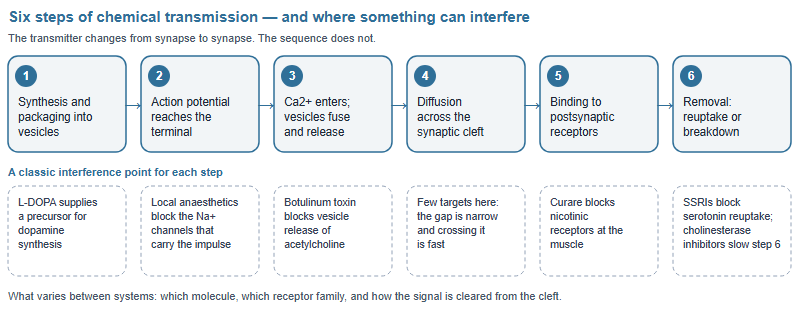
Step six deserves particular attention because it is where the systems genuinely differ, and because, from coaching these cohorts, it is the step we see students skip most often. Acetylcholine is destroyed in the cleft by acetylcholinesterase, with choline recovered afterwards for reuse. Glutamate is largely taken up by transporters on neighbouring glial cells, which is one of the cleanest examples of glia doing something other than support. The monoamines — dopamine, serotonin, norepinephrine — are mostly recovered intact by dedicated transporters and then broken down inside the terminal. If you can say which of those three routes applies to a given transmitter, you have already answered a whole family of questions about how drugs at that synapse work.
Ionotropic or metabotropic: the distinction that upgrades an answer
Almost every receptor you will meet belongs to one of two designs, and the difference explains timing, duration and why the same transmitter can do opposite-looking things in different places. This one distinction upgrades a thin answer into a complete one more reliably than any extra vocabulary.
| Ionotropic | Metabotropic | |
|---|---|---|
| What the receptor is | The receptor is the ion channel | The receptor is coupled to a G protein; the channel, if any, is elsewhere |
| Speed | Milliseconds | Slower to start, and it outlasts the signal |
| What follows binding | The channel opens; ions move | A second-messenger cascade, which can amplify and reach the nucleus |
| Typical description | Fast, brief, point-to-point transmission | Slow, lasting, modulatory transmission |
| Worked examples | Nicotinic acetylcholine; AMPA and NMDA for glutamate; GABA-A; 5-HT3 | Muscarinic acetylcholine; mGluR; GABA-B; all dopamine receptors; most serotonin receptors |
That last row is the point of the table. Students commonly answer “GABA is inhibitory” or “acetylcholine excites muscle” as though the molecule carried the instruction. It does not. The molecule is a key; the receptor is the lock and the lock decides what happens. When a question seems to contradict what you memorised — the same transmitter producing a different result in a different tissue — the receptor family is nearly always the resolution.
One anchor fact, four question formats
Take a single fact and watch it change shape. The dopamine neurons of the substantia nigra project to the striatum, and their loss underlies the motor features of Parkinson disease: slowness of movement, resting tremor, rigidity and postural instability. That one sentence generates a question in every section.
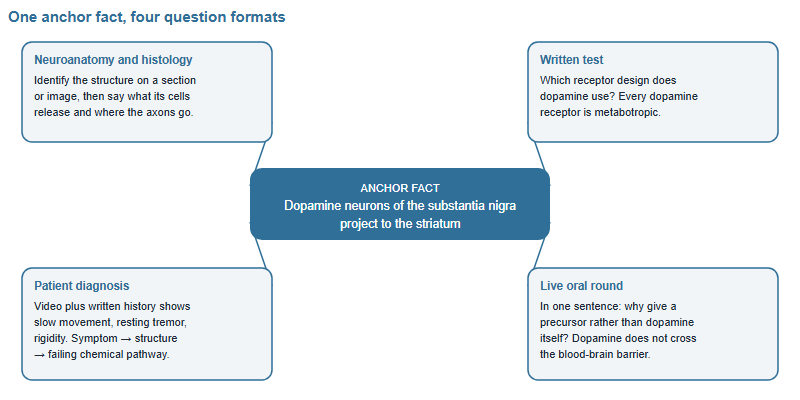
Notice what changes between the four boxes: not the knowledge, only the direction of travel. The anatomy question starts from a picture, the written question starts from a category, the diagnosis question starts from a behaviour, and the oral question starts from a treatment. Students who revise in one direction only — almost always structure to function — get caught by the other three. From coaching these cohorts, the single most common failure we see on this topic is not a gap in knowledge but a gap in direction: the student who can say what the substantia nigra does cannot start from a tremor and get back to it.
A three-week protocol that fits around a full IB or A-level timetable:
- Week 1, build. Twenty minutes a day rebuilding the seven-system grid from your own reading of the syllabus book, in your own words. Copying a table you found, including ours, teaches almost nothing; producing one teaches the material.
- Week 2, reverse. Drill backwards. From a toxin to the step it blocks. From a deficit to the transmitter. From a receptor family to the expected speed of the response. Twenty prompts, no notes, marked honestly.
- Week 3, speak. Sixty-second spoken explanations, out loud, in English. The oral round is a speaking test as much as a knowledge test, and English fluency in technical vocabulary is a separate skill from recognition. Explaining the six steps aloud without notes is a good benchmark for readiness.
Practice material is thinner for this competition than for the big biology olympiads, which is why the sequence above leans on self-generated questions rather than on question banks. We maintain our own gathered practice set built up over successive cohorts; worked solutions exist for some years and not for others, and we would rather say that plainly than imply a complete archive. For how the practice fits into the wider season, see our overview of the competition and its rounds.
Frequently asked questions
Do I need to memorise every neurotransmitter?
No. Seven systems plus the shared release-and-removal mechanism cover most questions; add rarer molecules only as your reading raises them.
Which book should I use for this topic?
The syllabus texts are Brain Facts, published by the Society for Neuroscience at brainfacts.org, or Neuroscience: The Science of the Brain.
Are drug names really tested?
Treat a drug as a label for one step of the synapse rather than as pharmacology. Confirm the scope of any round on the official site.
Is the mechanism the same for every transmitter?
The six steps are shared. What changes is the molecule, the receptor family, and how the signal is cleared from the cleft.
This is an independent guide operated by Hanlin Education for China-based international-school students. It is not affiliated with, endorsed by, or sponsored by the International Brain Bee (IBB), and it is not the official Brain Bee China national round; registration for the China region runs through the official chapter at chinabrainbee.com. Confirm current rules, formats and dates on thebrainbee.org. Errors reported to the editorial desk are corrected within 7 working days.