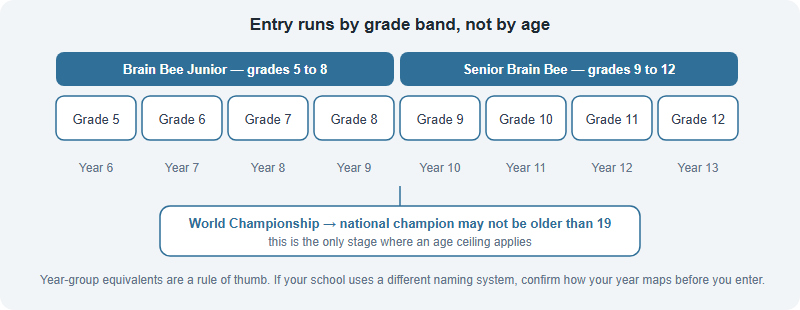
Brain Bee entry is organised by grade, not by age. In practice the competition runs for grades 5 to 12 — roughly ages 10 to 18 — and the China region splits that into two divisions: Brain Bee Junior for grades 5 to 8 and Senior Brain Bee for grades 9 to 12. The one firm age rule, that a national champion may not be older than 19, applies at the World Championship and nowhere else.
Eligibility is the single most-asked question about the Brain Bee and the one most often answered from a half-remembered figure. You will see age ranges quoted in general descriptions of the competition, and families reasonably assume that a stated range is the entry rule. It usually is not. The competition runs across many national chapters, each of which sets how entry works locally, so a general international description and a specific chapter's rules are two different documents.
For students in the China region the operative frame is the grade band. That is what determines which paper you sit, which division you are ranked in, and what the national round asks of you. Working from an age figure instead produces two classic mistakes: a capable grade 5 or 6 student assumes they are too young to enter at all, and a grade 12 student assumes an age rule they have heard about will stop them.
The two China divisions, and what each one actually sits
The division you fall into is not just an administrative label. It changes the paper, the national assessment and even whether part of your result depends on other people. The table below sets out the structure described in the operator briefing we work from for the China region.
| Brain Bee Junior | Senior Brain Bee | |
|---|---|---|
| Grades | 5 to 8 | 9 to 12 |
| Typical ages | about 10 to 14 | about 14 to 18 |
| Regional round | Written paper, 60 questions | Written paper, 80 questions |
| National round | 40-question, 40-mark individual paper, plus a team science poster worth 40 marks; teams of four to five formed after qualifying, topic issued on the day, presented live, credited to every member | Individual throughout, 100 marks: a 50-question written paper (50 marks); 13 image or specimen identification items (26 marks) covering brain structures and CT or MRI; 8 case-diagnosis items from case video (24 marks) |
| Route to the World Championship | Not the route — the chapter place comes from the Senior division | The chapter's representative is the highest-scoring Senior first-prize winner |
| Status of this structure | China-region arrangement, not an International Brain Bee structure. Confirm each season with the organiser. | |
Two implications are worth drawing out. First, a Junior student cannot simply borrow a Senior revision plan, because half the Junior national marks come from a collaborative task rather than an individual paper. Second, a student who spends their whole eligibility window in the Junior division will never be in line for the chapter place at the World Championship — that is decided in the Senior division. Neither of those is a reason to rush upward, but both are reasons to know which band you are in before you plan a multi-year run.
The number 19, and where it actually applies
The clearest firm age rule in the competition is at the top: a national champion competing at the International Brain Bee World Championship may not be older than 19. The World Championship is the one stage run by the International Brain Bee itself, gathering one representative from each national chapter.
What it is not is an entry requirement for a regional or national round. If you are a grade 11 student wondering whether an age limit will end your season, the honest answer is that the ceiling only becomes relevant in the scenario where you win your national round and go forward as the chapter's representative — and by then the organiser will be the one confirming your eligibility, not a page like this one.
The World Championship itself is held in November, alongside the Society for Neuroscience annual meeting. Its four sections are neuroanatomy and neurohistology worked on real brains or images, a written test, patient diagnosis from video footage together with a written medical history, and a live oral round judged in person. Our overview of the Brain Bee and its three tiers explains how those sections relate to the earlier rounds.
Which chapter you belong to
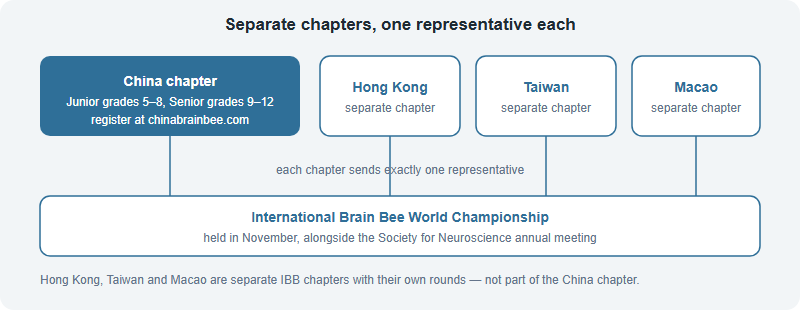
This is the eligibility question families get wrong most often, and it has nothing to do with age or grade. The Brain Bee runs through national chapters, and each chapter sends exactly one representative to the World Championship. Hong Kong, Taiwan and Macao operate as separate IBB chapters. They are not part of the China chapter, they run their own rounds, and they send their own representatives.
For students at international schools that has a practical consequence: your entry route follows the round your school or your family registers with, and you should not assume that a schedule, a syllabus emphasis or a division split you read about for one chapter applies to another. The official China national round is run by the National Brain Bee Organizing Committee, and chinabrainbee.com is where registration and the authoritative calendar live. The Brain Bee has run in China since 2013, with university partners including Tsinghua, the University of Hong Kong, Zhejiang, Fudan and the Chinese Academy of Sciences.
Eligible is not the same as ready
A grade 5 student is eligible for the Junior division. Whether entering at grade 5 is a good idea is a separate question, and the honest answer is: it depends on reading stamina more than on age. The syllabus is Brain Facts, published by the Society for Neuroscience and available at brainfacts.org, or Neuroscience: The Science of the Brain. Both are written for a general reader rather than for a specialist, but both are long, and both use terminology that has to be learned rather than guessed.
From our own cohorts, the students who cope well at the youngest end of the band tend to share one trait, and it is not prior biology knowledge — it is the willingness to reread a page they did not understand the first time. That is a teaching observation rather than a rule, and it is offered as a way of judging readiness, not as a filter.
There is also a structural argument for entering earlier rather than later. Eligibility runs across eight grades, which means a student who starts in Junior can spend several seasons building recognition and vocabulary before the Senior components — identification, imaging and case reasoning — start to matter. Starting at grade 11 is entirely allowed and gives you two seasons at most.
What to confirm before you register
Everything above describes structure rather than this season's arrangements. Divisions, grade bands, question counts and calendars can be revised, and we do not run any round, so the following should be checked against current official material rather than taken from here:
- Your division for this season. Confirm the grade bands in force, and how your school year maps onto them if your school does not use grade numbering.
- Who registers you. Whether entry is made by a school, by a coordinator or individually is set by the organiser, and this guide does not handle registration for anyone.
- Your chapter. Confirm which chapter's round you are entering — particularly relevant for families moving between Hong Kong, Macao, Taiwan and the mainland.
- Dates, fees and any documentation. We do not publish year-specific dates or fees. Those come from the organiser.
Once eligibility is settled, the useful work begins: the syllabus, structure recognition and the components that decide the national round. Our guide to what the Brain Bee is, how its rounds work and what it assesses is the place to start.
Common eligibility questions
What grades can enter the Brain Bee?
In practice it runs for grades 5 to 12, roughly ages 10 to 18, split into divisions by grade. Confirm your chapter rules officially.
Does the age limit of 19 apply to me?
Only at the World Championship, where a national champion may not be older than 19. It is not the entry rule for regional rounds.
Which division am I in for the China region?
China runs Brain Bee Junior for grades 5 to 8 and Senior for grades 9 to 12. That split is China-specific, not an IBB structure.
Is Hong Kong part of the China chapter?
No. Hong Kong, Taiwan and Macao are separate IBB chapters with their own rounds and their own representative to the World Championship.
This is an independent English-language guide to the Brain Bee, operated by Hanlin Education for China-based international-school students. It is not affiliated with, endorsed by, or sponsored by the International Brain Bee (IBB), and it is not the official Brain Bee China national round, which is run by the National Brain Bee Organizing Committee at chinabrainbee.com. Division structures and assessment details for the China region come from an operator briefing and can change between seasons; year-group equivalents are a rule of thumb, not an official mapping. Confirm current details on thebrainbee.org. Errors are corrected within 7 working days of notification.