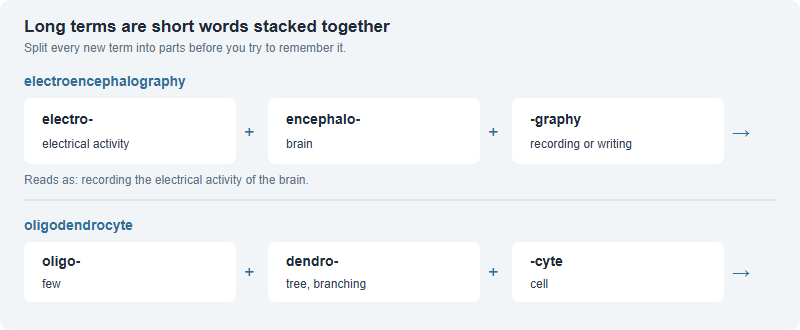
For students working in a second language, the hardest part of the Brain Bee is rarely the neuroscience. It is the English. A term like oligodendrocyte looks like eighteen letters to memorise — but it is three ordinary word parts meaning "few", "tree" and "cell". Learn the recurring parts and much of the syllabus becomes readable rather than memorisable. That shift is worth more than any number of flashcards.
Why terminology is the bottleneck, not the biology
Look at where vocabulary actually costs you marks. At the China regional stage, the official chapter describes written papers containing fill-in-the-blank items as well as multiple choice — and a blank gives you no candidate words to recognise, so you must produce the English term and spell it well enough to be marked. At the national stage, senior students face image and specimen identification, where the answer is very often just a name. At the World Championship, live oral judging means hearing a term spoken and answering under time pressure. Every one of those is a language task wearing a neuroscience costume.
Students consistently underestimate this. They understand perfectly well what a myelin sheath does, having learned it once in Chinese or in a school biology class, and then lose the mark because they could not produce the word myelination on a blank line. If you want the map of which round contains which task, our overview of the Brain Bee structure sets it out; this article is about the layer underneath all of them.
Decode, do not memorise: the word-part system
Neuroscience terminology is overwhelmingly built from Greek and Latin components, and it is built systematically. Once you know that -plegia means paralysis and hemi- means half, you do not need to learn hemiplegia as a new word; you can also read paraplegia and quadriplegia without ever having met them. This compounding is why a modest number of parts unlocks a disproportionate amount of the syllabus.
The practical method is to dissect rather than drill. Whenever you meet a long term, split it on paper into prefix, root and suffix, write the meaning of each part, and only then write the whole meaning. Do this for twenty terms and you will start recognising the parts in words you have never seen — which is exactly the skill a fill-in-the-blank item or an unfamiliar specimen label demands.
The word parts worth learning first
Not all parts are equally profitable. The table below is a starter set chosen for how often the components recur in introductory neuroscience material, rather than for how impressive the words look. Learn these before you learn any individual structure names.
| Part | Meaning | Turns up in | Why it pays |
|---|---|---|---|
| neuro- | nerve | neuron, neurotransmitter, neurogenesis, neuroglia | The single most productive root on the syllabus |
| encephal- | brain | encephalography, telencephalon, diencephalon, encephalitis | Unlocks the developmental division names |
| -cyte / cyto- | cell | astrocyte, oligodendrocyte, cytoskeleton | Tells you immediately that a term names a cell |
| glia / glio- | glue | glial cells, microglia, neuroglia | Separates support cells from neurons at a glance |
| dendr- | tree, branching | dendrite, oligodendrocyte, dendritic spine | Explains the shape, so the function is easier to hold |
| syn- / synapt- | together, joining | synapse, synaptic cleft, synaptogenesis | Core to every signalling question |
| af- / ef- | toward / away from | afferent, efferent | The most commonly confused pair in the whole syllabus |
| ipsi- / contra- | same / opposite | ipsilateral, contralateral | Essential for pathway and lesion questions |
| -plegia / -paresis | paralysis / weakness | hemiplegia, paraplegia, hemiparesis | Distinguishes severity in case descriptions |
| -itis | inflammation | encephalitis, meningitis, neuritis | Instantly signals a disease process |
| -genesis | formation, origin | neurogenesis, synaptogenesis, myelinogenesis | Marks a developmental process rather than a structure |
| myel- | marrow, sheath | myelin, myelination, demyelination | Recurs in both cell biology and disease sections |
Learn the direction words before you learn any structures
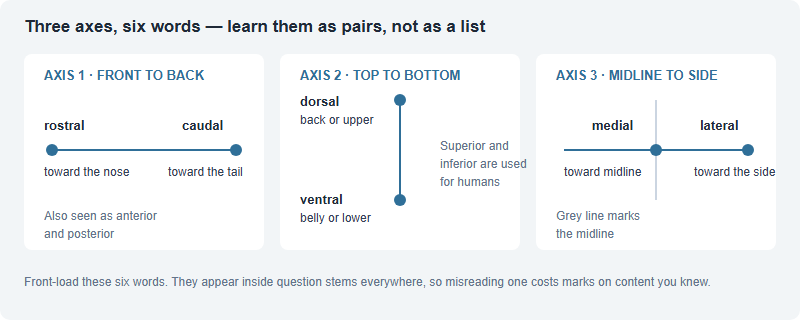
There is one vocabulary block that is worth front-loading above all others: the anatomical direction terms. Almost every description of where something sits uses them, so a student who is shaky on rostral versus caudal will misread question stems throughout the paper, no matter how well they know the structures themselves.
These terms come in opposed pairs along three axes, which makes them far easier to learn as a system than as a list. Learn the axis first, then the pair that runs along it.
The confusable pairs that cost the most marks
Some terms are difficult because they are long. Others are difficult because they sit next to a near-identical word with the opposite meaning — and those are far more expensive, because you answer confidently and wrongly. The fix is to learn them in pairs, never alone, with one distinguishing hook written next to each.
| Pair | The difference | A hook that holds |
|---|---|---|
| afferent / efferent | Carrying signals toward a structure / away from it | Efferent and exit both start with e |
| dendrite / axon | Receives incoming signals / carries the output away | Dendrite is the tree of branches taking things in |
| ipsilateral / contralateral | Same side of the body / opposite side | Contra means against, so contralateral crosses over |
| sympathetic / parasympathetic | Mobilising response / calming, restorative response | Para- sits alongside and damps the sympathetic system down |
| grey matter / white matter | Cell bodies and synapses / myelinated axon tracts | White is white because of myelin |
| excitatory / inhibitory | Increases the chance of firing / decreases it | Inhibit means to hold back |
| -plegia / -paresis | Full paralysis / partial weakness | Paresis is the milder of the two, and the shorter word |
A weekly routine that fits around everything else
Vocabulary work does not need long sessions; it needs frequent short ones and it needs to be written rather than read. A routine that holds up across a season looks like this.
- Keep one dissection notebook. Every new term goes in split into parts, with the meaning of each part, then the whole meaning in your own words. One line per term.
- Ten minutes, four times a week, book closed. Cover the term column and write the words from their definitions. Producing the spelling is the entire point — recognising it does not transfer to a blank line.
- Say the words out loud. If you ever reach a stage with live oral judging, you need to recognise these terms by ear and pronounce them clearly under pressure. Silent reading never builds that.
- Review confusable pairs on a separate list. Test them against each other, not individually, since the failure mode is mixing them up rather than forgetting them.
- Label diagrams from blank. Print or sketch an unlabelled diagram and fill in the names from memory. This is the closest cheap approximation of an identification task.
One honest note on ambition. Building fluency in this terminology is genuinely valuable well beyond the competition — it is the vocabulary of any first-year neuroscience or physiology course, and students who do this work often say it made later reading dramatically easier. But it is preparation for a science competition, not a credential; treat it as evidence of real interest in the subject rather than as something that acts on any admissions process. The official China chapter itself describes Brain Bee as an extracurricular interest exploration project that is not linked to admission, and that is the right frame.
If you are early in your preparation and still deciding how much of the syllabus to attempt, read our introduction to how the competition is structured first, then start the dissection notebook in week one. Terminology is the one thing that compounds: every word part you learn makes the next chapter faster to read.
Do I need to memorise every term in the syllabus?
No. Learn the recurring word parts first, then most unfamiliar terms become readable rather than needing separate memorisation.
Does spelling matter in the Brain Bee?
It matters wherever you produce the answer yourself, such as fill-in-the-blank items. Check the marking instructions on your paper.
Which vocabulary should I learn first?
The anatomical direction pairs: rostral and caudal, dorsal and ventral, medial and lateral. They appear inside question stems everywhere.
Why learn confusable terms in pairs?
Because the failure mode is reversing them, not forgetting them. Testing afferent against efferent is what fixes the distinction.
This is an independent guide operated by Hanlin Education for China-based international-school students. We are not affiliated with, endorsed by, or sponsored by the International Brain Bee (IBB), and we are not the official Brain Bee China national round; the official China chapter is chinabrainbee.com. Confirm current rules, dates and eligibility on thebrainbee.org and the official chapter site before acting on anything here. Errors reported to us are corrected within 7 working days.