
What the Question Actually Asks
Brain Bee Memory Systems is not a syllabus heading—it is a decision point. When a question asks about “memory,” students must know whether the examiner means the temporary holding pattern of working memory or the durable trace of long-term learning. The two systems differ in brain regions, functional characteristics, duration, and failure modes. Confusing them produces answers that are plausible-sounding but marked wrong.
This article works through a concrete teaching case with every step checked, then shows a contrasting case where the same stimulus is processed differently. The goal is to give you a decision rule you can apply under exam pressure, not a generic review of memory topics. For the broader sensory-to-cortex overview, see Brain Bee 2027 Sensory Systems: Trace Vision, Hearing, Touch, Taste and Smell From Receptor to Cortex.
The Core Distinction: Buffer Versus Archive
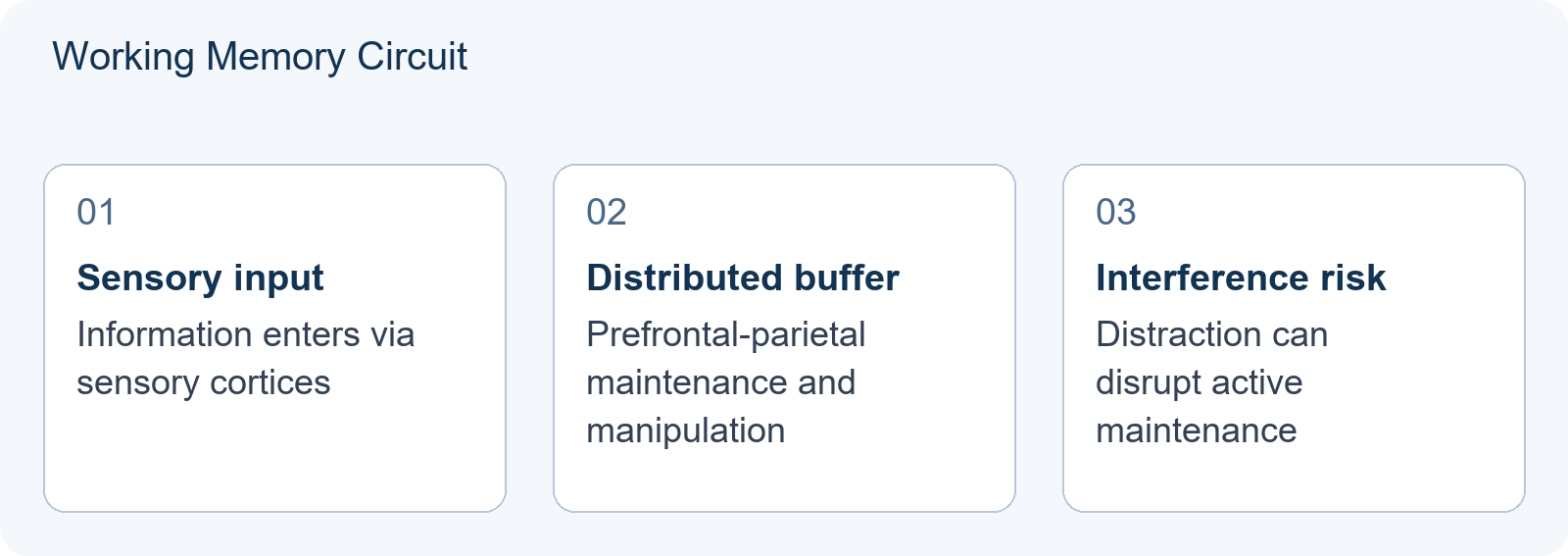
Working memory holds information in an active, labile state for brief periods, enabling both maintenance and manipulation. Long-term learning creates persistent changes that can last from days to years. The Brain Bee syllabus tests both, but in different question formats.
Working memory involves distributed networks including prefrontal cortex, parietal regions, and subcortical structures, supporting brief maintenance and manipulation of information. Long-term memory comprises multiple systems: episodic memory for personally experienced events, semantic memory for facts and concepts, and procedural memory for skills and habits. These systems rely on different neural substrates and mechanisms.
Teaching illustration: Brain Bee students who confuse these systems typically lose marks on questions about amnesia, drug effects, and the effects of sleep deprivation—because each condition affects the two systems differently.
Worked Teaching Case: Forward and Backward Digit Tasks
Consider a standard teaching illustration relevant to Brain Bee preparation: “A participant hears digits 7-3-9-2 and must repeat them forward, then backward. A distraction task follows, then recall is tested the next day.”
Step 1: Identify the systems. Forward repetition primarily taxes maintenance—holding the sequence in order. Backward repetition adds manipulation—reversing the sequence mentally. Both are working memory tasks, but backward span is more demanding because it requires manipulation, not just maintenance.
Step 2: Map to neural substrates. Maintenance engages persistent neural activity in prefrontal and parietal areas, with contributions from subcortical structures. Manipulation additionally recruits executive processes in dorsolateral prefrontal cortex. These distributed networks briefly sustain active representations.
Step 3: Predict the time course. Without effective maintenance, the sequence may quickly become difficult to report, especially with interference. After the distraction task, immediate recall may still succeed if attention returns promptly. Next-day recall, however, requires the sequence to have been consolidated into long-term memory—a different system entirely.
Step 4: Verify with the contrast. A participant might repeat 7-3-9-2 forward and backward immediately, yet fail next-day recall if consolidation was disrupted. Conversely, strong next-day recall does not imply larger working memory capacity; it reflects successful transfer to long-term storage.
Every step above is consistent with standard neuroscience references commonly used in Brain Bee preparation, including Brain Facts and Essential Neuroscience.
Contrasting Case: Where Similar Logic Fails
Now consider a superficially similar scenario: “A participant performs well on immediate digit span but poorly on a delayed recognition test for the same items after 24 hours.”
Intact immediate repetition does not establish that all memory functions are intact. Poor next-day recognition is consistent with difficulty in new long-term learning, but the task alone does not distinguish weak initial encoding, consolidation, later retrieval, or differences in attention and task difficulty. Describe the observed contrast first, then state what additional information would distinguish these explanations.
The error pattern is instructive. Students who confuse working memory with long-term learning treat intact immediate span as evidence that “memory is fine,” missing selective deficits in consolidation. Brain Bee questions exploit this confusion by asking about conditions where one system is spared and the other impaired.
The diagnostic rule: ask what fails and what survives. If immediate maintenance or manipulation is impaired, consider working memory limitations. If new learning or delayed recall is impaired while immediate performance is preserved, consider consolidation or retrieval deficits. If both are impaired, consider broader factors affecting multiple systems.
Neural Mechanisms: The Boundary Between Systems
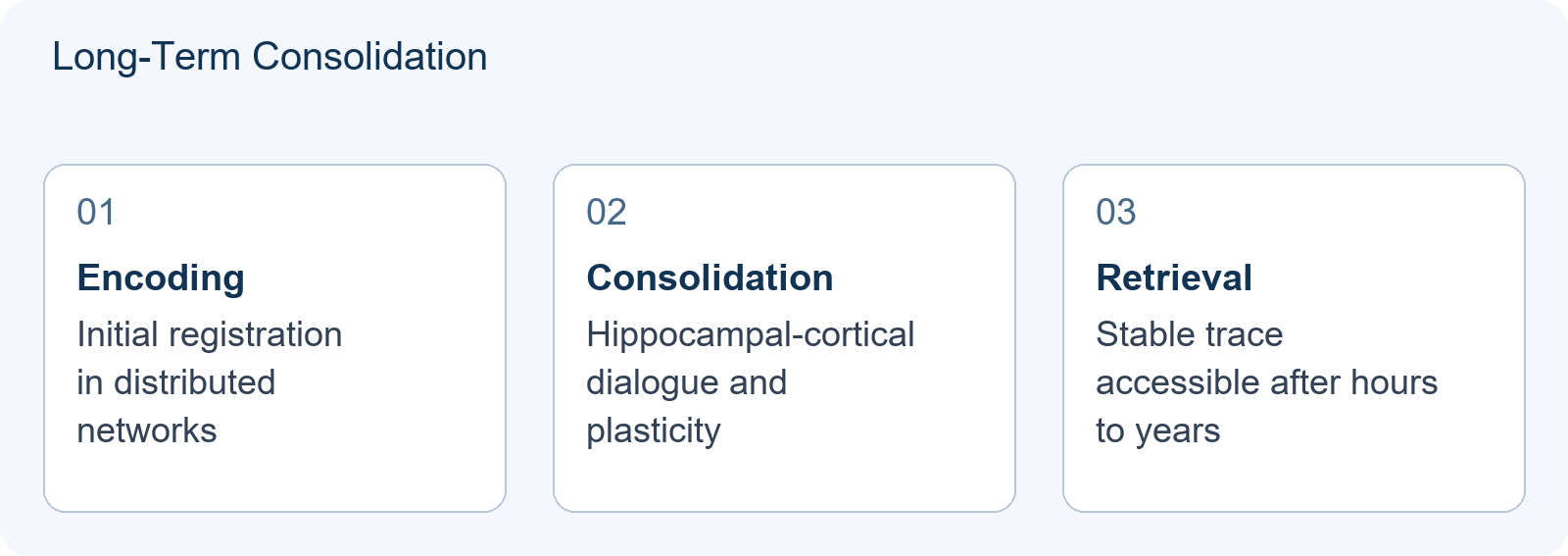
The transition from working memory to long-term memory involves multiple mechanisms, not a single molecular switch. Working memory can be supported by sustained neural activity and other dynamic mechanisms in distributed prefrontal-parietal networks. Long-term stabilization involves synaptic plasticity, structural changes, and systems-level consolidation.
Teaching illustration: Protein synthesis contributes to long-term stabilization but is not the sole switch between working memory and long-term memory. Other factors include synaptic tagging, neuromodulatory states, and systems consolidation involving hippocampal-cortical dialogue. For Brain Bee purposes, the key exam implication is that questions about molecular mechanisms require distinguishing which memory system is targeted.
Diagnostic Application: Distraction and Memory Questions
A common Brain Bee question format: “Explain why distraction during study impairs later recall of material but not the ability to hold a phone number while dialing.”
Apply the decision rule. Distraction during study may reduce attention to and initial encoding of the material; poorer later recall does not uniquely establish a consolidation failure. The phone number task relies on active maintenance in working memory, which is vulnerable to disruption only while the distraction occurs—not after the number has been successfully used.
Teaching illustration: A single episode of distraction during study may impair next-day recall by reducing initial encoding. In contrast, a brief distraction while holding a phone number may cause immediate loss if it interrupts rehearsal, but does not affect memories already consolidated from previous days.
Students who do not distinguish the systems may answer that “distraction hurts memory,” which is true but insufficiently precise for full marks. The examiner wants the functional and anatomical specificity.
What This Means for Your Next Study Task
If your diagnostic result is confusion between working memory and long-term learning, the useful feedback is to practice system-labeling for every memory term in your notes. For each concept, ask: duration (seconds vs. days/years), brain regions (distributed prefrontal-parietal vs. hippocampal/cortical), functions (maintenance and manipulation vs. multiple long-term systems), and failure mode (decay vs. consolidation or retrieval failure).
For structured preparation, see Memory, Plasticity and the Developing Brain: The Brain Bee Cluster That Rewards Chains, Not Lists, which develops the plasticity mechanisms in more depth. For study material selection, Brain Bee Study Materials: Matching Essential Neuroscience, BrainFacts and Atlas to the Questions You Will Actually Face provides attribution-mapped guidance.
Preparing for Consultation: What to Bring
If you are considering preparation support, the most productive first step is to self-diagnose which memory concepts remain unstable. A useful preparation is to attempt two questions: one asking you to trace a memory from encoding through consolidation (long-term system), and another asking you to explain how working memory maintenance differs from manipulation (working memory system). Note where your explanations become vague or functionally imprecise—these are the targets for focused work.
Applying the Decision Rule to Clinical Scenarios
The distinction between working memory and long-term learning becomes critical when interpreting hypothetical comparisons between memory tasks. Consider a hypothetical teaching illustration: “A participant can repeat a five-digit number immediately but cannot learn new vocabulary words over several days.” A student might incorrectly diagnose a general memory deficit. The correct application of the decision rule requires isolating the failure point.
Step 1: Describe the preserved performance. The participant repeated this short sequence immediately. That observation supports successful immediate maintenance on this trial; it does not establish that every working-memory component or attentional process is normal, and it cannot rule out a brain lesion.
Step 2: Describe the delayed performance. The participant struggled to retain new vocabulary over days. Possible explanations include how well the words were encoded, how learning was stabilized, and how retrieval was tested. The prompt does not identify which explanation applies.
Step 3: State a bounded inference. Immediate repetition and delayed new learning place different demands on memory. The contrast motivates separate tests of learning, retention and retrieval; it does not uniquely localize a deficit or prove a consolidation disorder. This is an interpretation exercise, not a clinical diagnosis.
Common Reasoning Errors in Case Analysis
Recall and recognition provide different kinds of retrieval support. Better recognition than unaided recall can be informative, but does not by itself prove a pure retrieval deficit. Failure on both tasks can reflect several stages of processing. A defensible answer describes the task demands and acknowledges the limits of the comparison.
Second, students overlook the role of manipulation versus maintenance. A participant may hold information briefly (maintenance) but fail to reorder it mentally (manipulation). For example, repeating digits forward is preserved, but backward span is impaired. This indicates executive control issues within working memory networks, distinct from long-term storage problems. Confusing these leads to incorrect localization.
Practice Task: System-Labeling Drill
To internalize this distinction, perform a targeted labeling exercise using your existing notes. Select three conditions discussed in class or textbooks: normal aging, acute stress, and a supplied example of disrupted new learning. For each, create a table with four columns:
- Immediate Span: Is forward/backward digit repetition affected? (Yes/No)
- New Learning: Is acquisition of novel facts impaired? (Yes/No)
- Remote Memory: Are childhood events or well-known facts preserved? (Yes/No)
- Primary Mechanism: Which system fails first? (Maintenance, Manipulation, Consolidation, or Retrieval)
For each comparison in your table, record the actual task and result supplied by the source. Avoid assigning a universal yes/no pattern to broad labels such as stress or aging. Ask which explanations remain possible and what additional comparison would help distinguish them; leave a cell marked unknown when the example supplies no evidence.
Frequently Asked Questions
How can a comparison exercise help distinguish these memory systems?
Compare immediate repetition or manipulation with learning tested after a delay. Identify exactly what each task requires and which performance is preserved. A contrast can guide further questions, but cannot by itself identify a single neural cause.
Is the hippocampus involved in working memory at all?
Hippocampal involvement depends on the task, including its relational and spatial demands. It is important in forming many declarative memories, but it is not a universal storage box for all long-term memory. Avoid a rigid one-region-per-system map.
How should I practice distinguishing these systems under time pressure?
Use the system-labeling method: for any memory term, immediately identify duration, key brain regions, functional characteristics (maintenance/manipulation vs. multiple long-term systems), and what impairment would look like. Practice with questions that present functional dissociations, not just definitions.