When you first sit down to prepare for the Brain Bee, three books sit on your desk and the clock is already ticking toward January 9. The instinct to start with the thickest volume, or to race through all three simultaneously, wastes the limited weeks before the regional paper. This Brain Bee Study Guide treats your three core resources as a deliberate sequence, not a pile to attack. By matching each book to a specific phase of learning, you build lasting structure rather than fragile memorization. The following eight sections show exactly how to move from first concepts to exam-ready integration, using a concrete study scenario to ground every recommendation.
Start With Brain Facts to Build the Skeleton
Brain Facts serves as your foundation because it was written for exactly this audience: students encountering neuroscience for the first time. The text introduces neurons, synapses, brain regions and basic functions without assuming prior coursework. For a ninth-grader beginning in October, this means you can read a chapter and genuinely understand it, rather than decoding jargon for hours. The regional paper draws heavily from this material, so early investment here returns points directly.
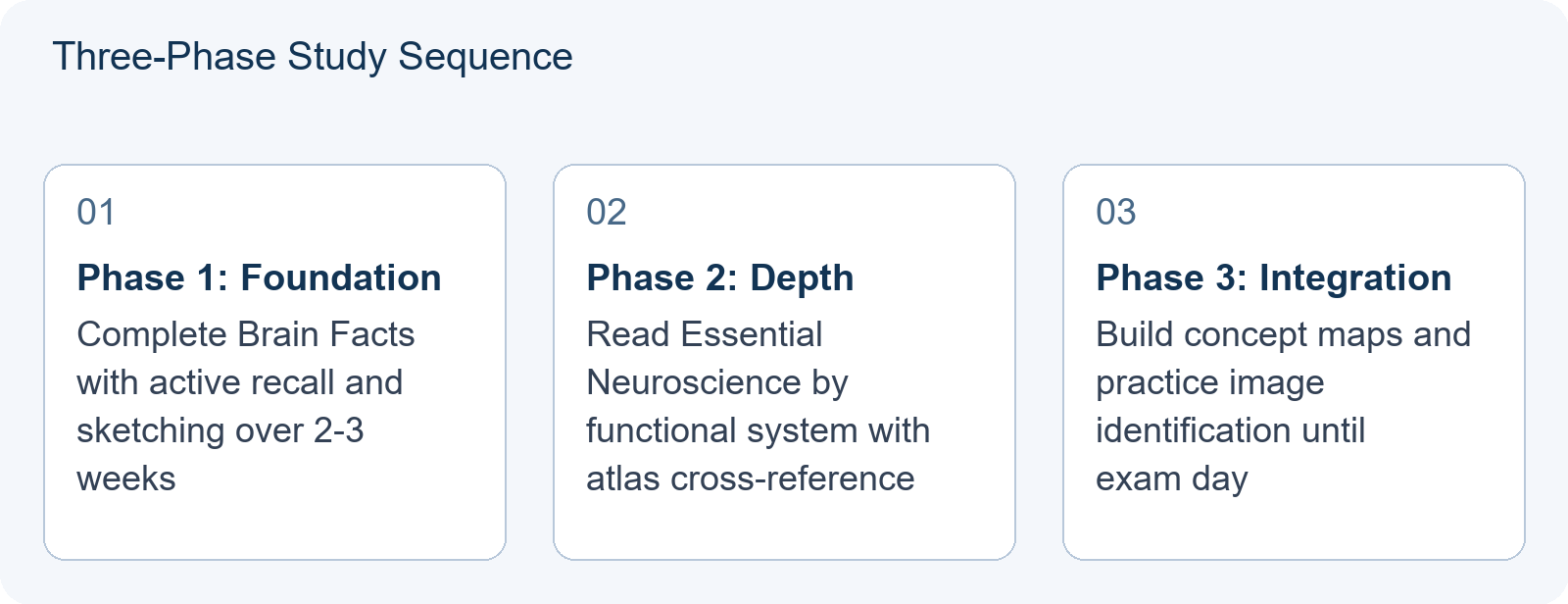
Your first two weeks should focus on completing Brain Facts with active recall. After each chapter, close the book and sketch what you remember: the shape of a neuron, the direction of signal flow, the four lobes and their primary functions. This practice exposes gaps immediately. One student we will call Mei spent her first ten days reading passively and found she could not distinguish temporal from parietal functions under timed conditions. Switching to closed-book sketches raised her accuracy from sixty to eighty-five percent on structure-function matching.
Do not linger on perfect memorization during this phase. The goal is recognizable familiarity, not performance-level recall. You need to know that the hippocampus relates to memory formation, not yet every pathway detail. Save that depth for the next resource. Mark sections that confuse you rather than stopping to resolve everything; these marks become your bridge into Essential Neuroscience later.
Move to Essential Neuroscience for Depth and Connection
Essential Neuroscience elevates your understanding from identification to mechanism. Where Brain Facts states that dopamine affects movement, Essential Neuroscience explains the nigrostriatal pathway, receptor types and why Parkinson’s disease produces specific symptoms. This depth becomes critical for national round preparation and for answering the integrated questions that increasingly appear even at regional level.
Transition to this text only after you have completed Brain Facts once. Attempting Essential Neuroscience cold wastes time because you lack the framework to organize its detail. Mei, now in her fourth week of study, found that chapters on motor systems connected naturally to her prior knowledge of basal ganglia structure. She could ask precise questions: how does the direct pathway differ from the indirect pathway? What happens when substantia nigra neurons degenerate? These questions have clear answers in Essential Neuroscience but would have overwhelmed her three weeks earlier.
Structure your reading by functional system rather than page order. Read all of sensory systems together, then motor, then integrative functions. This cross-chapter organization mirrors how the Brain Bee tests knowledge. When you encounter lateral inhibition in the visual system, you can immediately connect it to contrast enhancement in other modalities. The text becomes a network rather than a sequence.
Integrate the Atlas for Spatial Confidence
An atlas completes your trio by solving the spatial problem that text alone cannot address. Neuroscience is inherently three-dimensional, yet most students study it through flat diagrams and verbal descriptions. The atlas forces confrontation with actual brain geometry: how the hippocampus curves into the medial temporal lobe, how the internal capsule separates structures, how ventricles relate to surrounding tissue.
Introduce atlas work in parallel with your second pass through Essential Neuroscience. When you read about a structure, locate it immediately. Mei developed a habit of keeping her atlas open beside her textbook, tracing each newly encountered structure across three orthogonal views. This practice transformed abstract names into spatial anchors. During later image identification practice, she could mentally rotate structures rather than guessing from single perspectives.
Focus particularly on structures that appear repeatedly across functions: the thalamus as relay station, the corpus callosum as communication bridge, the brainstem as vital center. These structures appear in multiple question types and reward deep spatial knowledge. Do not merely identify them; understand their relationships to neighboring structures. A question about conus medullaris syndrome requires knowing not just the spinal cord termination but also its vertebral level relationship and surrounding structures.
Map Concepts Rather Than Memorize Lists
The Brain Bee rewards conceptual chains over isolated facts. A student who memorizes that the amygdala processes fear may answer a direct question correctly but fail when asked how fear conditioning alters synaptic strength in the lateral nucleus. Concept mapping transforms your three resources into connected knowledge rather than parallel lists.
Build your maps incrementally. Start with a central function like memory, branch to involved structures, then add neurotransmitters, then pathological conditions. Mei created a large wall map over six weeks, adding colored branches as she progressed through each resource. Blue for structures from Brain Facts, red for mechanisms from Essential Neuroscience, green for spatial relationships from her atlas. The visual pattern revealed connections she had not consciously studied, such as how cholinergic pathways linked memory and motor systems.
Test your maps by generating questions rather than answering them. Given any two nodes, can you explain their relationship? If handed dopamine and schizophrenia, you should trace from mesolimbic pathway through D2 receptor blockade to clinical features and treatment implications. This generative practice more closely simulates actual competition conditions than passive review.
Practice With Labelled Images Before Unlabelled Challenges
Image identification at national level requires moving from recognition to confident specification. Begin with labelled atlas pages where structures are clearly indicated, then progress to partially labelled diagrams, then to completely unlabelled specimens. This graduated exposure builds confidence without the paralysis of premature difficulty.
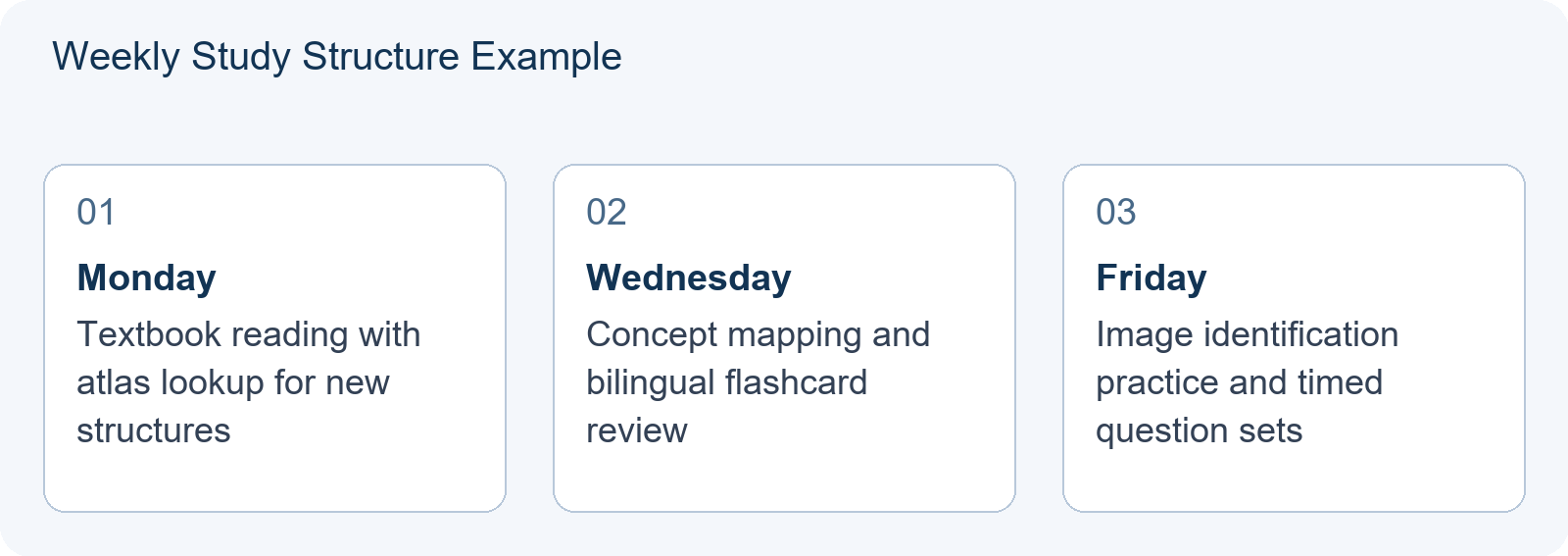
Mei’s weekly routine included three thirty-minute image sessions. Monday she reviewed labelled structures from her atlas, Wednesday she worked with diagrams where she had filled labels herself, Friday she confronted unlabelled images cold. This structure meant she always had reference points nearby when learning, but also developed independent identification skill. She tracked which structures consistently confused her sagittal versus coronal views, left versus right asymmetry and targeted these specifically.
For safety and accessibility, use clearly sourced anatomical images rather than attempting to access actual specimens. Many quality atlases include photograph and diagram pairs that develop the same skill. The critical element is your active engagement: naming structures aloud, tracing boundaries with a finger, predicting what lies beyond each visible plane. Passive looking creates familiarity without reliable recognition.
Time Your Progress Against the Exam Calendar
With regional papers on January 9 and national activities in March, your sequencing must respect real deadlines. Working backward from January 9, you need completion of Brain Facts by early November, substantial Essential Neuroscience progress by mid-December, and integrated review through the final weeks. The atlas weaves throughout but intensifies as image identification becomes your focus.
Mei’s hypothetical timeline illustrates this pacing. She began Brain Facts on October 1, finishing October 20. Essential Neuroscience occupied October 21 through November 30, with atlas integration beginning November 15. December brought concept mapping, image practice and timed question sets. This left two weeks before January 9 for targeted weakness repair and full practice papers. Her national round preparation then built on this foundation rather than starting fresh.
Adjust this skeleton to your own constraints. A student beginning November 1 must compress but should not skip the sequence. Brain Facts still comes first, but with tighter chapter targets. Essential Neuroscience becomes selective rather than comprehensive. The atlas gains priority given its direct national round relevance. The principle of ordered foundation-building persists even under time pressure.
Handle Bilingual Terminology Systematically
The China regional paper presents questions in Chinese with English technical terms provided. This creates a specific challenge for students who learned neuroscience primarily in English. Your three-resource sequence must include deliberate bilingual bridging to avoid recognition failure during the exam.
During Brain Facts reading, maintain a running glossary of terms in both languages. Do not trust that you will recognize Chinese character equivalents under pressure. Mei found that structures she knew perfectly in English, hippocampus and amygdala among them, initially stumped her when presented only as Chinese characters in practice questions. Her solution was to create flashcards with English on one side, Chinese on the other, and anatomical location on a third side for three-way association.
Essential Neuroscience and the atlas add complexity because mechanisms and spatial descriptions require more vocabulary. Prioritize terms that appear repeatedly: neurotransmitter names, pathway directions, lobe and gyrus identifications. For national round preparation, practice with actual past paper formats if available, or create your own by translating English questions into Chinese with technical terms preserved. The goal is automatic recognition, not translation skill.
Evaluate Your Readiness With Simulated Conditions
Final preparation requires testing under conditions that approximate the actual competition. The ninety-minute regional paper for senior students demands sustained concentration across eighty questions. Junior students face sixty questions in the same timeframe. Neither permits reference materials. Your three resources must be internalized by this point, not accessible.
Mei’s final month included weekly full-length practice papers under strict timing. She used questions drawn from all three resources, mixed randomly rather than by topic. This prevented the false confidence of chapter-targeted practice. After each paper, she analyzed errors by source: was the knowledge in Brain Facts, Essential Neuroscience or atlas material? This directed her limited final review time precisely.
Beyond knowledge, simulate the physical conditions. Sit at a desk, use standard answer sheets, take no breaks. The body learns routine as well as the mind. On competition day, this familiarity reduces anxiety and preserves cognitive resources for actual thinking. Your months of sequenced study through Brain Facts, Essential Neuroscience and the atlas culminate in this moment of confident, prepared performance.
General event background is available at Event background.
This is an independent preparation guide, not affiliated with, endorsed by, or sponsored by the International Brain Bee.
Frequently Asked Questions
Can I skip Brain Facts if I already took AP Biology?
No. AP Biology covers general biology, not the neuroscience depth and specific terminology that Brain Facts provides for this competition. The structured foundation remains essential even with strong prior biology knowledge.
How do I choose which atlas to use?
Select an atlas with clear labelled photographs, diagram cross-references and both gross and sectional views. The specific publisher matters less than your active engagement with the material. Ensure it covers structures mentioned in Brain Facts and Essential Neuroscience.
What if I cannot finish all three resources before the regional paper?
Prioritize completing Brain Facts fully, then use Essential Neuroscience selectively for your weakest areas. Maintain atlas work throughout. Partial deep knowledge outperforms shallow coverage of everything.