
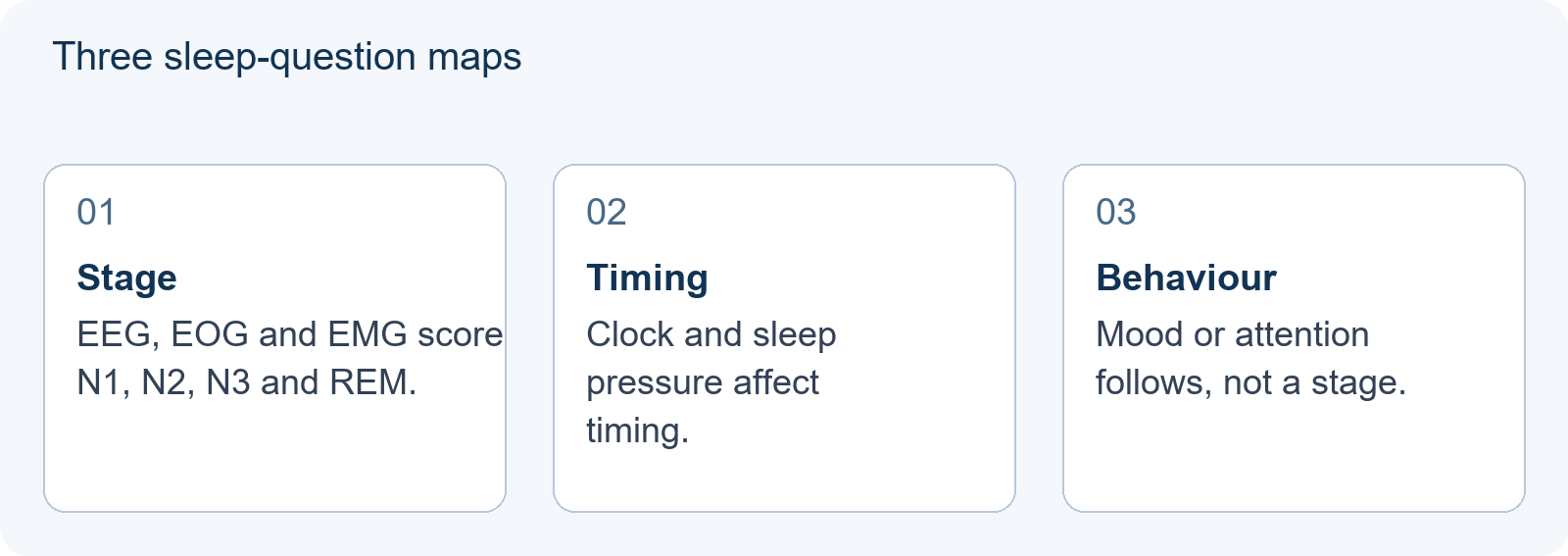
For the 2027 China preparation route described by Hanlin Courses, Brain Bee sleep questions are easiest when you separate three maps: stage scoring from EEG, EOG and EMG; circadian timing from clock and sleep-pressure evidence; and behavioural consequences such as attention, memory or mood. A stage label, a clock time and a daytime complaint answer different questions, so keep each map’s evidence separate.
A Hanlin Courses article published 31 October 2026, Exams begin 9 January! 2027 Brain Bee neuroscience competition, from memory to brain disease — how can beginners prepare?, lists sleep among the brain-function topics in its China 2027 preparation overview. A second Hanlin Courses article published 14 September 2026, 2027 Brain Bee neuroscience activity registration opens! Connect biology/psychology/AI into one language, places sleep in a function list with perception, learning, memory, language, movement, stress, motivation and emotion. These summaries support scope for the China 2027 route; they do not establish a universal sleep-scoring rule.
Why sleep questions feel easy until three maps collide
Sleep looks like a short topic: students learn a few stage names, a few brain regions and a few examples, then move on. The difficulty appears when a question combines a nocturnal trace, a clock time and a daytime complaint. A low-voltage EEG may be called REM too quickly; a clock time may be treated as if it explained a stage; a tired student may be treated as if the symptom identified the sleep stage.
The teaching task is to keep the three maps distinct even when one question mentions all three. Stage evidence comes from physiological channels. Timing evidence comes from clock context plus sleep history. Behavioural evidence comes from reports or observed performance. Mixing them produces confident answers that the record does not support.
Stage scoring: read EEG, EOG and EMG together
Stage-scoring questions ask what a record is consistent with. They are not asking for a single-channel guess. Wake, N1 and REM can all show low-voltage, mixed-frequency EEG, so the EEG alone may not separate them. Eye movements and muscle tone carry essential information: slow rolling eye movements appear in N1; rapid eye movements and very low EMG support REM; high-amplitude slow waves support N3.
| Stage or state | Useful signals | Misread to avoid |
|---|---|---|
| Wake | Alpha or mixed EEG, eye blinks, higher EMG | Calling every low-amplitude trace REM |
| N1 | Low-voltage mixed-frequency EEG, slow rolling eye movements, lower EMG than wake | Ignoring eye movements |
| N2 | Sleep spindles and K-complexes, low EMG | Treating one feature as the whole stage |
| N3 | High-amplitude slow waves, low EMG | Calling a flat-looking trace deep sleep |
| REM | Low-voltage mixed-frequency EEG, rapid eye movements, very low EMG | Equating REM with dream recall |
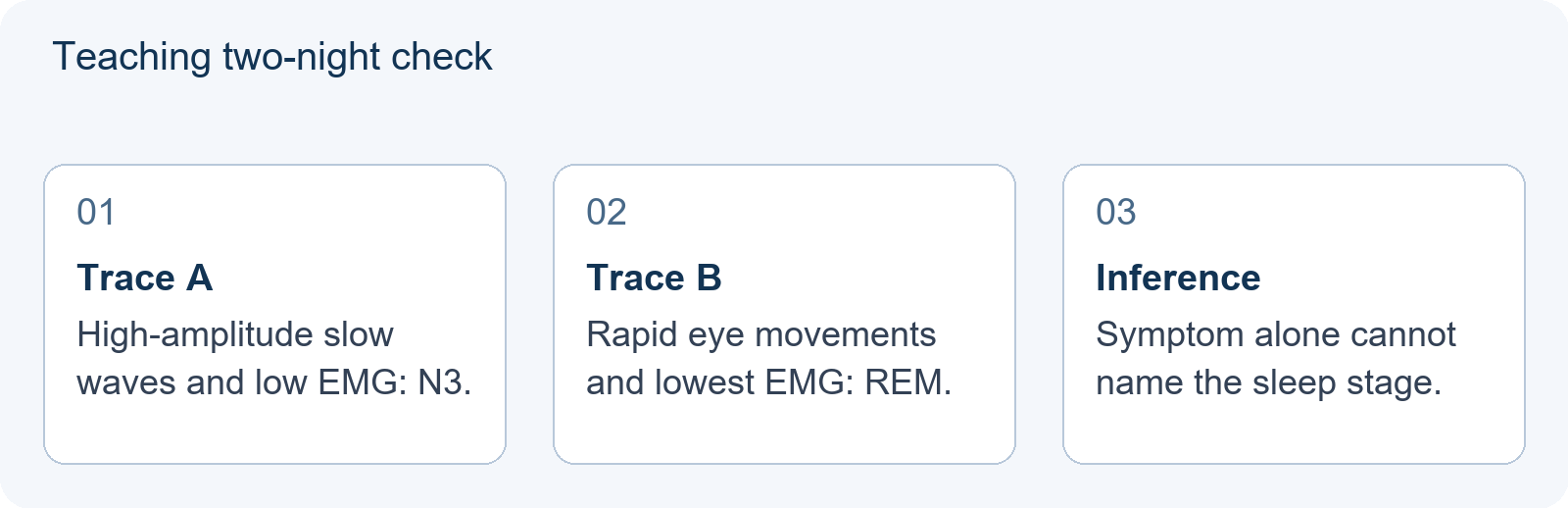
Consider two teaching traces. Trace A has high-amplitude slow waves, little eye movement and low EMG; it is consistent with N3. Trace B has low-voltage mixed-frequency EEG, rapid eye movements and very low EMG; it is consistent with REM. If only the EEG channel were shown, Trace B could be confused with wake or N1. A question that supplies one channel may be testing the limits of that channel, not asking for a confident label from incomplete evidence.
For modality choice, see Brain Bee EEG fMRI: Choose the Right Measurement for Time or Space Questions. The key discipline is the same: name the measurement before interpreting the result.
Circadian timing and homeostatic pressure: why at this time?
Circadian timing is a clock-like influence on when sleepiness and sleep are likely to occur. Homeostatic sleep pressure increases with time awake and decreases with sleep. Neither is a stage. A statement such as “the subject entered REM at 03:00” describes when a stage occurred; the clock time does not identify the stage. A statement such as “the subject felt sleepy at 23:00” may reflect circadian phase and accumulated sleep pressure, but it still does not tell you N1 versus N2 versus REM.
Teaching contrast: two hypothetical students are awake at 23:00. Student A has been awake for 18 hours; Student B took a two-hour nap and has been awake for five hours. Same clock time, different sleep pressure. If their sleep-onset latencies differ, that difference may be consistent with homeostatic pressure, circadian phase, or both; the clock alone does not choose. A Brain Bee question can hide this distinction by offering a clock time as if it were a stage label. Keep the maps separate: timing evidence answers a timing question, and stage evidence answers a stage question.
The habit also prevents an overclaim. A late sleep time may be described as a circadian or behavioural issue, but it does not make the following sleep stage abnormal by itself. The trace must still be read on its own terms.
Behavioural symptoms: consequences, not stage labels
A daytime attention complaint, a memory problem or a mood change can be associated with short sleep, irregular timing, sleep debt or other factors. Behaviour is important, but it is not a scoring channel. A single night cannot establish causation, and a symptom cannot name a stage. In an educational question, the safest inference is bounded: the behaviour is consistent with a sleep history, not proof of a particular stage.
For memory, the Brain Bee article Brain Bee Memory Systems: Distinguish Working Memory From Long-Term Learning helps separate memory systems. Sleep is relevant to consolidation, but a memory complaint does not mean REM occurred in the preceding night. If a question asks what follows from a record, separate what was observed from what was inferred. Observed: sleep duration, stage labels and timing. Inferred: possible effects on attention or consolidation. Unsupported: a one-to-one mapping from symptom to stage.
A teaching two-night record: stage, clock and complaint
The following two-night record is a teaching illustration, not an official contest problem or scoring guide. It uses invented times and observations only to make the reasoning visible.
Night 1 begins at a regular bedtime. The trace moves through N1, N2, N3 and REM. Night 2 begins later after a delayed bedtime and is shorter. The student reports poor attention the next day.
| Night 1 time | Observation | Best-supported label | Why |
|---|---|---|---|
| 23:50 | Low-voltage mixed EEG, slow rolling eyes, EMG lower than wake | N1 | Sleep onset with slow eye movements |
| 01:10 | Sleep spindle and K-complex | N2 | Defining N2 features |
| 03:00 | High-amplitude slow waves, low EMG | N3 | Slow-wave sleep signature |
| 05:00 | Low-voltage mixed EEG, rapid eye movements, very low EMG | REM | REM signature across channels |
On Night 2, the record still includes N2 and REM, and the student reports poor attention. A classmate concludes: “The REM period caused the attention problem.” That conclusion is not supported. The record supports that REM occurred; it does not isolate REM as the cause of the daytime complaint, because short sleep and delayed timing are also present. A better answer says the complaint is consistent with a short, delayed sleep history, while the trace independently supports REM.
- Distractor 1: flat EEG means N3. N3 is associated with high-amplitude slow waves; a flat-looking trace may reflect low amplitude, artifact or another state. The teaching record at 03:00 is not flat.
- Distractor 2: REM equals dreaming. Stage scoring uses EEG, EOG and EMG. Dream recall is a report after waking, not the defining signal.
- Distractor 3: a clock time is a stage. The 05:00 timing may be noted, but the REM label comes from the signal pattern, not the clock.
The reasoning drill is to ask: which map does the question use? Then name the evidence that map requires. Then state the smallest conclusion the evidence supports. This also avoids over-reading a single channel.
Traps to check in Brain Bee sleep questions
- REM equals dreaming. REM is a stage with rapid eye movements and very low EMG; dreaming can be reported, but it is not the scoring criterion.
- One channel is enough. Low-voltage EEG can appear in wake, N1 and REM; EOG and EMG help separate them.
- Deep sleep is a flat EEG. N3 shows slow, high-amplitude waves. A flat trace is not the signature.
- Circadian rhythm is a stage. It is a timing influence, not N1, N2, N3 or REM.
- A symptom identifies a stage. Attention, memory and mood reports are consequences or complaints, not labels.
- Clock time explains stage. Time can support a timing inference; it does not replace the physiological evidence for a stage.
Diagnostic table and revision drill
Use a three-map table when you review a sleep question. The goal is not to memorise more labels; it is to stop one map from borrowing the authority of another.
| Question asks | Evidence to check | Valid inference | Invalid leap |
|---|---|---|---|
| Which stage? | EEG, EOG and EMG pattern | The record is consistent with REM | The student was dreaming |
| Why at this time? | Clock, circadian cues and prior sleep or wake | Timing may reflect circadian and homeostatic factors | It is 03:00, so the stage must be REM |
| What behaviour follows? | Sleep duration, timing and symptom report | The complaint is consistent with short sleep | The symptom identifies N3 |
- Label the question before looking at the options: stage, timing or behaviour.
- Write the evidence that map requires: channels for stage; clock plus sleep history for timing; duration, timing and report for behaviour.
- Write the answer with a qualifier such as consistent with, supports or cannot be determined. Avoid proves when the record is partial.
Preparing a study-plan or resource question
Before asking for course-fit advice or a resource request, make a one-page diagnostic. Include three sleep questions you missed, the map each belongs to, and the evidence you overlooked. Add a two-column list: observation versus inference. Then ask a specific question, such as whether a resource treats stage scoring, circadian timing and behavioural interpretation as separate skills. This is more useful than asking for a generic sleep handout.
For material selection, see Brain Bee Study Materials: Matching Essential Neuroscience, BrainFacts and Atlas to the Questions You Will Actually Face. If you use the site contact route to discuss fit, bring the diagnostic page; do not assume a particular course, pack or service exists unless it is described in the current materials you are shown.
For the official international competition structure, the International Brain Bee site is the current reference. The stage, timing and behaviour method above is a teaching method, not an official sleep-scoring rule.
This is an independent preparation guide, not affiliated with, endorsed by, or sponsored by the International Brain Bee.
Frequently Asked Questions
Does REM equal dreaming in Brain Bee sleep questions?
No. In stage scoring, REM is identified from EEG, EOG and EMG patterns. Dream recall is a report after waking, not the defining scoring signal. A question may ask about dreaming, but treat it as a separate experiential or behavioural claim.
Can I identify N3 from a flat EEG trace?
No. N3 is associated with high-amplitude slow waves, not a flat line. A flat-looking trace may reflect artifact, low amplitude or another state. Use all available channels and the evidence stated in the question.
Is circadian rhythm a sleep stage?
No. Circadian timing is a clock-like influence on when sleepiness and sleep occur. Stage scoring describes N1, N2, N3 and REM from physiological signals. A clock time can support a timing inference but not a stage label.