For the China-region 2027 Brain Bee season, the Junior regional paper is a 90-minute closed-book written paper of 60 questions worth 60 points, set in Chinese with professional terms marked in Chinese and English. The Junior division covers grades 5-8, but that grade band is an eligibility rule, not a readiness verdict. A grade 5 or 6 student may be a sensible entrant if three checks look manageable: reading load, term recall, and 90-minute stamina. The regional activity is scheduled for 9 January 2027, 10:00-11:30. Base-school registration closes 5 December 2026; non-base-school families use an individual window from 5 to 12 December 2026, according to Hanlin Courses’ 31 October 2026 report, Exam on 9 January: 2027 Brain Bee, from memory to brain disease, how to prepare from zero. This article is a Hanlin preparation perspective, not official guidance; confirm registration and paper rules with the organizer or school.
What the Junior regional paper actually asks
The first step is to separate the regional paper from the later national round. The regional paper is the entry paper. The 16 October 2026 Hanlin Courses report, 2027 Brain Bee registration is open: a cross-disciplinary challenge open to grade 5, describes the national Junior round as a 40-question written test worth 40 points plus a team science poster worth 40 points; the 31 October 2026 report notes that the 2027 national-round format remains subject to later organizer notice. A student who can handle the regional paper has not automatically trained for the national poster, and a family should not treat the two as one long paper.
| Feature | 2027 China-region Junior regional paper |
|---|---|
| Grade band | Grades 5-8 in the China-region Junior division |
| Time and format | 90 minutes, closed-book written paper, multiple-choice and fill-in questions |
| Question count and marks | 60 questions, 60 points |
| Language | Chinese paper; professional terms are marked in Chinese and English |
| Fill-in answers | Chinese or English acceptable; professional terms may use English abbreviations |
| Knowledge base | The 31 October report says China’s recommended foundation resource is Brain Facts, both groups are advised to read it fully, and regional knowledge is mainly based on it |
The paper is therefore a Chinese reading task with bilingual vocabulary support. That distinction matters for a younger student: the student must keep the stem’s logic while switching between a Chinese sentence and an English term. The 31 October report also notes that fill-in answers may be written in Chinese or English, and professional terms may use English abbreviations, so parents should not assume that limited English vocabulary alone rules a student out. The readiness checks below focus on reading load, active term recall and 90-minute stamina.
Why 60 questions in 90 minutes is not simply 1.5 minutes each
Sixty questions in 90 minutes averages 1.5 minutes per question. That calculation is correct, but it hides the real work. A multiple-choice item may be answered in 30 seconds if the student recognises the term and the distractors. A fill-in item may take longer because the student must retrieve the term, decide whether to answer in Chinese or English, and check spelling or abbreviation. A bilingual stem may also require a second pass. The average is a budgeting figure, not a promise that every question will take the same time.
For grade 5-6 students, a practical question is where time is lost. Is the student losing time because the Chinese sentence is long, because the term is only half-known, or because accuracy falls after 45 minutes? Those are three different problems, and they need three different remedies. A family that only asks ‘Is my child interested in the brain?’ will miss the operational question: can the child show that interest on this paper, under this format, by this deadline?
Diagnostic 1: reading load
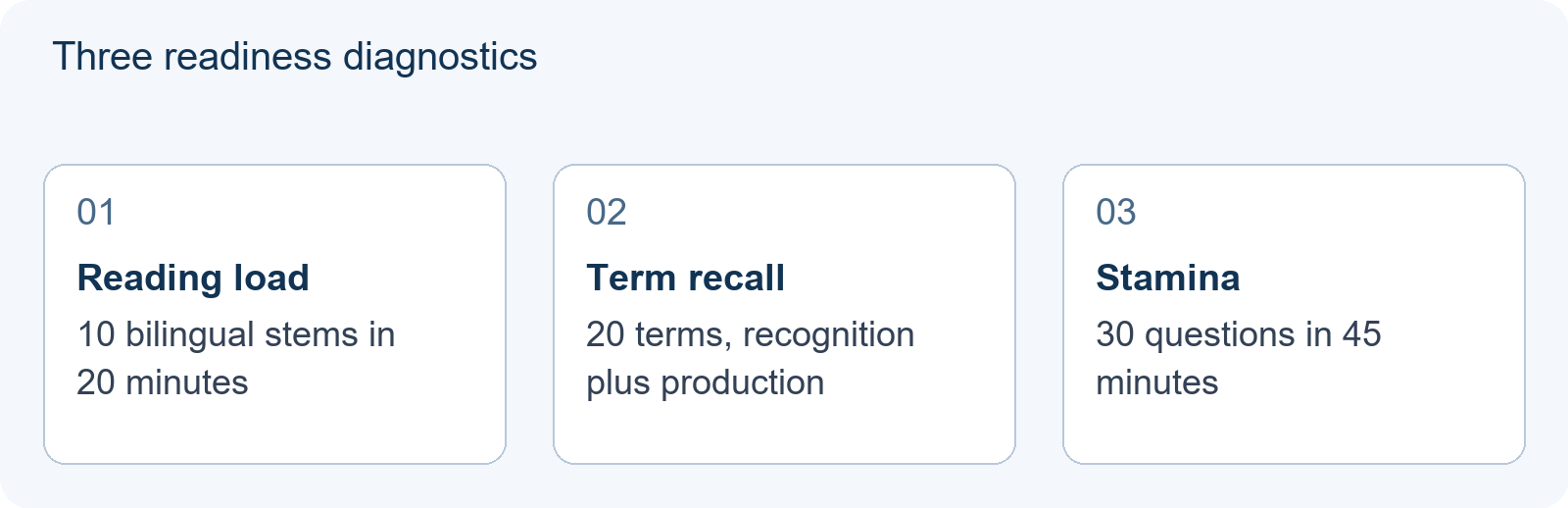
Run a 20-minute reading check with ten short Chinese stems that include two bilingual terms each. These should be teaching stems, not copied contest questions. A simple teaching illustration, not an official question, is: A patient has difficulty forming new declarative memories. Which structure is linked to this function? A. hippocampus B. cerebellum C. medulla D. thalamus. The point is not the answer. The point is whether the student can read the Chinese stem, notice the bilingual term, and choose without asking for a translation of every line.
Score the check in two columns: completion time and errors caused by misreading the stem. If the student finishes all ten in 20 minutes with no more than one misread error, reading load can be treated as manageable for this diagnostic. If the student understands the science but needs 25-30 minutes, the bottleneck is reading speed, not knowledge. If the student can read quickly but misses words such as ‘most often’, ‘except’ or ‘not’, the problem is precision. The remedy for a reading bottleneck is short timed reading with vocabulary support, not more fact memorisation.
Parents can also check the student’s language habit. A student who learned neuroscience in English may know ‘hippocampus’ but pause at the Chinese term. The reverse is also possible. The 31 October report says terms are marked bilingually, which helps recognition, but bilingual marking does not remove the need to read the surrounding Chinese sentence. The student should practise reading the whole stem, not only hunting for the English word.
Diagnostic 2: term recall
Recognition and production are different skills. A student may match ‘hippocampus’ to ‘memory’ on a list and still fail a fill-in blank that asks for the structure’s name. Build a 20-term audit from four groups: structures, functions, disorders, and methods. For each term, test recognition first, then production. A teaching illustration, not an official question, is: recognition asks, ‘Which structure is linked to forming new declarative memories?’; production asks, ‘The structure linked to forming new declarative memories is ______.’ The first format only requires choosing. The second requires retrieval.
A suggested coaching standard is 12 or more correct answers on the full 20-term production task, with errors concentrated in terminology rather than concept confusion. That is not an official cut-off. It is a teaching decision aid. If a student recognises 18 of 20 terms but produces only 8 correctly, the next month should include active recall: cover the term, say it aloud, write it, and check the Chinese and English forms. If the student produces terms but cannot explain what they do, the problem is conceptual, and the student needs more Brain Facts reading before more quizzing.
Do not overcorrect spelling. The 31 October report says fill-in answers may be in Chinese or English and professional terms may use English abbreviations. The student still needs a recognisable answer, but the goal is accurate retrieval, not dictionary-perfect spelling. The audit should record whether the student knows the term, not whether the handwriting is neat.
Diagnostic 3: 90-minute stamina
Use a 30-question, 45-minute half-paper assembled from Brain Facts-aligned teaching items. Mark the first 15 and last 15 separately. A hypothetical teaching example: Student A scores 14/15 on the first half and 7/15 on the second; Student B scores 11/15 and 10/15. Both total 21/30, but the pattern is different. Student A starts strongly and fades. Student B is steadier but has more early gaps. The same total does not lead to the same preparation plan.
For a grade 5-6 student, a drop of more than three correct answers between the halves is a signal to check stamina, pacing and anxiety. The remedy may be shorter timed sets, a planned mid-paper pause of a few seconds, or practice in a quiet room with a visible clock. If the student cannot finish 30 questions in 45 minutes in this diagnostic setting, the full 60-question paper would add further time pressure. That does not mean the student cannot study neuroscience; it means the December registration decision should be made carefully.
Decision rule before December 5
| Pattern from the three checks | What it suggests | Suggested next step |
|---|---|---|
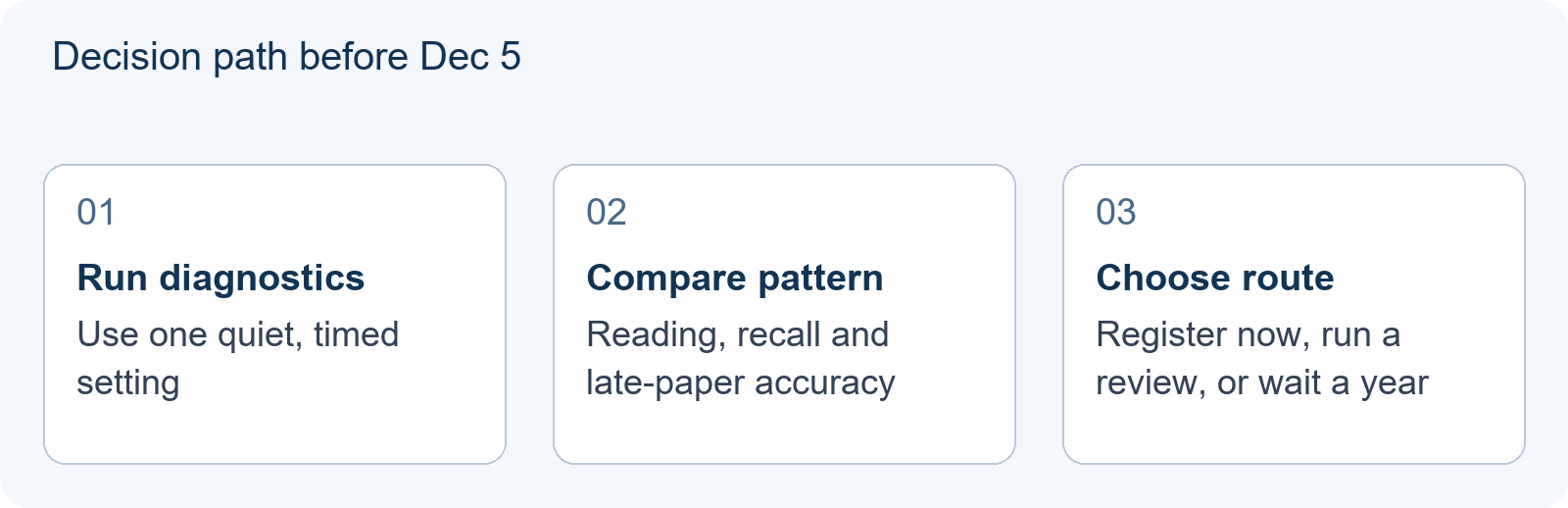
| Reads ten bilingual stems in about 20 minutes; produces at least 12 of 20 terms; second-half score within three of the first half | The format can be treated as manageable with a steady plan | Register now with support: three weekly sessions, one timed half-paper, one error-log review |
| Understands concepts but reading is slow, or production is 8-11 of 20, or stamina drops by four or more | The student is not far off, but one bottleneck needs focused work | Register only after a two-week diagnostic review; target the weak check before committing |
| Cannot complete 30 questions in 45 minutes in the diagnostic setting; frequent frustration; no weekly study time before 9 January | The full regional paper may be premature this season | Consider waiting a year, or use a low-pressure neuroscience reading plan first |
This rule is a coaching judgment, not an official selection standard. It is designed to prevent two opposite errors: entering because the grade band allows it, and withdrawing because the paper sounds intimidating. The relevant question is whether the student’s current reading, recall and stamina profile fits a 60-question paper in 90 minutes. The decision should use the three diagnostics rather than grade alone. For the grade-band rules and division labels, see Brain Bee Eligibility, Decoded: Grade Bands, the Age Ceiling That Only Bites at Worlds, and Which Chapter You Belong To.
A four-week pre-registration plan
From the week of 9 November 2026 to the 5 December base-school deadline, a family can run a realistic four-week check without turning the month into a cram cycle. Week 1: read the opening chapters of Brain Facts and build a 40-term glossary in Chinese and English. Week 2: sort the glossary into structures, functions, disorders and methods; run the 20-term recognition and production audit twice. Week 3: take the 30-question, 45-minute half-paper; mark the halves separately; review every error as reading, recall or concept. Week 4: take one full 60-question, 90-minute teaching simulation, then spend the remaining days on the error log rather than new topics. The 31 October report says both groups are advised to read Brain Facts fully and regional knowledge is mainly based on it, so the reading plan should stay close to that book rather than jumping between unrelated sources.
This plan is deliberately modest. A younger student who is new to neuroscience needs time to connect a term to a function and a disorder, not just time to tick off pages. If the four-week plan creates daily tears or leaves no room for normal schoolwork, that is useful evidence about fit. If the student finishes each session curious and the error log shows fewer reading mistakes, that is also useful evidence.
Regional paper versus national Junior round
The regional paper is a 60-question, 60-point paper. The 16 October 2026 Hanlin Courses report describes the national Junior round as adding a team science poster and changing the written component to 40 questions worth 40 points; the 31 October 2026 report notes that the 2027 national-round format remains subject to later organizer notice. The two stages reward different behaviours. The regional paper rewards fast reading, term retrieval and steady pacing. The national round also rewards explanation, teamwork and visual communication. A family should not use a strong regional score as proof that the poster is ready. For the national structure, see Brain Bee Junior National Round: Balancing the 40-Point Test and 40-Point Poster.
What to confirm with the school before December 5
Base-school students register through their school, with a registration deadline of 5 December 2026. Non-base-school students use an individual channel open 5-12 December 2026. The 31 October report also lists a regional activity fee of 450 RMB per person. Families should confirm the school’s internal deadline, the correct grade band, the registration route and how venue details will be communicated before the window closes. Do not assume that a school that has never entered students will handle the process at short notice. For the non-base-school route, see Brain Bee China 2027: The Non-Base-School Registration Route.
If the diagnostics point to a support plan, a useful preparation conversation should start with the three results: reading time, production score and half-paper pattern. Ask for a plan that addresses the weak check. A plan should answer whether the student needs reading practice, active recall, pacing work or a later start. The article does not promise a particular score or invitation; it gives a decision aid so that registration is based on evidence rather than grade-band permission alone.
Bottom line
The Brain Bee Junior regional paper is realistic for some grade 5-6 students and premature for others. The format is fixed: 60 questions, 60 points, 90 minutes, Chinese with bilingual terms, mainly based on Brain Facts. Readiness is not fixed. Use the reading, recall and stamina checks before 5 December. If the pattern is steady, register with a support plan. If one bottleneck is clear, run a short diagnostic review. If the full paper is beyond the student’s current reading and stamina, waiting a year is a legitimate academic decision, not a failure.
General event background is available at Event background.
This is an independent preparation guide, not affiliated with, endorsed by, or sponsored by the International Brain Bee.
Frequently Asked Questions
What makes grade 5 different from grade 8 on the same Junior paper?
In the China-region Junior division, grades 5-8 sit the same 60-question, 90-minute regional paper. Grade 5 students are not given a shorter paper. The difference is usually reading speed, active term recall and stamina, not the official question count. That is why a readiness check should test the format rather than assume the grade band settles the decision.
How is the 60-question regional paper different from the 40-question national written test?
The regional paper has 60 questions worth 60 points in 90 minutes. The 16 October 2026 Hanlin Courses report describes the national Junior round as a 40-question written test worth 40 points plus a team science poster worth 40 points; the 31 October 2026 report notes that the 2027 national-round format remains subject to later organizer notice. The regional paper is the entry stage; the national round adds a different task and follows qualification. A student should prepare for the regional paper first and not confuse the two formats.
What should a parent confirm with the school before December 5?
Confirm whether the school is a base school, the school’s internal deadline, the correct grade band and how venue details will be communicated. Base-school registration closes on 5 December 2026; non-base-school families use the individual window from 5 to 12 December 2026. The 31 October 2026 report also lists a 450 RMB regional fee, so ask the school or organizer to confirm the current payment process rather than relying on a forwarded message.