
For the 2027 Brain Bee China regional round, the short answer is: write Chinese or English, and use an English abbreviation only when it is a standard, unambiguous short form for a professional term. Hanlin Courses reported on 31 October 2026 in “Starting 9 January! 2027 Brain Bee Brain Science Competition: From Memory to Brain Disease, How Can Beginners Prepare?” that the regional paper is a 90-minute closed-book written paper with multiple-choice and fill-in questions, set in Chinese with professional terms marked in both Chinese and English. The same report states that fill-in answers may be written in Chinese or English, and professional terms may use English abbreviations. This answer applies to the China regional paper described in that report; it is not a claim about every Brain Bee region worldwide.
What the 2027 rule actually settles
The rule settles the language medium. A student who learned neuroscience in English is not forced to translate every term into Chinese under time pressure, and a student who knows the Chinese term is not forced to produce an English spelling. The rule also expressly allows English abbreviations for professional terms.
The rule does not settle answer precision. A blank asking for a structure still needs the correct structure, not a related function or a broader system. It also does not tell us how double answers, misspellings or non-standard short forms are marked. Hanlin’s report does not describe those details, so a sensible preparation rule is to write one clear, correct form rather than treating the language allowance as a guarantee about every possible string.
The 16 October 2026 Hanlin report, “2027 Brain Bee Brain Science Activity Registration Is Open! A Grade-5-Accessible Interdisciplinary Competition!”, restates the regional arrangement: the paper is in Chinese, professional terms are labelled in Chinese and English, and fill-in answers can be written in Chinese or English. That consistency is useful, but it still leaves the student with a choice. The choice should be based on clarity, not on the idea that one language is automatically safer.
Three answer modes, compared
The three practical modes are full Chinese term, full English term and English abbreviation. They are not ranked in the source. They are tools for different situations. The table below uses teaching illustrations, not official questions or an official answer key.
| Mode | Use it when | Main risk | Teaching illustration |
|---|---|---|---|
| Full Chinese term | You know the Chinese label and can write it accurately. | A rare character or an uncertain translation. | The Chinese term for hippocampus. |
| Full English term | You know the English spelling and the term is not easily confused with another. | Spelling drift under time pressure. | hippocampus, cerebrospinal fluid. |
| English abbreviation | The short form is standard in the field and the question context fixes its meaning. | Two plausible expansions for the same letters. | CSF for cerebrospinal fluid in a central-nervous-system context. |
For the study-side method behind this choice, see the site’s Brain Bee China 2027 Papers Are Set in Chinese: A Bilingual Method for Students Who Learned Neuroscience in English. That article addresses how to learn across the two languages; this article addresses what to write in the blank.
Why an abbreviation can be clear or risky
The phrase “professional terms may use English abbreviations” is permission, not a promise that every short form will be read as the student intends. Abbreviations are clear when the field uses them routinely and the question context removes competition. They are risky when the same letters can expand to a structure, a disease and a measurement.
Consider a teaching illustration. A hypothetical question asks for the fluid that surrounds the brain and spinal cord and fills the ventricles. Writing CSF can be read as cerebrospinal fluid because the context is central-nervous-system fluid. Writing the full term, cerebrospinal fluid or the Chinese term for cerebrospinal fluid, is also clear. In that case the abbreviation is a time-saving option, not a necessity.
Now consider a short form whose convention varies. A student who writes SC for a structure may intend superior colliculus, while another reader may know SC as spinal cord in a different anatomy context. The full term, superior colliculus or the Chinese term for superior colliculus, removes that doubt. The same caution applies to MS, which is a standard short form for multiple sclerosis in disease contexts but is not a form to use when the disease context is unclear, and to BG, which can mean basal ganglia in neuroanatomy but blood glucose in a clinical context. These are teaching illustrations, not official answer keys.
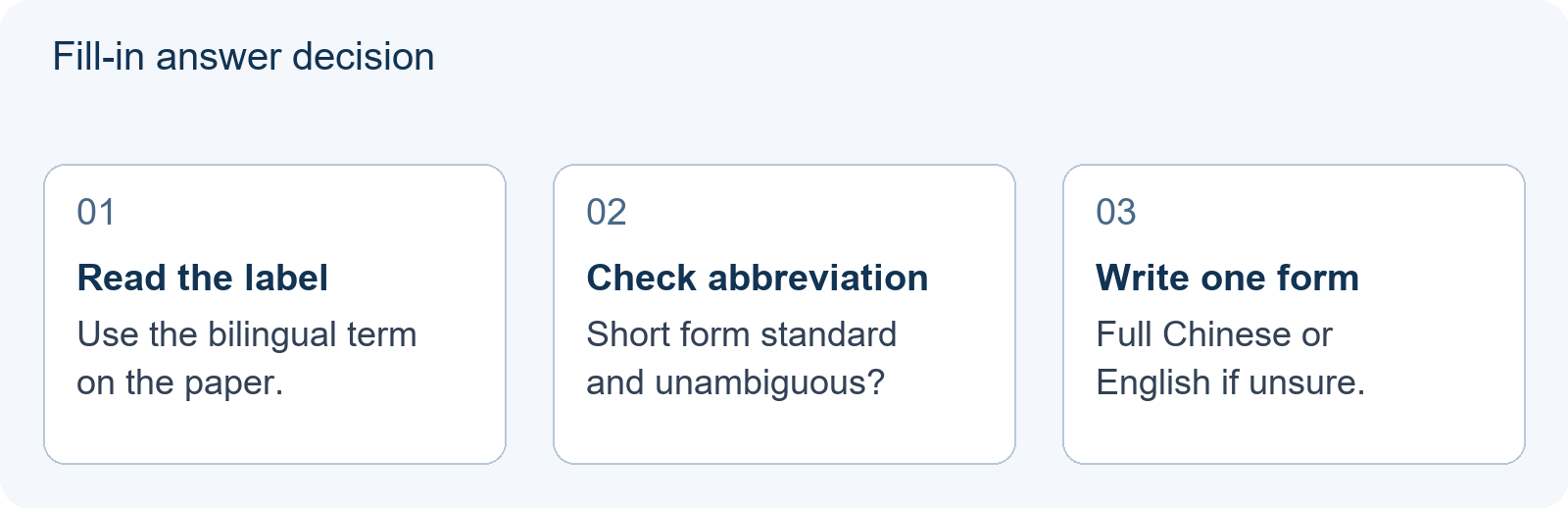
The practical audit is simple: if the abbreviation could reasonably expand to two different answers in the same question, do not use it. Write the full Chinese or English term. If the abbreviation is standard and the surrounding words pin the meaning, it can be a clear choice.
A five-minute practice drill
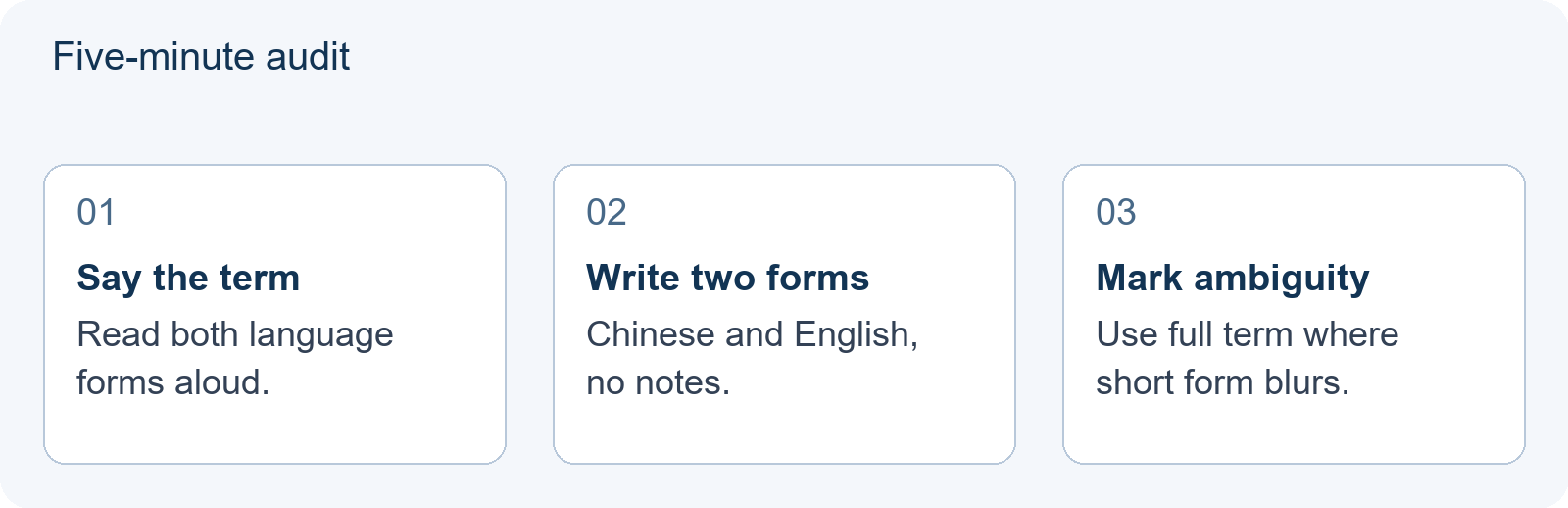
Use five term cards. For each card, cover the term, write the Chinese form and the English form from memory, then mark whether an abbreviation would be clear without extra explanation. This is a suggested teaching drill, not a description of an official exercise.
| Term | Chinese form | English form | Abbreviation audit |
|---|---|---|---|
| Hippocampus | Chinese term for hippocampus | hippocampus | No standard short form needed; write the full term. |
| Cerebrospinal fluid | Chinese term for cerebrospinal fluid | cerebrospinal fluid | CSF is clear when the context is CNS fluid. |
| Multiple sclerosis | Chinese term for multiple sclerosis | multiple sclerosis | MS is a standard short form in disease contexts; spell it out if the context is mixed. |
| Superior colliculus | Chinese term for superior colliculus | superior colliculus | SC can collide with spinal cord; write the full term. |
| Basal ganglia | Chinese term for basal ganglia | basal ganglia | BG is useful in neuroanatomy; spell it out in a mixed clinical context. |
After the drill, sort the cards into three piles: full term only, abbreviation acceptable, and abbreviation risky. The sorting decision is the skill. A student who can recognise a term but cannot choose a clear written form is losing time at the blank, not at the recall stage.
For self-testing beyond a single blank, see Practising for the Brain Bee Without an Official Question Bank: Testing Yourself in Four Formats. The format choice should match the answer mode you are training.
Exam-room workflow for a fill-in blank
First, read the bilingual label if the paper gives one. The prompt’s label is a spelling reference, so use it rather than reconstructing an English word from memory. Second, decide the answer mode before writing: full Chinese, full English or a standard abbreviation. Third, if the abbreviation has two plausible expansions in that question, choose the full term. Fourth, write one clear answer and move on. Hanlin’s report does not describe how double answers are marked, so writing two forms as insurance is not a documented strategy.
Do not switch mid-answer. A student who writes the Chinese term, crosses it out and then writes an English abbreviation has created a marking ambiguity that the language rule did not require. The same applies to writing an abbreviation and then adding a partial expansion that changes the answer.
The pacing context matters. Both regional papers are described by Hanlin as 90-minute papers: the senior Brain Bee paper has 80 questions worth 80 points, while the Junior paper has 60 questions worth 60 points. Those counts come from the 31 October 2026 report and are not a promise about every paper. For the senior pacing problem specifically, see Brain Bee Senior Regional Paper 2027: An 80-Question, 90-Minute Pacing Clinic. Answer-format decisions should be fast enough that they do not consume the time needed for the next question.
How to prepare a format question for a teacher
A useful question about answer format is specific. Bring the exact term, the answer you would write, the alternative you are considering, and the reason you are unsure. For example: “The blank asks for the structure damaged in a teaching case of anterograde amnesia. I know the English term and the Chinese term for hippocampus. I was going to write HIP. Is HIP a standard abbreviation a reader would recognise, or should I write the full term?” That question can be answered without guessing about the student’s general ability.
This preparation list is not a description of a Hanlin service, and it is not an official scoring request. It is a way to make a short diagnostic conversation useful. If you use the site contact route, bring those four notes: the exact prompt wording, your intended answer, your alternative, and the ambiguity you see. The teacher can then separate a knowledge gap from a format choice.
Parents can also use the same list. The productive question is not “Is Chinese better?” but “In this blank, is the student’s chosen form clear, standard and unambiguous?” That question respects the reported rule while keeping attention on answer quality.
The decision rule to remember
Write Chinese or English as the 2027 China regional rule allows. Use an English abbreviation only when it is a professional short form that a neuroscience reader would recognise and the question context fixes its meaning. If the short form could expand to two different answers, write the full term. If the student is unsure, the full term is the clearer default, not a sign of weaker preparation.
This is a Hanlin preparation perspective, not an official answer key. The source reports the language allowance; the student still has to supply the correct term. The next step is to practise choosing the form, not just recalling the word.
General event background is available at Event background.
This is an independent preparation guide, not affiliated with, endorsed by, or sponsored by the International Brain Bee.
Frequently Asked Questions
Can I write Chinese in every Brain Bee 2027 regional fill-in blank?
For the China regional paper described in Hanlin’s 31 October 2026 report, fill-in answers may be written in Chinese or English, and professional terms may use English abbreviations. That is a language allowance, not a guarantee that any Chinese wording will be marked correct; the answer still has to identify the right term.
Should I use an English abbreviation or spell out the term?
Use an abbreviation only when it is standard in the field and the question context makes its meaning clear. If the same letters could expand to two different structures, diseases or measurements, write the full Chinese or English term. This is a clarity rule, not an official scoring rule.
Does “Chinese or English accepted” mean spelling and abbreviations are not marked?
The reported rule describes accepted answer language; it does not say that spelling, terminology or abbreviation choice is ignored. Hanlin’s report also does not describe how double answers or partial credit are handled, so write one clear, correct form rather than relying on an undocumented shortcut.