
Why This Distinction Matters on Competition Day
Brain Bee preparation often treats “neurotransmitter” and “receptor effect” as a single fact to memorize. In practice, candidates who can separate the chemical signal from the cellular response earn stronger results. A molecule like acetylcholine can excite skeletal muscle at the neuromuscular junction and slow the heart at the vagus nerve terminal—same transmitter, opposite effects, because the receptor differs. The skill that distinguishes stronger competitors is not recall of one outcome, but the ability to reason from receptor type to expected effect.
Worked Teaching Illustration 1: Glutamate at Two Synapses
Consider this teaching illustration: a presynaptic neuron releases glutamate onto two different postsynaptic cells.
- Cell A expresses AMPA receptors. Glutamate binding opens a non-selective cation channel; Na⁺ influx depolarizes the membrane. Result: excitatory postsynaptic potential (EPSP).
- Cell B expresses NMDA receptors on the same circuit. The same glutamate molecule binds, but the ionic mechanism differs: NMDA receptors permit Ca²⁺ entry and require depolarization to relieve Mg²⁺ block. The transmitter has not changed—only the receptor and its coupled effect.
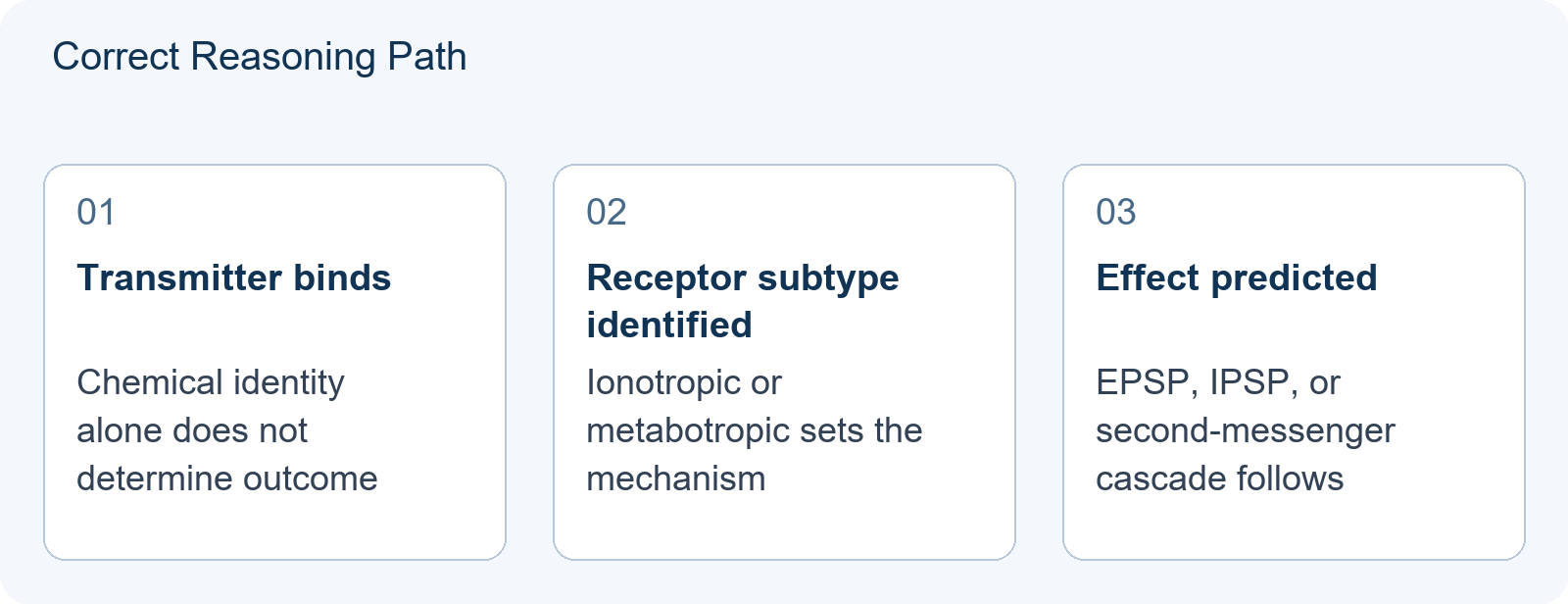
The correct reasoning path is: identify the transmitter → identify the receptor subtype → predict the ionic or second-messenger consequence. Skipping the middle step risks conflating “glutamate” with “excitation” as an absolute rule. A student who reasons this way can handle novel synapse descriptions even when the specific transmitter-receptor pairing has not appeared in standard study materials.
Worked Teaching Illustration 2: Where the Shortcut Fails
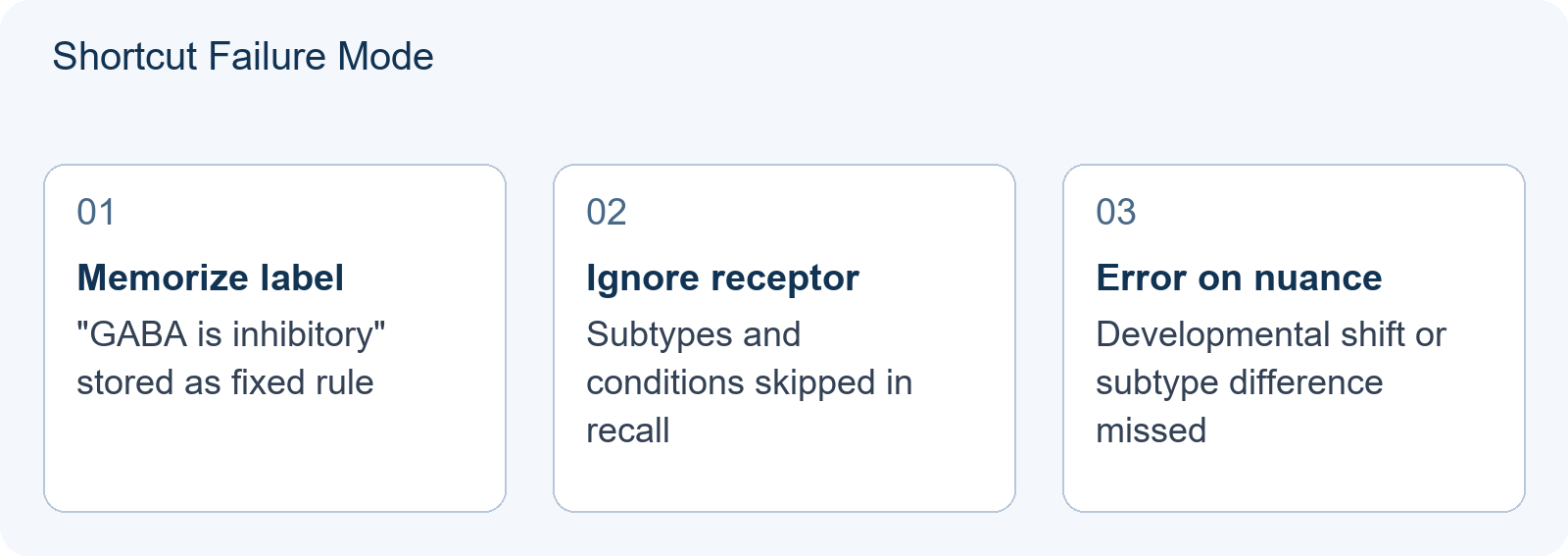
Now suppose a student memorizes: “GABA is inhibitory.” This shortcut works for many synapses, but it collapses under scrutiny. GABAA receptors are ligand-gated chloride channels that typically hyperpolarize or stabilize the membrane. Yet the same GABA molecule, acting at a GABAB receptor, engages a G-protein cascade that modulates presynaptic calcium channels or activates K⁺ channels through a different temporal profile and spatial spread.
More subtly, in developing neural tissue, intracellular chloride concentration is higher, shifting the chloride reversal potential in a depolarizing direction. Under these conditions, GABAA receptor opening can produce depolarization rather than hyperpolarization—a nuance that teaching illustrations sometimes use to test whether a student relies on receptor-effect reasoning or transmitter-label recall. The mistake is not the factual statement that GABA is usually inhibitory in mature circuits. The mistake is treating the transmitter name as the explanation for the effect, rather than treating the receptor-effector coupling as the explanatory level.
Worked Teaching Illustration 3: Dopamine’s Opposite Paths
A third teaching illustration shows how one transmitter can produce directly opposite effects even in the same brain region. Dopamine released from midbrain neurons projects to the striatum, where it acts on two distinct receptor families:
- D1-family receptors (excitatory Gs-coupled) on direct-pathway medium spiny neurons facilitate movement initiation.
- D2-family receptors (inhibitory Gi/o-coupled) on indirect-pathway medium spiny neurons suppress movement.
The same dopamine molecule, in the same synaptic cleft, produces opposite physiological consequences depending solely on which receptor subtype occupies the postsynaptic membrane. A student who memorizes “dopamine excites” or “dopamine inhibits” will face contradictions. The reliable approach is to identify the receptor family first, then map to its coupled G-protein and downstream effect. This illustration also demonstrates why pharmacological agents that block one dopamine receptor subtype can produce motor symptoms while sparing cognitive circuits—the receptor, not the transmitter, determines the functional domain.
Diagnostic Table: Signal vs. Receptor Effect
| Question asks about… | Focus on | Common trap |
|---|---|---|
| Which ion enters? | Receptor channel selectivity | Naming the transmitter only |
| Excitatory or inhibitory outcome? | Receptor subtype + ion reversal potential | Assuming all outputs of one transmitter are identical |
| Speed of onset | Ligand-gated ionotropic vs. metabotropic | Confusing synaptic location with kinetics |
| Second messenger involved | G-protein or enzyme coupling | Attributing cascade to transmitter name alone |
| Functional circuit effect | Receptor family + target neuron identity | Assuming uniform action across all projections |
Building the Skill: A Practice Sequence
To build reliable separation between signal and effect, try this progression:
- Isolate the receptor: Given a synapse description, name the receptor family first, then justify the expected potential change. Example: “This is a nicotinic acetylcholine receptor, therefore ligand-gated cation channel, therefore depolarization.”
- Cross-comparison: Pick one transmitter and map its receptor subtypes to opposite effects across tissues. Acetylcholine is ideal: nicotinic excitation at skeletal neuromuscular junction versus muscarinic slowing at cardiac pacemaker cells. The same molecule, opposite outcomes, explained entirely by receptor identity.
- Conditional reasoning: Practice “if…then…because” statements where the condition is receptor identity, not transmitter presence. For example: “If the receptor is ionotropic, then the response is fast and direct, because no second-messenger cascade is required.”
- Deliberate mismatch practice: Construct scenarios where the expected association fails. Ask yourself: “Under what conditions would GABA produce depolarization?” or “When would glutamate receptor activation not produce an EPSP?” This builds flexibility for unfamiliar question formats.
For broader circuit context, see our Brain Bee 2027 Sensory Systems: Trace Vision, Hearing, Touch, Taste and Smell From Receptor to Cortex, which traces receptor-to-cortex pathways where this same principle applies. If you are earlier in preparation, the Brain Bee Study Materials: Matching Essential Neuroscience, BrainFacts and Atlas to the Questions You Will Actually Face covers synaptic structure terms used here. For competition structure and registration timing, refer to Brain Bee Registration 2027: Preparing Your Entry and Study Plan.
Applying the Distinction Under Exam Conditions
A well-prepared competitor should handle questions that present a novel synapse and ask for the predicted effect. The demonstrated skill is: given transmitter X and receptor Y, derive consequence Z—without relying on a fixed association between X and Z. This means recognizing that dopamine can excite through D1-family receptors in some pathways and inhibit through D2-family receptors in others, or that serotonin receptor families range from ionotropic (5-HT₃) to multiple G-protein-coupled subtypes with divergent signaling.
The protective habit is mechanical: every time you see a transmitter name, immediately ask which receptor subtype is specified before committing to an effect. If the question does not specify, look for contextual clues—tissue type, developmental stage, or circuit location—that point toward one receptor family as more probable. This disciplined intermediate step prevents the most common error in this topic area and converts memorization-dependent recall into transferable analytical reasoning.
What You Should Be Able to Demonstrate
After working through these teaching illustrations, a prepared competitor should handle synapse-level questions by identifying the receptor subtype as the decisive variable. The target skill is conditional prediction: given a specified receptor, state the expected ionic or second-messenger consequence, and explain why the same transmitter could yield a different outcome elsewhere. This level of reasoning separates label-memorization from the analytical application that competition questions at the national and international levels consistently require.
Frequently Asked Questions
Does Brain Bee expect me to know specific receptor subtypes for every transmitter?
Preparation should prioritize the major receptor families that explain classic physiological effects—nicotinic/muscarinic for acetylcholine, ionotropic/metabotropic for glutamate, GABA-A/GABA-B for GABA, D1/D2 families for dopamine. The exam tests whether you can use receptor identity to explain an effect, not exhaustive pharmacological cataloging.
How do I avoid confusing similar-sounding receptor names under time pressure?
Build associations around mechanism, not spelling. AMPA and NMDA are both glutamate receptors, but AMPA is purely ionotropic (fast Na⁺/K flux) while NMDA adds voltage-dependent Mg²⁺ block and Ca²⁺ permeability. Linking the name to its functional signature prevents cross-wiring.
Should I study ion reversal potentials in detail for this distinction?
Yes, at the level of knowing that Cl⁻ reversal near resting potential makes GABA-A opening typically stabilizing/hyperpolarizing, while a depolarized Cl⁻ equilibrium in immature neurons can reverse this logic. The exam tests whether you understand that the same receptor can have context-dependent consequences.