Every Brain Bee China paper in the 2027 season is written in Chinese. The National Brain Bee Organizing Committee's September 2026 notice says technical terms in the questions are marked in both Chinese and English, and written answers may be given in either language, with English abbreviations accepted for technical terms. So a student who learned neuroscience in English does not need to write Chinese. They need to read it quickly and accurately, and that can be trained.
This matters most to the readers this site is written for: international-school students who study biology in English, revise from an English syllabus text, and then sit a paper whose every question stem is in Chinese. The fix is not translating harder under the clock. It is a few reading habits and a way of keeping notes that makes both languages point at the same idea.
What the notice promises, stage by stage
The language rule appears three times in the notice, for the regional round and for the national round of each group, and it says the same thing each time, with one addition for the Junior poster.
| Stage | Questions are written in | You may answer in | What it changes |
|---|---|---|---|
| Regional paper, both groups, 9 January 2027 | Chinese, with technical terms marked in Chinese and English | Option letters for multiple choice; Chinese or English for blanks; English abbreviations for technical terms | Reading speed becomes part of what is tested |
| National written paper, both groups | Chinese, with technical terms in both languages | Chinese or English; English abbreviations accepted | The same skill on harder content |
| National identification and case questions, grades 9–12 | Chinese, with technical terms in both languages | Chinese or English for any answer that is not multiple choice | You can name structures and argue a diagnosis in English |
| National team poster, grades 5–8 | A designated theme, worked on site | Made and presented in Chinese or English | Settle your team's working language before the day |
Two numbers put the table in perspective. The regional paper runs from 10:00 to 11:30: 90 minutes for 80 questions in the Brain Bee group for grades 9–12, about 67 seconds a question, and 90 minutes for 60 questions in Brain Bee Junior for grades 5–8, or 90 seconds. Every one of those seconds includes reading a Chinese stem, and every question is worth one mark. A student who reads Chinese science prose slowly can lose marks without getting a single fact wrong.
One correction is worth making plainly. Some guidance written before this notice, ours included, told students to drill English spelling on the assumption that blanks had to be answered in English. The 2027 notice removes that pressure. It does not remove the pressure to read.
Why is the bilingual label not the hard part?
Look at the exact promise: technical terms are marked in both languages. Nothing is said about the words around them, such as the verbs that say what a structure does, the quantifiers that decide whether a statement is true and, above all, the words that tell you what kind of answer the question wants. In Chinese-language multiple-choice papers generally, those small words carry the logic of the question, and they are where English-trained readers slip.
| Pattern | What it means | The trap |
|---|---|---|
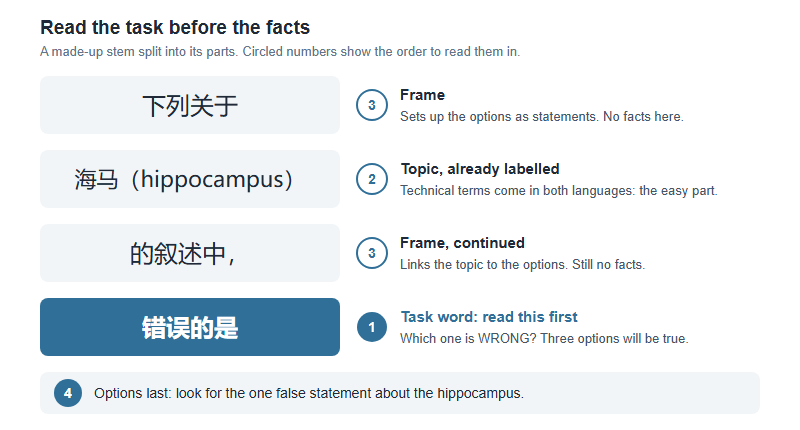
| 下列说法中,错误的是 | Which of the following statements is wrong? | Three options are true; you are hunting for the false one |
| 不正确的是 / 不属于 | Which is not correct / does not belong | A single character, 不, reverses the task |
| 除……外,其余均…… | Apart from one, all the rest are… | The answer is the odd one out |
| 最可能 | Most likely | Several options may be defensible; choose the best supported |
| 主要 | Mainly, chiefly | A partly true option can still be the wrong answer |
| 均 / 都 | All, every | One exception makes the whole statement false |
| 促进 / 抑制 | Promotes / inhibits | The direction decides the answer, not the structure named |
| 升高 / 降低 | Rises / falls | Read the direction before you read the options |
The habit that fixes this is mechanical, and it works. Before you read a single option, find the task word and circle every negative. Only then read the options. It costs two or three seconds a question and removes the most expensive error on a second-language paper, answering the opposite of what was asked, which here costs a full mark every time it happens.
Bridge terms instead of translating them
Students who already decode English terms by their Greek and Latin parts have an advantage they may not know about. Many Chinese neuroscience names were built on the same picture as the Latin or Greek. The hippocampus is named after a sea horse, and 海马 means sea horse. The amygdala is an almond, and 杏仁核 is an almond-shaped nucleus. Where the picture is shared, you do not translate the term at all; you recognise the image in whichever language appears.
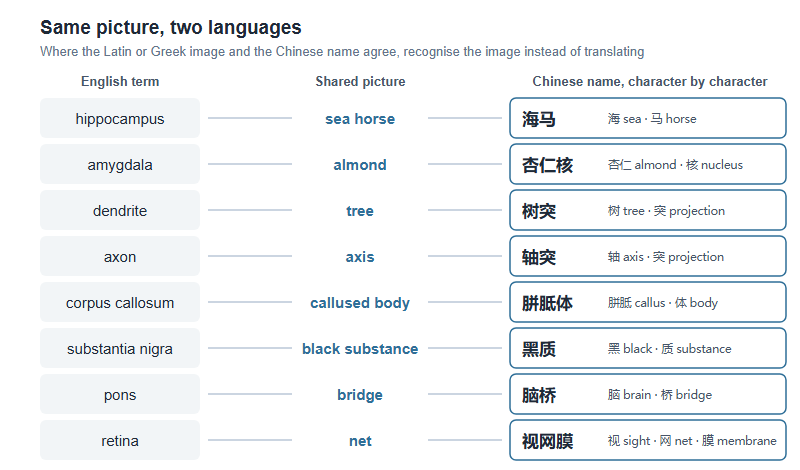
The match is not universal, and the exceptions deserve a line in your notes. Thalamus comes from a Greek word for an inner chamber, while 丘脑 reads as "mound brain". Synapse means a joining together, while 突触 describes the point where a projection makes contact. Where the pictures differ, learn the pair deliberately rather than hoping one will suggest the other.
The traps: two names for one thing, and names one character apart
Two kinds of vocabulary cost English-trained readers more than any long technical term. The first is a concept with two Chinese names, where you know one and the paper uses the other. The second is a pair of names that differ by a single character and mean opposite or neighbouring things. The knowledge outline attached to the notice shows why the first kind matters: it writes Alzheimer's disease as 阿兹海默症, Parkinson's disease as 帕金森症, stroke as 中风 and autism as 自闭症, while many Chinese textbooks and clinical texts use 阿尔茨海默病, 帕金森病, 脑卒中 and 孤独症.
| English | Chinese you may meet | Why it trips readers |
|---|---|---|
| serotonin (5-HT) | 5-羟色胺 · 血清素 | The formal and everyday names look unrelated |
| cerebral cortex | 大脑皮层 · 大脑皮质 | One character differs; both are correct |
| basal ganglia | 基底神经节 · 基底核 | Two established names in textbooks |
| receptor | 受体 (molecular) · 感受器 (sensory) | One English word, two different Chinese words |
| nucleus | 细胞核 (of a cell) · 核团 (a cluster of neurons) | One English word for two different things |
| thalamus / hypothalamus | 丘脑 / 下丘脑 | One character, 下, meaning below |
| cerebrum / cerebellum | 大脑 / 小脑 | Big brain and little brain are easy to swap at speed |
| sympathetic / parasympathetic | 交感神经 / 副交感神经 | 副 carries the para- |
| afferent / efferent | 传入 / 传出 | Carry in and carry out |
| neuron / nerve | 神经元 / 神经 | A single cell versus a bundle of fibres |
| rods / cones | 视杆细胞 / 视锥细胞 | Rod-shaped versus cone-shaped receptors |
| depolarisation / hyperpolarisation | 去极化 / 超极化 | Opposite directions of voltage change |
Build these as pairs from the first week, not as a list to cram in December, and notice which risk each kind carries. For the two-name concepts the risk is recognition: you may simply not know the word in front of you. For the one-character pairs the risk is speed: they are hard to misread at leisure and easy to misread at 67 seconds a question.
Answering in English: when abbreviations help and when they hurt
Because written answers may be given in Chinese or English, the rule is simple: write the version you can produce precisely. For most students who revised from Brain Facts, published by the Society for Neuroscience and available at brainfacts.org and named in the notice as the main basis of the regional paper, that will be English. Do not switch to Chinese in the middle of a paper for a term you are unsure how to write; a half-remembered character is no more precise than a correctly spelled English word.
The notice accepts English abbreviations for technical terms but does not list which ones, and that silence argues for caution. The safe end is the set of standard, single-meaning forms: the outline itself uses EEG, CT, PET, MRI, fMRI and ALS, and GABA and LTP are just as unambiguous in textbooks. Two-letter forms such as AD, PD, MS or AP can stand for more than one thing, so write those terms in full. An abbreviation that saves four seconds and leaves a marker in doubt is not a saving.
Junior students have one extra decision. The team poster may be made and presented in Chinese or English, and teams of four to five form after the qualifier list is published. A team that settles its working language before the day spends its set time on the poster rather than on negotiating how to write it. If you are still getting oriented to how the rounds fit together, our guide to what the Brain Bee is lays out the whole ladder.
A reading-first routine for the weeks before 9 January
Mid-September to the regional paper is about sixteen weeks. The routine below adds reading practice to content study rather than competing with it, and it is built to fit inside about three hours a week alongside school.
- Three-column notes from day one. For every term you meet in Brain Facts, write the English term, the Chinese term, and the picture or meaning that links them. One line per term; the third column is what makes the other two stick.
- Parallel reading once a week. For the Brain Bee group, the notice suggests relevant chapters from a 2025 Chinese-language introduction to cognitive neuroscience by Shen Zheng, Fang Fang, Yang Jiongjiong and co-authors, and from introductory textbooks such as Neuroscience: Exploring the Brain by Mark F. Bear, Barry W. Connors and Michael A. Paradiso, which it names alongside its Chinese title. After finishing a Brain Facts chapter, spend twenty minutes on the matching section in Chinese with your English notes beside you. Junior students can do the same with the Chinese-language science reading their school already uses.
- Circle negatives on every practice question. Task word first, negatives circled, options last, until the order runs without thinking.
- Two full-length timed runs in December. Sit 80 questions, or 60 for Junior, in 90 minutes, using Chinese-language question stems wherever you can get them, so that reading speed is tested before 9 January rather than on it. We keep our own gathered pack of past-style questions, which you can ask for through the contact banner at the foot of this site; worked solutions cover some years, not all.
- Keep the English alive. Your syllabus text is in English and your notes should stay bilingual. Dropping English terminology to prepare for a Chinese paper simply moves the problem to the next thing you read.
None of this changes what the paper tests, which is neuroscience. It changes whether what you know reaches the answer sheet. For the rules themselves, the notice on chinabrainbee.com is the authority, and our overview of the competition covers the structure around it.
Questions students ask
Is the Brain Bee China 2027 regional paper in Chinese or English?
In Chinese. The 2027 notice says technical terms inside the questions are marked in both Chinese and English.
Can I answer fill-in-the-blank questions in English?
Yes. The notice accepts blank answers in Chinese or English and allows English abbreviations for technical terms.
Which English abbreviations are safe to use?
The notice does not list them. Use unambiguous textbook forms such as EEG, MRI or GABA, and write two-letter forms like AD in full.
Can the Junior national poster be in English?
Yes. The notice says the team poster may be made and presented in Chinese or English, so agree your team's language early.
This is an independent guide operated by Hanlin Education for China-based international-school students. We are not affiliated with, endorsed by, or sponsored by the International Brain Bee (IBB), and we are not the official Brain Bee China national round; entry, rules and language arrangements for the China region sit with the National Brain Bee Organizing Committee at chinabrainbee.com. Confirm current details on thebrainbee.org. Any factual error reported to us is corrected within 7 working days.