A Brain Bee result is worth something specific and limited: it is evidence that you performed four quite different intellectual tasks under pressure — recall, visual identification, case reasoning and spoken retrieval. It is not a credential that produces an outcome, and no competition result is. Understanding exactly which claim your result supports is what lets you describe it convincingly instead of vaguely.
Start with what the competition actually measures
Most students describe a competition result by its level — regional, national, an award tier. That is the least informative thing about it, because a reader outside the competition has no calibration for what those words mean. What travels much better is what you had to be able to do.
The Brain Bee is unusually well suited to this, because its assessment is genuinely multi-modal. The competition runs in three tiers — Local, then National, then the IBB World Championship — with each national chapter sending exactly one representative to the world final. That final has four sections: neuroanatomy and neurohistology on real brains or images; a written test; patient diagnosis from video footage plus a written medical history; and a live oral judging round in which two wrong answers eliminate a competitor. Our overview of the competition sets out how those pieces connect.
Four sections, four different demands. That is the substance of the signal.
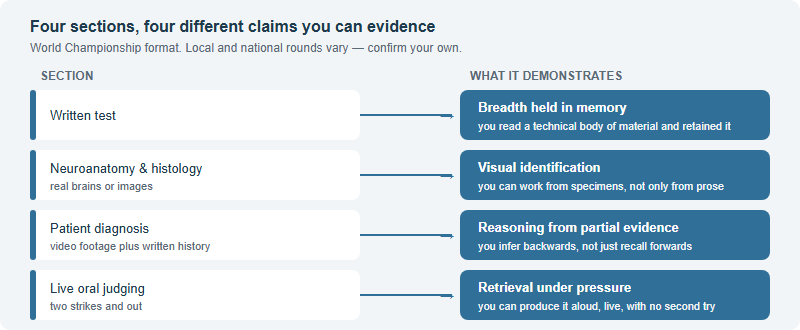
The reason this mapping is useful is that it lets you make a claim with a receipt attached. “I am interested in neuroscience” is an assertion anyone can make. “I spent a season learning neuroanatomy well enough to identify structures on unfamiliar images, and to reason from video signs to a location in the nervous system” is a description of work, and it happens to be checkable.
Why the structure of the funnel matters when reading a result
A second thing that makes Brain Bee results readable is that the pathway is narrow by design. Three tiers, and one representative per national chapter at the world final. That is an unusually sharp funnel, and it means a placing in a national round is not a participation marker.
But it also means something more sober: most students who do this well will not reach the world final, because the structure only permits one per chapter. If your mental model is “the point is the World Championship,” the arithmetic is against you and the disappointment is built in. A better model is that each tier is a real test with its own value, and the learning is the part that transfers regardless of where you stop.
Here is the shape of one cohort we worked with, shown honestly — not as a benchmark you should expect to match.
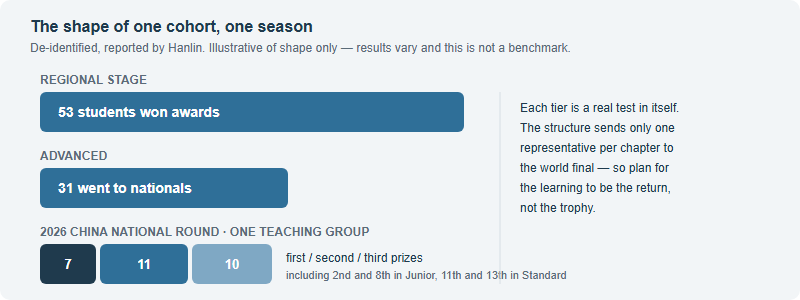
Two caveats on that figure, stated plainly. Junior (grades 5–8) and Standard (grades 9–12) are China-region divisions, not an International Brain Bee structure. And these numbers describe one group of students in one season, are de-identified, vary by student, are not a prediction for any individual, and are not tied to Chinese school admission, which operates under entirely separate policy.
How to describe a result without overclaiming
The most common failure is not exaggeration; it is vagueness. Below are the rewrites we push students towards. The pattern in every case is the same: replace the adjective with the evidence.
| Weak version | Why it fails | Stronger version |
|---|---|---|
| “I am passionate about neuroscience.” | Unverifiable, and identical to what thousands of others write. | “I worked through the Brain Bee syllabus over one season and learned to identify structures on unfamiliar images, not only in diagrams.” |
| “I won a prize in a national neuroscience competition.” | The reader has no calibration for the prize and learns nothing about you. | “In my round I was assessed on anatomy identification and on reasoning from a case history — the second was much harder for me, and it changed how I revise.” |
| “This competition proves I can handle a medical degree.” | Claims something a school competition cannot establish. Readers discount it. | “It was the first time I had to give a scientific answer out loud with no chance to revise it, which is a skill I had never practised.” |
| “I studied very hard for it.” | Effort without a method is not evidence of anything. | “I stopped rereading chapters and started drawing labelled diagrams from memory every week, because rereading was not producing recall.” |
Notice that the strong versions frequently mention something that went badly. That is not modesty for its own sake. A student who can name the section they struggled with, and what they changed as a result, is demonstrating self-assessment — which is a rarer and more persuasive quality than a placing, and one that cannot be manufactured after the fact. It also reads as true, because it is.
One method note from our own teaching that is worth generalising, and worth stating carefully. Students sometimes ask whether starting in grade 9 is already too late. The transferable point is entirely about method — a late start is not disqualifying if the preparation is production-based rather than reading-based, which is the argument behind our whole approach to this competition. It is not a claim that a competition result produced any admission or offer, and nothing here should be read that way.
What a result cannot do
Being precise about the limits is what makes the rest credible. Four things a Brain Bee result does not do:
- It does not guarantee an outcome anywhere. No competition result does, and any programme that implies otherwise is telling you something it cannot know. Outcomes depend on the whole application and on decisions made by other people.
- It does not substitute for sustained work. A single competition sitting in isolation reads as a one-off. The same result inside a pattern — continued reading, a related project, a sustained interest visible over time — reads completely differently.
- It does not translate automatically across systems. How any credential is treated varies by country, by institution and by year, and Chinese school admission in particular follows separate policy. Do not assume a competition result carries the same meaning everywhere.
- It does not make you a scientist yet. It shows you can learn a body of knowledge and apply it under pressure. That is genuinely worth something, and it is not the same as having done research.
The healthiest way to hold all of this: enter because the material is interesting and the four-way assessment will make you better at things you are otherwise never asked to do — identifying structures visually, reasoning backwards from evidence, and answering aloud without a safety net. Those skills outlast the certificate. If a result also helps you describe yourself more precisely, that is a genuine secondary benefit, not the reason to start.
Before you plan around any of this
Confirm the following officially rather than taking it from an article. Your eligibility and division: in practice the competition runs for grades 5–12, roughly ages 10 to 18, split into divisions by grade, and the one firm ceiling is that a national champion at the World Championship may not be older than 19 — but division rules are set by your chapter. Your round format, since local and national rounds do not necessarily mirror the four-section world final. And this season's dates, which change every year and which we deliberately do not state here.
For the China round, registration and official information sit with the National Brain Bee Organizing Committee at chinabrainbee.com; Brain Bee has run in China since 2013, with university partners including Tsinghua, HKU, Zhejiang, Fudan and the Chinese Academy of Sciences. Note that Hong Kong, Taiwan and Macao are separate chapters rather than part of the China chapter. The syllabus material is Brain Facts, published by the Society for Neuroscience and available at brainfacts.org, or Neuroscience: The Science of the Brain. Everything above about the three tiers and the four World Championship sections is documented on thebrainbee.org.
Frequently asked questions
What does a Brain Bee result actually demonstrate?
That you handled four different tasks: written recall, visual structure identification, reasoning from a case, and answering aloud under elimination pressure.
Does a Brain Bee placing guarantee anything for an application?
No. No competition result guarantees an outcome. It is one piece of evidence about how you work, and it is strongest inside a wider pattern.
How should I write about it?
Replace adjectives with evidence. Name the section that was hardest and what you changed, rather than describing yourself as passionate.
Is it too late to start in grade 9 or later?
Not necessarily. Method matters more than start date — production-based revision beats rereading. Confirm your division's eligibility officially.
This is an independent English-language Brain Bee guide operated by Hanlin Education for China-based international-school students. It is not affiliated with, endorsed by, or sponsored by the International Brain Bee (IBB), and it is not the official Brain Bee China national round, which is run by the National Brain Bee Organizing Committee at chinabrainbee.com. Round formats, rules, divisions, eligibility and dates are set by the organisers and change from year to year — always confirm current details on thebrainbee.org before planning around them. Nothing here is admissions advice or a prediction of any admission, offer or outcome; how any credential is treated varies by institution, country and year, and Chinese school admission follows separate policy. Competition results reported here are de-identified, provided by Hanlin, describe one cohort in one season, vary by student, and are not a benchmark or a prediction for anyone. Confirmed errors are corrected within 7 working days.