
One of the four sections at the International Brain Bee World Championship is patient diagnosis, worked from video footage together with a written medical history. Two things about it are widely misreported online: it is not conducted with live actor patients, and it is not a memory test. It rewards a reasoning habit — localise first, then characterise — that you can train deliberately, and this article shows how.
What the section is — and the myth to drop first
The Brain Bee runs in three tiers — Local, then National, then the IBB World Championship — and each national chapter sends exactly one representative to the world final. That final has four sections: neuroanatomy and neurohistology on real brains or images; a written test; patient diagnosis from video footage plus a written history; and a live oral judging round. Our Brain Bee overview explains how those tiers and sections connect.
The myth worth correcting immediately, because it changes how students prepare: you will read in a lot of second-hand write-ups that competitors “interview real patients” or “examine actors playing patients.” The verified format is video footage with a written history. That difference matters practically. You are not being assessed on bedside manner, on asking good questions, or on performing an examination. You are being assessed on what you notice in footage you cannot control, what you infer from a history you are handed, and which limited set of investigation results you choose to request. Preparation aimed at “practising taking a history from a volunteer” trains the wrong muscle entirely.
One scope note we want to be strict about: that four-section structure describes the World Championship. Whether any particular local or national round includes a diagnosis component, in what format, and with what weighting, is set by the organisers and varies by year. Confirm the format of the round you are actually entering — for the China round, the official channel is the National Brain Bee Organizing Committee at chinabrainbee.com, which is also where registration lives. This site is an independent guide and does not run that round.
A second, non-negotiable note. Everything below is a study framework for a science competition. It is not clinical guidance, it is not a diagnostic method, and it must never be used to assess a real person's symptoms. If something concerns you about someone's health, that is a matter for a qualified clinician, not for competition practice.
Why this section separates thinkers from memorisers
Most competition preparation optimises for recall: you learn a disorder, you learn its features, and a question asks you to reproduce them. Case reasoning runs the other way. You are given features and asked to work backwards to the process that produced them — and the features arrive incomplete, in an unfamiliar order, and mixed with detail that turns out not to matter.
Students trained only on recall tend to fail in one characteristic way: they pattern-match on the loudest single feature. A tremor appears in the footage, and the answer arrives before anything else has been considered. The trouble is that a single sign is usually compatible with several very different processes, and the information that separates them is almost always sitting in the written history rather than in the footage — in the age, the speed of onset, and the shape of the course over time.
The fix is to impose an order on your thinking and never break it, which is what the next section is about.
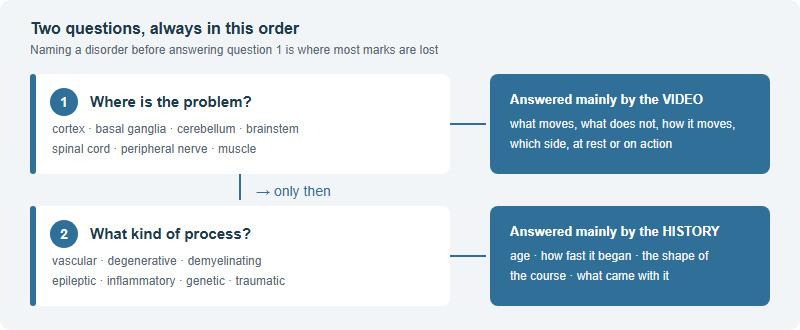
Question one: what the footage can tell you
Watch with a checklist rather than an opinion. The point of a first pass is not to decide anything; it is to collect observations you can later defend. A workable checklist, in the order it is easiest to run:
- Symmetry. Is one side of the body or face doing something the other is not? Asymmetry is one of the strongest localising observations available, and it is easy to miss if you are already busy hypothesising.
- Movement that should not be there. Is there a tremor, and if so, is it present at rest or when the person reaches for something? Is there stiffness, or a movement that looks involuntary?
- Movement that should be there and is not. Slowness, reduced facial expression, reduced arm swing, weakness on a particular task.
- Coordination and gait. Is the walking pattern wide, unsteady, shuffling, or veering to one side? Does a reaching movement overshoot?
- Speech and eyes. Is speech slurred, slow, or hesitant in finding words — three quite different problems? Do the eyes move together?
Then convert observations into a location claim. Very broadly — and this is a study heuristic, deliberately coarse — problems with coordination and balance point towards the cerebellum; problems with the amount and quality of movement rather than raw strength point towards the basal ganglia; clear one-sided weakness with the face and limb involved together points towards the opposite side of the brain; and weakness or sensory loss following the pattern of a nerve or a muscle group points outside the brain altogether. Getting to the right region is worth far more than guessing a named disorder, because it is the step that eliminates most of the wrong answers at once.
Question two: the shape of the story over time
Once you have a location, the written history tells you what kind of process is producing it. The single most informative thing in almost any history is how the problem began and what it has done since — and that has a small number of recognisable shapes.
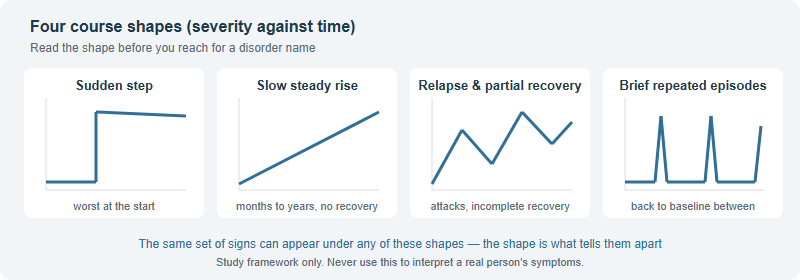
Used together, the shape of the course and the patient's age narrow the field before you name anything. The table below sets out the pairing we teach students to run — again as a revision scaffold, deliberately broad, and explicitly not a diagnostic tool.
| What the history says | The category it points towards | The trap |
|---|---|---|
| Maximal within seconds to minutes, then stable or slowly improving | A vascular event — something happened to the blood supply | Assuming “sudden” means severe. Speed of onset is the clue, not severity. |
| Gradual over months or years, steadily worsening, no recovery | A degenerative process | Reading “noticed recently” as recent onset — families often notice late. |
| Distinct attacks with partial recovery in between, over years | A relapsing process such as demyelination | Treating each attack as a separate event instead of one pattern. |
| Brief, repeated, stereotyped episodes with a return to normal between them | An episodic process such as seizure activity | Missing the word “identical each time” — stereotypy is the key word. |
| Days to weeks, with fever, illness or other systemic features | An infectious or inflammatory process | Ignoring the non-neurological detail in the history as irrelevant. |
| Present since early life, or a family history mentioned | A genetic or developmental cause | Skipping the family history line because it looks like background. |
Notice how often the trap column is about reading rather than knowing. Case questions are partly comprehension tests, and the detail that decides the answer is regularly the one that looks like scene-setting.
A six-week training plan you can run without a hospital
You cannot rehearse the real section, because you do not control the footage or the histories. You can rehearse every component skill. Work with published teaching cases, textbook case vignettes and the case material in your syllabus reading rather than anything involving a real identifiable person.
- Weeks 1–2 — observation only. Take any teaching video or described case and write ten observations before allowing yourself a single hypothesis. The discipline being built is delay, and it is harder than it sounds.
- Weeks 3–4 — localise out loud. For each case, say where the problem sits and name the one observation that made you say it. If you cannot name the observation, you guessed.
- Week 5 — shape the history. Read only the written history, with no footage, and sketch the course curve. Then predict what the footage would show. Then check.
- Week 6 — full runs under time. Combine both, on a clock you set yourself, and finish every case with a one-sentence answer in a fixed form: “This localises to X, because of Y; the course suggests a Z process.”
Two habits are worth carrying beyond the six weeks. Keep an error log that records which step failed — missed observation, wrong localisation, or right localisation with the wrong process — because the three need different remedies. And practise saying the answer aloud in one sentence, since the ability to state a conclusion cleanly under pressure is exactly what the spoken section of the competition also demands.
What our own cohort suggests, and what to confirm officially
Across one recent season, students prepared by Hanlin took 53 awards at the regional stage, with 31 advancing to the national round; at the 2026 China national round one teaching group within that cohort took 7 first prizes — including 2nd and 8th in the Junior division and 11th and 13th in the Standard division — plus 11 second prizes and 10 third prizes. Junior (grades 5–8) and Standard (grades 9–12) are China-region divisions rather than an International Brain Bee structure. These figures are de-identified, reported by Hanlin, describe one cohort in one season, vary by student, are not a prediction for anyone, and are not tied to Chinese school admission.
The teaching observation behind them is narrow but consistent: on case work, the students who improved fastest were not the ones who learned more disorders. They were the ones who stopped answering with a disorder name and started answering with a location. Once a student can reliably say “this is cerebellar” or “this is basal ganglia” and justify it from one observation, the disorder name usually follows from far less memorised content than they expected — which is the same efficiency argument behind our broader approach to preparing for this competition. We also maintain our own gathered pack of past questions for students we work with, though worked solutions are not available for every year.
Confirm these things officially rather than from this article. Whether the round you are entering includes a diagnosis component at all and in what format; your division and current eligibility; and this season's dates, which change every year and which we deliberately do not state here. For the China round the official channel is the National Brain Bee Organizing Committee at chinabrainbee.com — and note that Hong Kong, Taiwan and Macao are separate chapters rather than part of the China chapter. What is stated above about the four World Championship sections, including that diagnosis is worked from video footage and a written history, is documented on thebrainbee.org.
Frequently asked questions
Does the Brain Bee patient diagnosis section use real patients?
No. The World Championship section works from video footage together with a written medical history, not live actor patients or real interviews.
What should I do first when a case appears?
Answer where the problem sits before naming any disorder. Localisation from the footage eliminates most wrong answers immediately.
What does the written history add?
Mainly age, how fast the problem began, and the shape of its course — which is what separates disorders that look identical on video.
Can I use this framework on a real person?
No. It is a competition study device only. Any real health concern is a matter for a qualified clinician.
This is an independent English-language Brain Bee guide operated by Hanlin Education for China-based international-school students. It is not affiliated with, endorsed by, or sponsored by the International Brain Bee (IBB), and it is not the official Brain Bee China national round, which is run by the National Brain Bee Organizing Committee at chinabrainbee.com. Round formats, rules, divisions, eligibility and dates are set by the organisers and change from year to year — always confirm current details on thebrainbee.org before planning around them. The reasoning frameworks, tables and drills above are our own teaching devices for competition study, not published marking schemes and not clinical or medical guidance. Competition results reported here are de-identified, provided by Hanlin, vary by student, are not a prediction of any outcome, and are not tied to Chinese school admission. Confirmed errors are corrected within 7 working days.