Most Brain Bee local rounds are based on Brain Facts, published by the Society for Neuroscience and available at brainfacts.org, or on Neuroscience: The Science of the Brain; each national round is organised individually, so confirm what your own round sets — for China, through the National Brain Bee Organizing Committee at chinabrainbee.com. The mistake almost every student makes is to read the book twice and call that preparation. The method below turns each chapter into three things you can be tested on — a glossary card, a blank diagram and three recall questions — and then schedules the retest.
Why reading it twice does not work
Reading builds recognition. The Brain Bee tests recall. Those are different memory operations, and the gap between them is where good students lose. When you re-read a paragraph about the basal ganglia, your brain registers “yes, I know this” because the words are familiar. Two weeks later, asked to name the structure without the paragraph in front of you, nothing arrives. The feeling of fluency during reading is the single most reliable predictor of a bad score, because it stops you doing the harder work.
The four sections of the competition make this worse than in a normal exam subject. As set out in our Brain Bee overview, the World Championship tests neuroanatomy and neurohistology on real brains or images, a written test, patient diagnosis from video footage with a written history, and a live oral round where two wrong answers eliminate you. Three of those four give you nothing to recognise. There is no stem to jog you, no list of options, and in the oral round, no time.
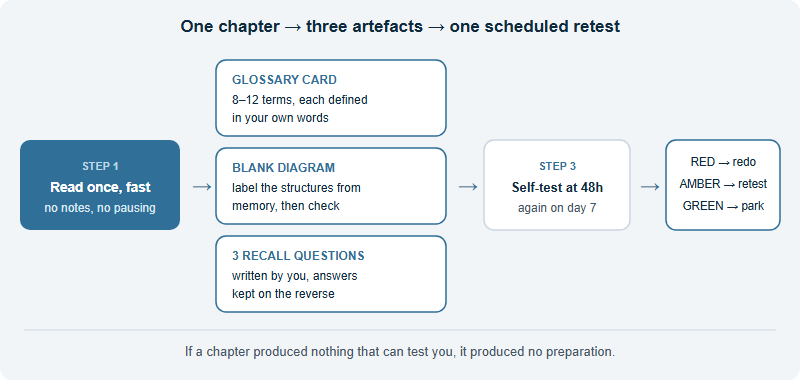
So the method has one governing rule: a chapter is not finished when you have read it; it is finished when it has produced something that can test you. If an evening of study produced no artefact, that evening produced no preparation.
The three artefacts every chapter must produce
1. A glossary card of 8 to 12 terms. One card per chapter, terms on the front, definitions on the back, and the definitions written in your own words rather than copied. For international-school students working in English, this card does double duty: it fixes the concept and it fixes the spoken form of the word, which matters enormously in the oral round. Write the definition as one clause — “myelin: the fatty sheath that speeds conduction along an axon” — not as a paragraph. If you cannot compress it to a clause, you have not understood it yet.
2. A blank diagram. Redraw the chapter's main figure with the labels removed, then label it from memory. Not every chapter has an anatomical figure; when a chapter is process-heavy rather than structure-heavy, draw the process as a flow instead (stimulus → receptor → pathway → cortical area) and blank the arrows' labels. The physical act of drawing is what converts “I have seen the thalamus on a picture” into “I can place the thalamus.”
3. Three recall questions you write yourself. The value here is not the answers, it is the act of predicting what could be asked. Write one factual question (“which cells produce myelin in the central nervous system?”), one locational question (“where does this structure sit relative to the ventricles?”) and one applied question (“if this pathway is damaged, what does the patient show?”). That third type is the one that trains the patient-diagnosis section, and it is the type students almost never write unprompted.
Three artefacts per chapter is a demanding standard, and it is deliberately slower than reading. A student who covers ten chapters this way is better prepared than one who has read the whole book three times.
Our eight-block route through the material
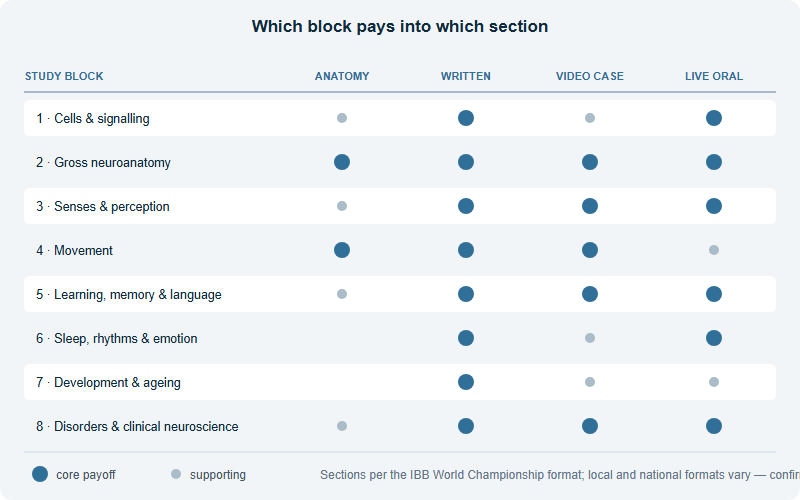
The blocks below are our editorial grouping, not the book's table of contents — chapter titles and ordering differ between editions and between the two set texts, so map these onto your own copy. What the blocks do is guarantee that you cover the ground the competition actually draws on, in an order where each block makes the next one easier.
| # | Block | The recall test that proves you know it | Where students usually fail |
|---|---|---|---|
| 1 | Cells & signalling — neurons, glia, the action potential, synapses, neurotransmitters | Draw a synapse and narrate transmission end to end without notes | Knowing the parts but not the sequence or the direction of flow |
| 2 | Gross neuroanatomy — lobes, cortex, subcortical structures, brainstem, cerebellum, ventricles, cranial nerves | Label a blank lateral view and a blank mid-sagittal view | Only ever studying one view, then failing on a coronal section |
| 3 | Senses & perception — vision, hearing, touch, taste, smell, pain | Trace each sense from receptor to cortex in five steps | Learning receptors and cortical areas but skipping the relay in between |
| 4 | Movement — motor cortex, basal ganglia, cerebellum, spinal circuits, reflexes | Say what breaks when each motor structure is damaged | Confusing cerebellar with basal-ganglia signs |
| 5 | Learning, memory & language — plasticity, hippocampus, memory types, language areas | Distinguish memory types and name the structure each depends on | Vague answers — “the hippocampus does memory” |
| 6 | Sleep, rhythms & emotion — sleep stages, circadian control, stress, reward, the amygdala | Sequence a night of sleep and name what governs the clock | Treating this as light reading because it feels familiar |
| 7 | Development & ageing — the developing brain, adolescence, the ageing brain | Explain what changes, in what order, across a lifespan | Skipping it entirely because it looks non-technical |
| 8 | Disorders & clinical neuroscience — neurological and psychiatric conditions, injury, treatment | Given three signs, name the plausible condition and the structure involved | Memorising disease names without the underlying anatomy |
Blocks 1 and 2 are non-negotiable foundations; every later block refers back to them. If your time is short, it is better to own blocks 1, 2 and 8 completely than to skim all eight, because those three carry most of what the anatomy and case sections ask.
Turning a chapter into neuroanatomy recall: the three-pass drill
Neuroanatomy is the section where the reading-versus-recall gap is widest, and it is worth a dedicated drill. Use three passes on the same blank diagram, spaced across a week.
- Pass 1 — open book. Label the diagram with the text beside you. Say each label out loud as you write it. Goal: correct spelling and correct spatial placement.
- Pass 2 — 48 hours later, closed book. Label from memory in pen, then correct in a different colour. The corrections are your actual revision list; the labels you got right are finished business.
- Pass 3 — day 7, closed book, different view. Same structures, different orientation — if pass 2 was a lateral view, do a mid-sagittal or coronal one. This is the step that catches the most common failure mode: students who can label one familiar picture and freeze when the structure is presented from another angle or on a real specimen.
Add one refinement for the specimen section. Whenever you learn a structure, learn its neighbours and its function in the same breath — “this is the thalamus; it sits here relative to the ventricles; nearly all sensory information relays through it.” Identification questions are often followed immediately by a functional follow-up, and a student who has stored only the name has half an answer.
The retest rhythm that makes it stick — and a realistic first month
Artefacts are worthless if nobody uses them. Fix a rhythm and keep it boring:
| When | What you do | How long | What you record |
|---|---|---|---|
| Same evening | Read the chapter, then build the three artefacts | One session | Date on the card |
| +48 hours | Answer your own three questions, label the blank diagram cold | 10–15 minutes | Red / amber / green on the card |
| +7 days | Retest reds and ambers only; second diagram view | 15 minutes | Update the colour |
| End of block | Mixed test across every chapter in the block, in random order | 30 minutes | Which chapter still leaks |
| Monthly | Spoken round: a partner reads your questions, you answer aloud in under 10 seconds | 20 minutes | Terms you could not pronounce |
The monthly spoken round is the one students skip and the one that separates a strong written performer from someone who can survive a live oral. Answering aloud, at speed, in a second language, is a distinct skill — and it decays fast if it is never practised.
A realistic first month. If you are starting from zero, do not plan the whole book. Plan four weeks: block 1 in week one, block 2 across weeks two and three (it is the biggest and most valuable), and block 8 in week four so that you get an early taste of clinical reasoning while your anatomy is still fresh. That gives you roughly a dozen glossary cards, half a dozen blank diagrams and about thirty self-written questions — a real revision kit rather than a highlighted book. Then repeat the pattern for blocks 3 to 7 and re-test everything monthly. Students who work this way usually report the same thing at their first competition: the written test felt shorter than expected, because they were retrieving rather than reconstructing. That is the whole point. For how the rounds connect and where each of these skills is used, see our guide to how the Brain Bee works.
Where past questions and the harder material fit
Past questions are diagnostic, not curricular. Their job is to show you the form a question takes — how tightly it is worded, how often it asks for location rather than definition, how much of it is straightforward recall. Use them after you have built artefacts for a block, not instead of building them. We maintain our own gathered pack of Brain Bee–style past questions, assembled and organised by our editorial team; worked solutions exist for some years, not all, and we say so plainly rather than promising full coverage. It sits alongside our preparation resources, and is available on request through the contact banner on this site.
Two honest caveats about scope. First, the World Championship draws on university and medical-school course content, and IBB lists further texts beyond the two set books — check the current list on thebrainbee.org — so the set texts alone are the floor rather than the ceiling at that level. Second, what a local or national round includes varies by chapter and by year — confirm the current structure through official channels, and for the China round through the National Brain Bee Organizing Committee at chinabrainbee.com, which is where registration and rules live. This site is an independent guide and does not administer that round.
Frequently asked questions
What book do I need for the Brain Bee?
Most local rounds use Brain Facts, published by the Society for Neuroscience and available at brainfacts.org, or Neuroscience: The Science of the Brain. Each national round is organised individually, so confirm what your own round sets.
How many times should I read Brain Facts?
Once per chapter, fast. Then build a glossary card, a blank diagram and three recall questions. Re-reading builds recognition, not recall.
How do I revise neuroanatomy for the specimen section?
Use blank diagrams in three passes — open book, closed book at 48 hours, then a different view on day 7 to break single-picture memory.
Is the set text enough for the World Championship?
No. The world final draws on university and medical-school course content, and IBB lists further texts beyond the two set books — check the current list on thebrainbee.org.
This is an independent English-language Brain Bee guide operated by Hanlin Education for China-based international-school students. It is not affiliated with, endorsed by, or sponsored by the International Brain Bee (IBB), and it is not the official Brain Bee China national round (run by the National Brain Bee Organizing Committee / chinabrainbee.com). Study material, round formats, eligibility and dates are set by the organisers and change from year to year — always confirm current details on thebrainbee.org and the official China channel before planning around them. The eight study blocks above are our own editorial grouping, not the set text's chapter list. Confirmed errors are corrected within 7 working days.