
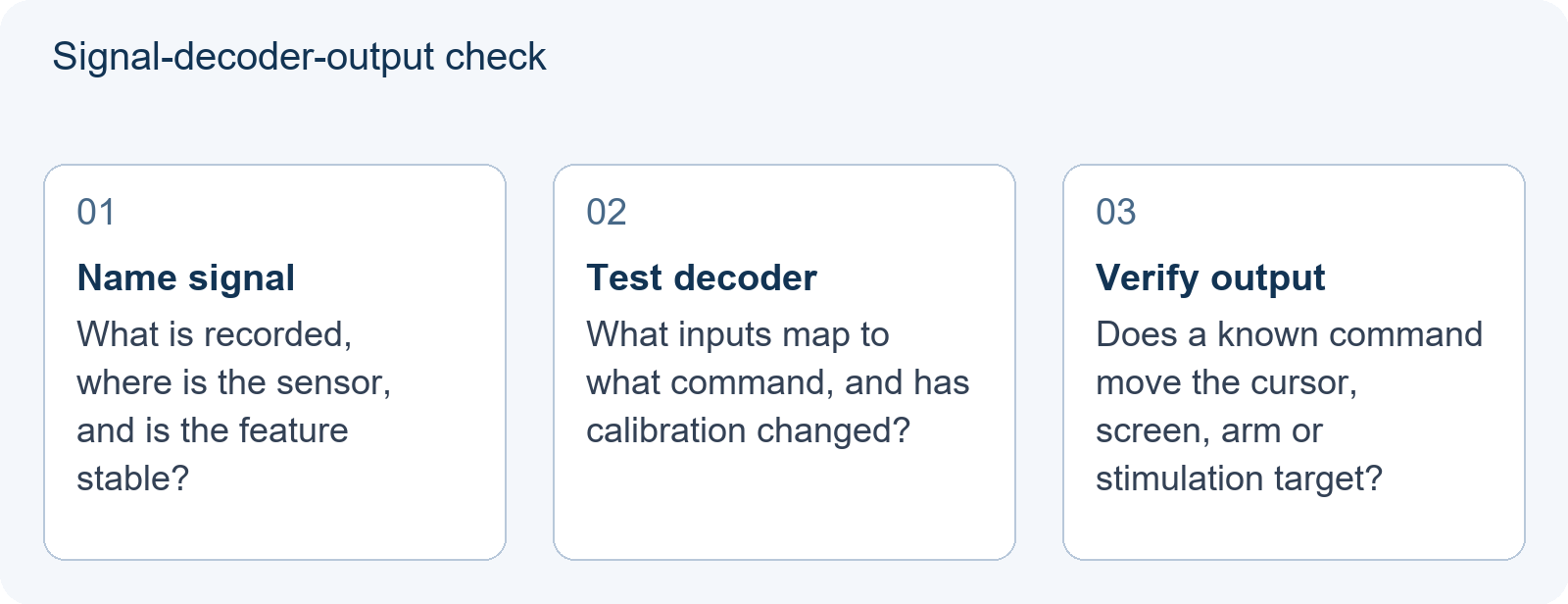
For a 2027 Brain Bee brain-computer interface question, use the signal-decoder-output method: name what is recorded, how features are mapped to a command, and what device acts. Match the stem’s verb—record, decode, move, stimulate, display—to one layer, and test every option against evidence. This short chain turns a futuristic BCI item into a checkable system question.
A Hanlin Courses teaching note titled “Brain-Computer Interfaces Go Viral! Understanding ‘Mind-Controlled Screens’ Starts with Brain Bee Neuroscience Activity,” published 13 November 2026, motivates this clinic by connecting public BCI coverage to Brain Bee study. It is teaching context, not an official contest question. A Hanlin Courses note titled “2027 Brain Bee Registration Opens: Linking Biology, Psychology and AI into One Language,” published 14 September 2026, lists brain-computer interfaces among brain-research and technology topics, alongside brain imaging, gene therapy, deep brain stimulation, and neural networks and artificial intelligence.
News language compresses several engineering steps into one phrase. A Brain Bee answer should expand them. If a stem says that a participant imagines movement and a cursor moves, the chain is: neural activity is recorded; a decoder maps features of that activity to a command; a computer or device executes the command. If the question asks what the electrode measures, answer at acquisition. If it asks why recalibration changes performance, answer at the decoder. If it asks why a correct command produces no movement, answer at the output stage. Students from computing backgrounds can use Brain Bee for AI and Computer-Science Students: Where the Syllabus Meets Their Interests to connect AI vocabulary to neural mechanisms, but the three-layer chain still applies.
What are the three BCI layers?
| Stem wording | Likely layer | Question to ask | Common wrong turn |
|---|---|---|---|
| electrode records neural activity | Signal acquisition | What is measured, where is the sensor, and what artifact could alter the feature? | Jumping straight to the cursor |
| algorithm translates activity into a command | Decoder | What are the inputs and outputs of the mapping, and has calibration changed? | Calling the algorithm a brain region |
| cursor moves on a screen | Output or effector | What device acts after the command, and is that device working? | Confusing a command with an action |
| current is delivered to cortex | Stimulation | Is the system writing to the nervous system rather than reading from it? | Calling stimulation recording |
The table is a first pass, not a substitute for reading the stem. A system can combine layers. A recording system can feed a decoder, and a stimulation system can be an output that writes to tissue. The useful Brain Bee habit is to ask which direction the information flows and which layer the stem is testing.
When a stem really asks whether EEG or fMRI is better for time or space, use the dedicated Brain Bee EEG fMRI: Choose the Right Measurement for Time or Space Questions rather than forcing a BCI frame. BCI questions can borrow measurement logic, but they add a decoder and an effector.
Layer 1: signal acquisition and what is actually measured
Signal acquisition asks two questions: what biological quantity is converted into a signal, and by what sensor. Compare scalp EEG with implanted electrodes directly. Scalp EEG uses electrodes placed on the scalp and records summed electrical activity that reaches the surface. Implanted electrodes are placed within the skull or brain and record from a different physical position. Do not rely on a blanket definition that every sensor outside the skull is non-invasive; use the stem’s paired comparison and state the placement and the measured quantity. Invasiveness is a property of the device and procedure, not a complete explanation of signal quality.
A Brain Bee item on acquisition may ask what the electrode measures, why electrode contact matters, or why impedance or movement artifact can change the recorded feature. If the stem says that the same attempted movement produces a different feature pattern after the electrode contact changes, the first suspect is acquisition. If the stem says that the feature pattern is stable but the command changes after retraining, acquisition is less likely to be the answer. That contrast is more useful than memorising a slogan about invasive versus non-invasive systems.
A sensor label does not decide the answer by itself. A stem may present a trade-off involving placement, stability or signal quality, but the student must read what the stem supplies. Do not infer that one method is automatically superior because it sounds more advanced. The question usually rewards the layer that matches the evidence, not the most futuristic word in the option.
Layer 2: the decoder, calibration and training data
The decoder is a mapping. It receives features extracted from recorded activity and produces a command, a probability or a control signal. In a Brain Bee answer, the decoder is not a mysterious mind reader and not a synonym for the brain. It is the computational layer between measurement and action. Calibration matters because the mapping may be learned from training data and adjusted across sessions.
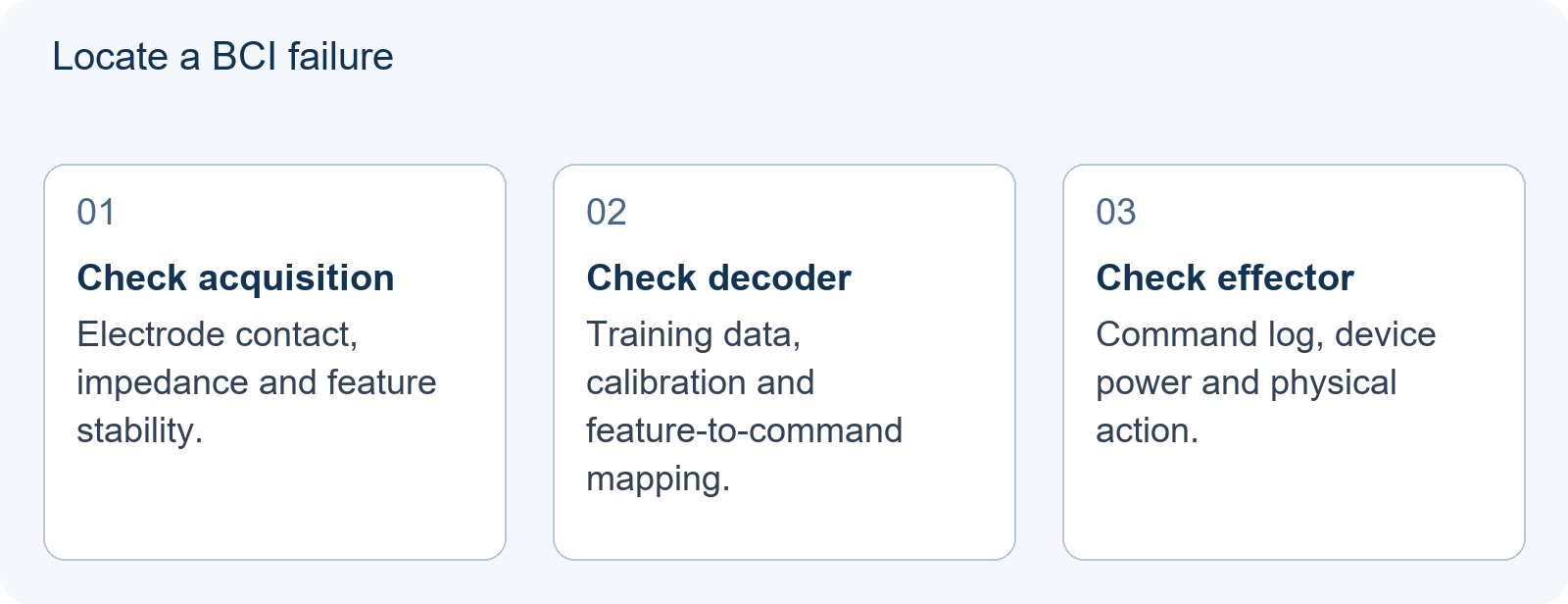
A decoder hypothesis is conditional. Stable sensor features and a checked functioning output device are required before blaming the mapping. The mere presence of a signal does not prove decoder error; a signal can be present while the decoder is correct and the effector is disconnected. Conversely, a clean command log does not prove that the biological signal was unchanged. The student should ask which evidence in the stem rules out the other layers.
A useful contrast is this: suppose the recorded features for the same attempted movement remain in the training range, a direct test command moves the cursor correctly, and the decoder log shows the wrong command for the attempted movement. If the sensor features are stable and the output has been checked, the most likely change is decoder mapping or calibration. If instead the signal quality changes after the electrode contact moves, the first suspect is acquisition. If the decoder log shows the correct command but the cursor does not move, the first suspect is output or effector. Decoder accuracy is also not the same as clinical recovery. A system can decode a command accurately while the person’s underlying impairment is unchanged.
For revision, write the decoder as a box with an input and an output. The input is a feature set, not a thought. The output is a command, not a movement. That small discipline prevents answers that confuse a brain region, a machine-learning model and a cursor.
Layer 3: output, effector and the difference between reading and writing
The output or effector is what acts after decoding. It may be a cursor, a screen application, a robotic arm or another device. A BCI can also write to the nervous system through stimulation. Deep brain stimulation, which the same Hanlin Courses note lists separately, is stimulation rather than decoding. An implanted stimulating device is not automatically a BCI. If a stem describes current delivered to cortex, the key layer is stimulation, not thought reading. If a stem asks why a decoded command fails to move a robotic arm, the key layer is output or effector, not the electrode.
This recording-versus-writing distinction is one of the cleanest ways to eliminate wrong answers. Recording systems acquire signals from the nervous system. Stimulation systems deliver energy or current to influence it. Some clinical systems combine both, so the student should ask which direction the question describes. Do not merge deep brain stimulation, cortical stimulation and motor-cortex decoding into one category just because all are neurotechnology. Stimulation is not a decoder layer; it is a different direction of information flow, writing to tissue rather than reading from it.
A complete hypothetical cursor-control example
Teaching example, original and hypothetical; this is not an official contest question. A participant attempts a right-hand movement to move a cursor right. The system has three parts. First, a scalp EEG cap records sensorimotor activity. Second, a decoder trained on earlier trials maps two feature values to a left or right cursor command. Third, a laptop receives the command and moves the cursor on a screen. In session one, the system works. Before session two, the electrodes remain in the same positions, impedance is in the acceptable range, and the recorded feature values for right-hand attempts remain in the training range. A direct test command sent to the laptop moves the cursor right, so the output device is checked and functioning. During session two, however, the decoder log shows a left command for right-hand attempts, and the cursor moves left. Which layer is most likely? The decoder mapping or calibration, because acquisition is stable and the output has been checked. What evidence would change the answer? If electrode contact changed and the feature values shifted, suspect acquisition. If the decoder log showed a right command but the cursor stayed still, suspect output or effector. The word wireless would not settle the layer, because it describes hardware rather than the failure point.
This example is deliberately simple. Its purpose is to force a conditional statement: given stable sensor features and a checked functioning output, a wrong command points to the decoder. If either condition is missing, the conclusion changes. That is exactly the reasoning a Brain Bee item rewards.
Common traps in BCI multiple-choice and fill-in items
- EEG equals BCI. EEG is one acquisition method. A BCI also needs decoding and an output.
- Decoder accuracy equals recovery. Accurate control of a cursor does not show that a spinal injury or brain disorder has changed.
- AI vocabulary equals neuroscience mechanism. A computational model may use neuron-like nodes, but the biological question still asks which cells, synapses or signals are involved.
- Invasive equals automatically better. Invasive describes sensor placement. The stem must supply the trade-off being tested.
- Stimulation equals recording. Current delivered to tissue is writing to the nervous system, not reading a thought.
- Implant equals BCI. An implanted device may stimulate, record or do neither in the sense of a closed-loop control system. Read the direction of information flow.
These traps are not reasons to avoid BCI. They are reasons to slow down at the verb. Record, decode, move, stimulate and display are different actions. When an option sounds futuristic but names the wrong action, it is probably wrong.
A one-page practice routine for 2027
Make a four-column table for each BCI case: what is measured, how it is decoded, what acts, and what evidence would falsify your layer choice. Then answer three self-check questions. First, is the system recording from the nervous system, writing to it, or both? Second, is the failure in the signal, the mapping or the device action? Third, which phrase in the stem proves that layer? Keep the table short enough to redraw from memory.
For textbook-to-question matching, see the Brain Bee Study Materials: Matching Essential Neuroscience, BrainFacts and Atlas to the Questions You Will Actually Face. Keep the BCI table separate from general neuroanatomy notes so that the decoder does not get lost among brain regions. A useful revision test is to take one news sentence and rewrite it as three separate Brain Bee stems, one for each layer. If you cannot write all three, you probably do not yet own the distinction.
Course-fit and resource-request preparation
If you ask a teacher or program adviser to map this method to your grade and round, bring four things: the BCI material you have already seen, two stems that confused you, your one-page layer table, and a note on whether your syllabus treats BCI as an application of sensory and motor systems or as a separate technology topic. Ask whether a course uses BCI as a worked application or only as a news hook. Hanlin Courses resource descriptions mention a preparation pack with a selected past-paper collection, 100 mock questions and core notes; if you request any resource list, ask for its year and scope, and treat mock material as practice rather than official scoring guidance.
This is preparation analysis, not official scoring guidance. The strongest 2027 habit is simple: name the layer before choosing the option.
General event background is available at Event background.
This is an independent preparation guide, not affiliated with, endorsed by, or sponsored by the International Brain Bee.
Frequently Asked Questions
Is a brain-computer interface one Brain Bee topic or three?
Treat it as a chain for preparation: signal acquisition, decoding and output or effector. A stem may ask about one layer, but a full system question needs all three.
Do I need machine-learning mathematics for BCI questions?
Advanced mathematics is not the first requirement; you need to explain what a decoder receives, what it outputs, and why calibration or training data matters. If a stem supplies a model, read its inputs and outputs rather than guessing from the name.
How can I distinguish a decoder error from a sensor or output failure?
Use the evidence in the stem. If recorded features are stable and a direct test command works but the decoder log shows the wrong command, suspect decoder mapping. If signal quality changes with electrode contact, suspect acquisition. If the log shows the correct command but the device does not act, suspect output or effector.