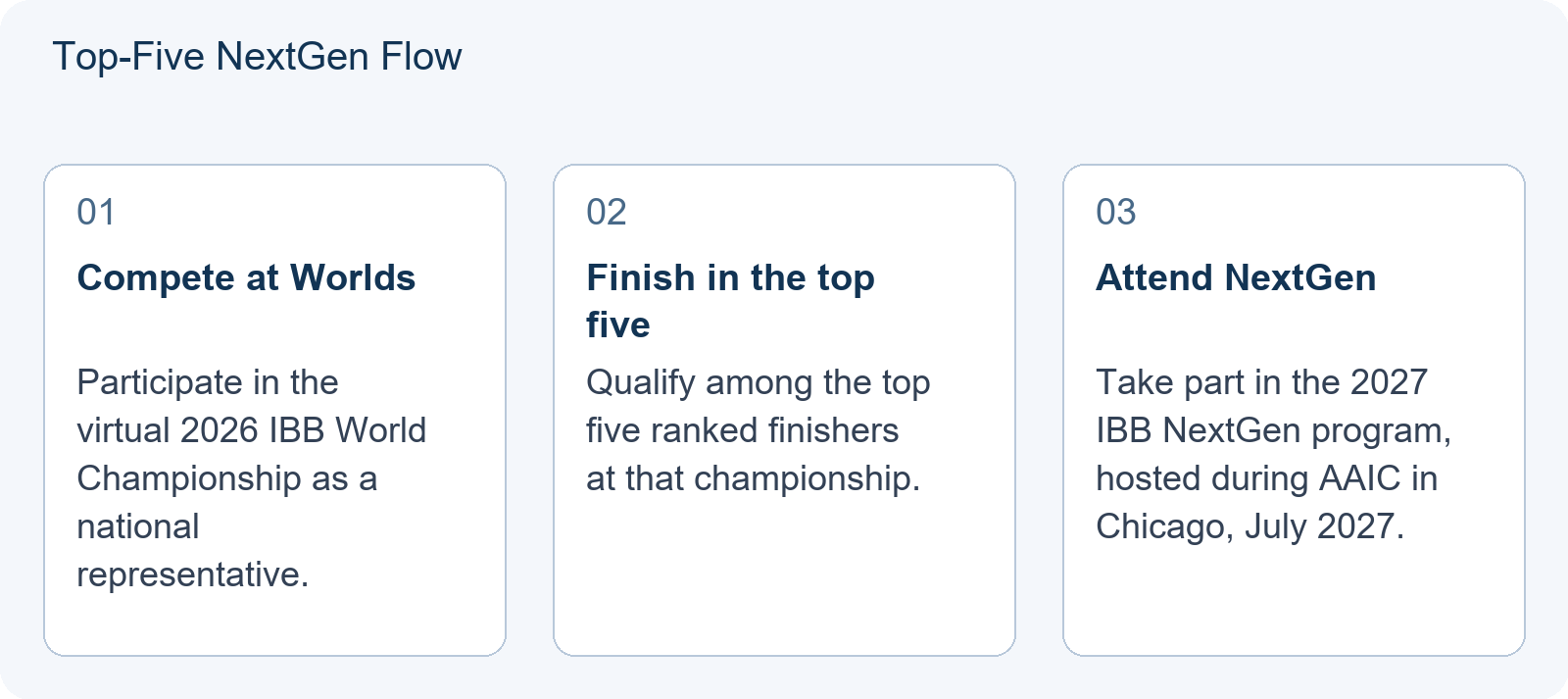
Short answer first: the 2026 International Brain Bee (IBB) World Championship is a virtual event held November 6–11, 2026, in conjunction with Neuroscience 2026, the annual meeting of the Society for Neuroscience. It is not open to registration. Per the official International Brain Bee source, International Brain Bee – The Neuroscience Competition for Teens, each year National Brain Bees send one representative to compete at the World Championship. The top five finishers then qualify for the 2027 IBB NextGen program, hosted during the Alzheimer’s Association International Conference (AAIC) in Chicago in July 2027.
For students and parents tracking the global calendar, that is the whole picture in three sentences. The rest of this article explains what the world level is for, what the virtual label does and does not imply, and how a family in the 2027 China season should (and should not) plan around it.
What the 2026 IBB World Championship Actually Is
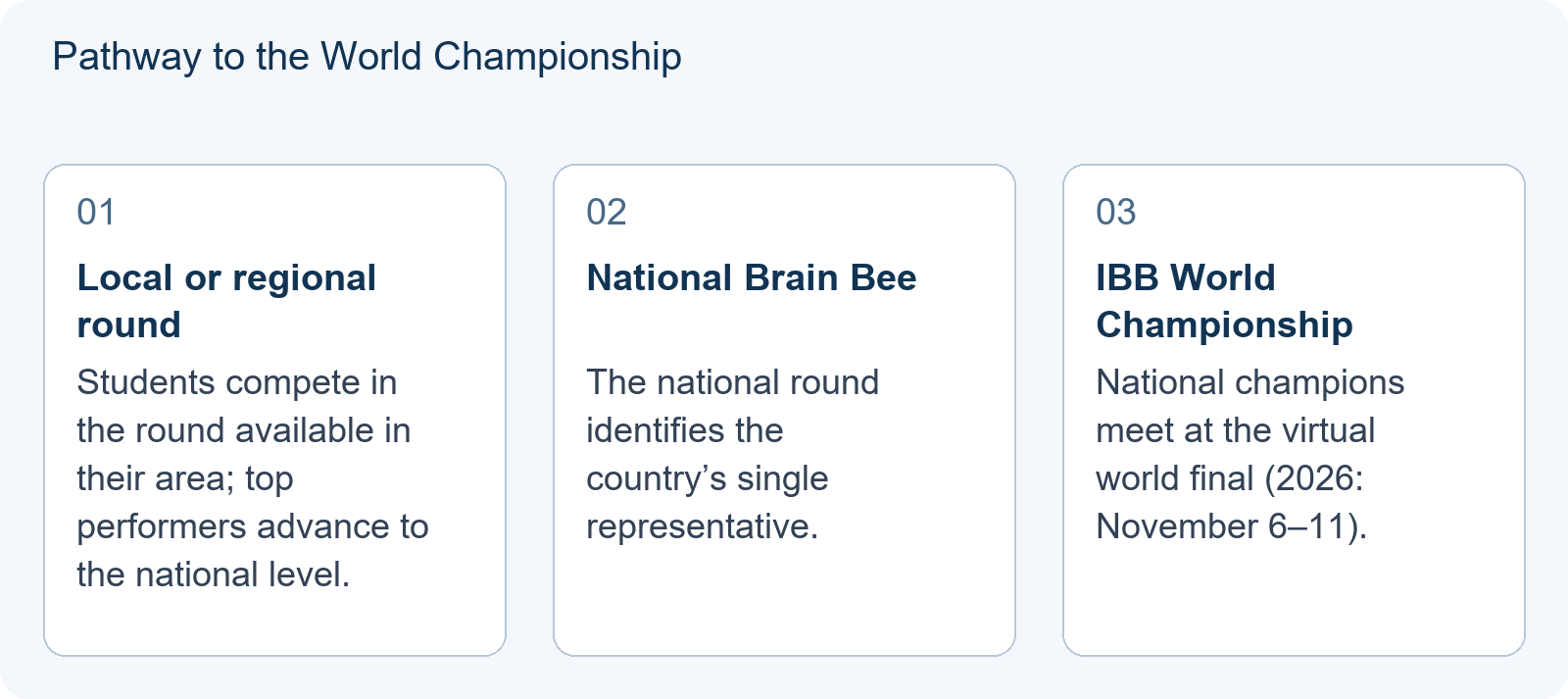
The International Brain Bee describes a three-tiered competition: students typically begin at a Local Brain Bee where one exists, top performers advance to their country’s National Brain Bee, and each National Brain Bee sends one representative to the IBB World Championship. This is why the world level has a small, fixed field relative to the national rounds — it is a gathering of national champions, not a mass-entry exam.
The official source states that the 2026 edition “will be held virtually from November 6–11 in conjunction with Neuroscience 2026,” and describes it as bringing together national champions from around the world “for an exciting competition and educational and social program.” The previous cycle followed the same pattern: the 2025 IBB World Championship was also virtual, from November 7–12, 2025, tied to Neuroscience 2025. Two consecutive virtual editions is enough to treat the online format as the current norm, not a one-off adjustment — but it is not a permanent promise, and families should not assume the 2027 edition will follow it.
How a Student Reaches the World Championship
A common misconception is that a strong independent score is enough to enter the world round. It is not. Access is mediated by national competition. As the official source puts it, National Brain Bees send one representative each year. There is no open entry, no wildcard lane described on the official site, and no direct registration.
For readers following the China pathway specifically, the Hanlin Curriculum WeChat Official Account report (published 2026-10-16) describes the selection as follows: the highest-scoring first-prize winner in the senior Brain Bee group (grades 9–12) at the national round earns the qualification to represent China at the international Brain Bee activity. Other countries may structure selection differently — some use a single grand champion, others a committee — so the general rule is one representative per nation, and the specific rule is set locally. Always confirm with the chapter you actually compete in.
The practical implication is straightforward: the world level does not have a separate preparation regime you can start in parallel with the national round. The competencies tested nationally — neuroanatomy, systems physiology, disorders, research methods, and case reasoning — are the raw material of the world round too. Preparing for the world before securing a national spot is preparing for a race you have not yet qualified for.
Timeline: Which World Championship Is “yours”?
This is where many families trip. The current event (November 6–11, 2026) is being contested by champions selected through national competitions completed earlier in 2026. It is already locked in.
Students registering now for the 2027 China season — regional round on 9 January 2027, national round 13–14 March 2027, per the Hanlin Curriculum report — are not competing for a spot in the November 2026 event. Their national result would feed into the international activity that follows that season. The China source lists the international activity for that cycle as August 2027. That is a different edition from the November 2026 event described above, and the exact date and format should be confirmed through official channels when it is published.
| Cycle | National selection | World / international activity | NextGen follow-on |
|---|---|---|---|
| Current cycle (2026 Worlds) | National champions already selected in 2026 | Virtual, November 6–11, 2026 (with Neuroscience 2026) | Top five → 2027 NextGen, AAIC Chicago, July 2027 |
| 2027 China season | Regional 9 Jan 2027; national 13–14 Mar 2027 | Listed by Hanlin as August 2027; confirm official edition when released | Follow-on for that edition would be announced after the final |
Note carefully: the two rows above are not the same event. A reader who is planning the 2027 China season is planning toward the second row, not the first. Treating the November 2026 date as a target you can still reach from a 2027 national run is a planning error.
What “Virtual” Does and Does Not Tell Us
The official descriptions confirm the 2026 event is online and scheduled alongside Neuroscience 2026. Beyond that, they do not publish the proportion of asynchronous versus live components, the proctoring model, time zones, or the technical platform. Those specifics are not absent because they are secret — they are simply not part of the public summary at this date.
Two consequences follow for readers:
- Do not infer a soft format from “virtual.” A national championship level of accuracy is expected at the world round regardless of venue. The mode of delivery changes logistics, not the standard.
- Do not over-plan for logistics you have not yet earned. No national representative needs to buy anything until the national round is over.
What we can say from precedent is that the virtual model lowers travel friction for national champions, who would otherwise cross continents mid-academic term. The 2025 edition was also held remotely, so participants in the current cycle are working within a known operating pattern.
The NextGen Pathway: What Happens After Worlds
The International Brain Bee has added a second stage for elite performers. According to the official source, the top five winners of the IBB World Championship take part in the following year’s IBB NextGen program. For the current cycle, that means the top five of the 2026 World Championship will participate in the 2027 IBB NextGen program, hosted during the Alzheimer’s Association International Conference (AAIC) in Chicago in July 2027.
The pattern is now three editions old. The top five winners of the 2024 IBB World Championship participated in the second IBB NextGen event at AAIC in Toronto in July 2025. The top five winners of the 2025 IBB World Championship participated in the third IBB NextGen event at the FENS Forum in Barcelona in July 2026. The 2027 destination, Chicago, continues the rotation of major neuroscience conferences.
The official language frames NextGen as an opportunity for champions “to experience an international neuroscience conference and engage with the global neuroscience community.” That is what the public description supports. It does not document a research placement, a funding package, a guaranteed mentorship match, or any admissions outcome. Families should read it as exposure to a professional scientific community, not a credential promise.
National Champion vs. Top Five: A Comparison
| Outcome tier | Eligibility | Format | Timing / location | What the official source supports |
|---|---|---|---|---|
| World Championship participant | National representative sent by a National Brain Bee | Virtual | November 6–11, 2026 (with Neuroscience 2026) | Competition, educational and social program with global peers |
| Top-five finisher (NextGen) | Ranked in the top five at the 2026 World Championship | Follow-on program | Hosted during AAIC, Chicago, July 2027 | Conference experience and engagement with the global neuroscience community |
Notice what the table does not claim. It does not claim that being a national champion is equivalent to a top-five world ranking, and it does not claim that NextGen is guaranteed to any national champion. The only documented bridge from Worlds to NextGen is the top-five placement.
Decision Aid: How to Plan Around the World Pathway
The right decision depends on where the student is in the pathway right now.
Case 1 — Not yet nationally qualified. The world pathway is not a planning input. Study for the round in front of you. If you are building your reading list, the site’s guide to matching Brain Bee Study Materials: Matching Essential Neuroscience, BrainFacts and Atlas to the Questions You Will Actually Face to the questions you will actually face is a more useful starting point than any international timetable. World-level dates will still be there after the national result.
Case 2 — Nationally qualified or on the cusp. Understanding the world pathway is useful motivation, not a study plan. The The Brain Bee China Pathway: How the Regional, National and World Rounds Test Three Different Things article explains how the regional, national and world rounds test different things, and it is the honest place to check whether your current preparation actually maps onto the national round rather than a fantasy international one. Grade and age rules matter too — the Brain Bee Eligibility, Decoded: Grade Bands, the Age Ceiling That Only Bites at Worlds, and Which Chapter You Belong To covers the age ceiling that only bites at the world level.
Case 3 — Confirmed national representative. Now the world details matter. Read the official announcement, follow the conference-linked schedule, and recognise that the visible public summary will not answer every logistics question. Wait for the official technical guidance rather than inferring it from previous editions.
In all three cases, the correct order of operations is the same: qualification first, then pathway logistics. Any preparation advice that inverts this order is selling anticipation rather than results.
Scope Note
All 2026 World Championship and 2027 NextGen details in this article are drawn from the official International Brain Bee site (International Brain Bee – The Neuroscience Competition for Teens) as retrieved 2026-10-26. The China pathway timeline and the senior-group representative rule are drawn from the Hanlin Curriculum WeChat Official Account report (published 2026-10-16). Where the official site has not published virtual-format specifics, this article does not fill the gap with assumptions. Students should re-check official IBB channels as the November 2026 event approaches and as the 2027 cycle’s editions are announced.
General event background is available at Event background.
This is an independent preparation guide, not affiliated with, endorsed by, or sponsored by the International Brain Bee.
Frequently Asked Questions
Who attends the 2026 IBB World Championship?
National representatives selected by each country’s National Brain Bee. The official source states that each year, National Brain Bees send one representative. There is no open registration lane; entry comes through national qualification.
Is the 2026 World Championship in person?
No. The 2026 IBB World Championship is virtual, from November 6–11, 2026, alongside Neuroscience 2026. Separately, the top five finishers of that championship are eligible for the 2027 IBB NextGen program, hosted during the Alzheimer’s Association International Conference in Chicago in July 2027.
Does every country send a champion?
Every National Brain Bee that is active sends one representative. The official formulation is that National Brain Bees send one representative each year. Where a national programme does not run in a given cycle, that country will not have a representative in that edition.