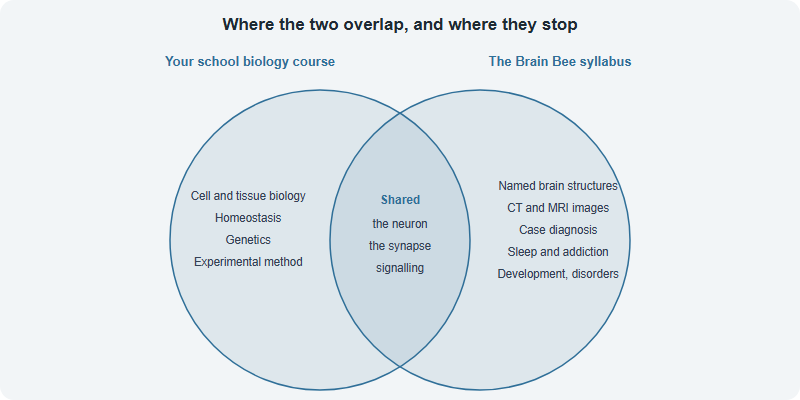
Your school biology course gives you one thing for the Brain Bee: the neuron. Resting potential, action potential, synaptic transmission, neurotransmitters — that material transfers almost intact. Nearly everything else the competition asks for sits outside a standard IB, AP or A-level biology course, and three specific gaps account for most of the marks we see students lose at the national round.
Students who take biology seriously at school arrive at the Brain Bee with a reasonable assumption: this is a biology competition, I am good at biology, the preparation should be an extension of what I already do. That assumption survives the first read of the syllabus, because the opening material looks familiar. It usually does not survive the first serious practice set.
The reason is that school biology treats the nervous system as one system among many, taught for the concepts it illustrates — signalling, gradients, feedback. The Brain Bee treats the brain as the whole subject and asks a different family of questions about it. From coaching students who come in from all three systems, the pattern we see repeatedly is that strong school biology produces a strong written-paper performance and does almost nothing for the other components. That is a teaching observation from our own cohorts rather than a published finding, and it is worth stating plainly because it changes what a sensible study plan looks like.
What genuinely transfers
The transferable material is worth naming precisely, because it is the part you should not re-learn from scratch. If your course has taught the nervous system properly, you should already be able to handle questions on membrane potential and how it is maintained, the sequence of an action potential and why it is all-or-nothing, how a signal crosses a synapse, what a neurotransmitter does at a receptor, and the broad division between central and peripheral nervous systems.
Two less obvious things also transfer, and students undervalue both:
- Experimental reasoning. School biology drills control variables, sample size and the difference between correlation and cause. The Brain Bee syllabus is full of research findings, and questions often turn on what a study actually showed.
- Exam stamina and precision. Sitting a long multiple-choice paper without accuracy decay is a trained skill. Students with a heavy school-exam load usually arrive with it already.
What does not transfer is anything requiring you to recognise rather than describe, anything clinical, and most of the syllabus by topic. Those are the three gaps.
Gap 1: recognition is a different skill from description
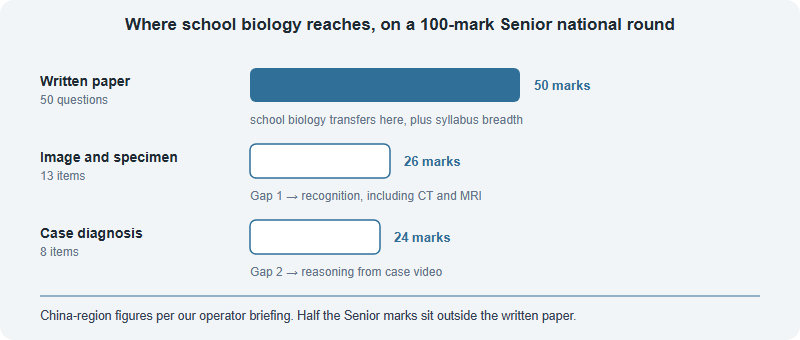
A school biology exam shows you a labelled diagram and asks what a labelled part does. The Brain Bee reverses that. In the China national round, per the operator briefing we work from, the Senior division sits 13 image or specimen identification items worth 26 marks, covering brain structures and CT or MRI. At the International Brain Bee World Championship there is a neuroanatomy and neurohistology section worked on real brains or images.
The difference is not difficulty, it is direction. Being able to explain the function of the hippocampus is description. Finding the hippocampus on an unlabelled coronal section, in an orientation you have not seen, is recognition — and no amount of essay-style revision produces it. Recognition is built by repeated exposure to varied images of the same structure, tested with the label hidden.
The practical consequence for a school-biology student is that this gap cannot be closed by reading more. It closes by looking, covering the caption, naming the structure aloud, and checking. Twenty minutes of that, three times a week, beats a weekend of reading the same chapter again.
Gap 2: reasoning from a case
The second gap is clinical. In the China national round the Senior division answers 8 case-diagnosis items worth 24 marks, based on case video. At the World Championship, patient diagnosis is worked from video footage together with a written medical history — it is video-based, not a live actor-patient exercise.
School biology almost never asks you to move from a set of presenting signs to a likely site of damage or a likely mechanism. It asks the reverse: here is a condition, explain its cause. Case reasoning runs the other way, and it requires you to hold a working map linking symptom, structure and mechanism, so that a described deficit points somewhere specific rather than to a list of everything you have memorised.
Students who come from a strong school course often find this the most uncomfortable section, because it rewards a kind of disciplined guessing that school exams punish. You are asked to commit to the most likely answer on partial information. That is trainable, but only by working cases, not by revising content.
Gap 3: breadth, which quietly costs the most
The third gap is the least dramatic and the most expensive. The Brain Bee syllabus is Brain Facts, published by the Society for Neuroscience and available at brainfacts.org, or Neuroscience: The Science of the Brain. Those sources range across sensory systems, movement, learning and memory, sleep, emotion, stress, development and ageing, addiction, and a long list of neurological and psychiatric disorders — the breadth our introduction to the competition and its syllabus describes as the real workload of the written paper.
A school biology course does not attempt that range, and has no reason to. Which means that on a 50- or 80-question paper drawn from the whole syllabus, a student relying on school knowledge answers the neuron questions confidently and then meets a long tail of items about topics they have simply never studied. It rarely feels like failure in the moment — each individual unknown question seems like bad luck — but it compounds.
| What the Brain Bee asks | Typical school biology treatment | What you still have to build |
|---|---|---|
| Action potential, synapse, transmitters | Covered, often in detail | Little. Revise for speed and precision of terms |
| Named brain structures and their relations | Usually a brief overview at most | A recognition habit built on unlabelled images |
| CT and MRI appearance | Generally not covered | Familiarity with orientation, planes and what normal looks like |
| Clinical case reasoning | Not a school-exam skill | Symptom to structure to mechanism mapping, practised on cases |
| Sleep, addiction, development, disorders | Rarely covered as neuroscience | Straight syllabus reading, chapter by chapter |
| Terminology under time pressure | Built in your language of instruction | Secure recall of the exact terms, spelled correctly |
One caution on this table. It describes patterns we see across cohorts, not any particular board's specification. Curricula are revised, and your own course outline is the authority on what you have actually been taught — read it before deciding what you can skip.
A bridge that fits alongside a full school load
The good news is that the three gaps respond to different, small activities, and none of them competes with school revision for the same kind of attention. The bridge below is our coaching sequence, not an official recommendation.
- Week 1: audit, do not study. Open your school syllabus and the Brain Bee syllabus side by side and mark every topic that appears in one and not the other. Most students discover the list is longer than expected, which is the point.
- Weeks 2 onward: split the week by skill, not by topic. Two short recognition sessions, one case session, and one reading session covering an unfamiliar chapter. Twenty to thirty minutes each is enough if they recur.
- Use your school course as the anchor, not the plan. When your class reaches the nervous system, that is the moment to push past it into the syllabus chapters that extend it, while the base material is fresh.
- Test yourself in the exam's direction. If the assessment hides the label, your revision should hide the label. If the assessment gives you signs and asks for a site, your revision should do the same.
If you are still deciding whether the competition is a sensible use of a busy year, our overview of the Brain Bee, its rounds and its syllabus sets out the structure before you commit. And if you are choosing between this and a biology or psychology competition, the honest answer is that they reward different work — the neuron overlap is real, but it is the smallest part of what the Brain Bee actually tests.
Registration, division rules and the current assessment structure sit with the National Brain Bee Organizing Committee at chinabrainbee.com for the China region. We are an independent guide and do not run any round; anything in this article that concerns format should be confirmed against the current official material before you plan around it.
Questions students ask
Does AP or IB Biology cover the Brain Bee syllabus?
Only partly. School courses handle the neuron and synapse well but leave neuroanatomy recognition, imaging and case reasoning uncovered.
What should I read alongside my school biology course?
Brain Facts, published by the Society for Neuroscience at brainfacts.org, or Neuroscience: The Science of the Brain.
Which Brain Bee section punishes school-only preparation most?
Structure and image identification. Naming a labelled diagram is not the same skill as identifying an unlabelled specimen or scan.
How long does the bridge from school biology take?
Plan several weeks of short, frequent recognition drills rather than one long block. Little and often beats a single revision push.
This is an independent English-language guide to the Brain Bee, operated by Hanlin Education for China-based international-school students. It is not affiliated with, endorsed by, or sponsored by the International Brain Bee (IBB), and it is not the official Brain Bee China national round, which is run by the National Brain Bee Organizing Committee at chinabrainbee.com. Assessment figures for the China region come from an operator briefing and can change between seasons; descriptions of school biology courses are general observations from our own teaching, not any board's specification. Confirm current details on thebrainbee.org. Errors are corrected within 7 working days of notification.