In the China region the Brain Bee runs two divisions: Junior for grades 5 to 8 and Senior for grades 9 to 12. Crossing that line changes three things at once — the regional paper gets longer, the national assessment gains image identification and case-diagnosis items, and the team poster disappears. A student who simply carries forward a Junior study plan will be underprepared in a specific, predictable way.
First, the line itself is a China-region line
Worth being clear about, because it is a common misreading: the Junior and Senior split is how the competition is organised in the China region. It is not a structure of the International Brain Bee, and other national chapters organise their own arrangements. Hong Kong, Taiwan and Macao operate as separate IBB chapters and are not part of the China chapter.
On eligibility, the competition runs in practice for grades 5 to 12 — roughly ages 10 to 18 — split into divisions by grade. The only firm ceiling anyone should plan around is that a national champion competing at the IBB World Championship may not be older than 19. Beyond that, treat any age or grade figure you find in circulation with caution and confirm it with the National Brain Bee Organizing Committee at chinabrainbee.com, which runs registration for every round in the China region. We are an independent guide and do not administer it.
If the three-tier structure itself is new to you, start with our guide to what the Brain Bee is, which sets out how local, national and world rounds connect before you worry about divisions.
Three things change at once
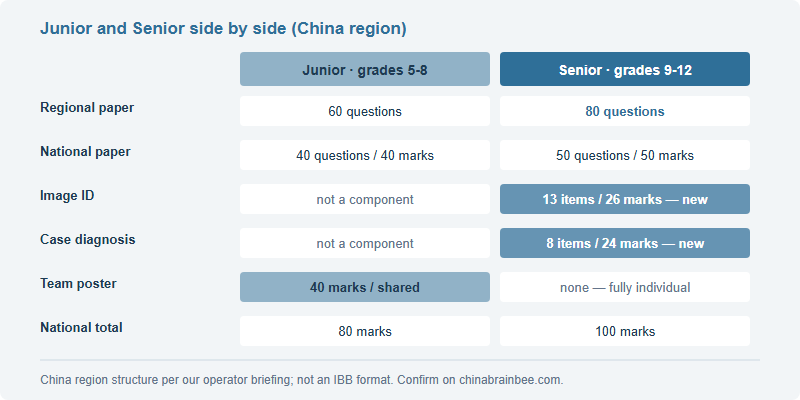
The table below compares the two divisions as set out in the operator briefing we work from. Read the scope note that follows it before you plan against these figures.
| Junior (grades 5–8) | Senior (grades 9–12) | What the change costs you | |
|---|---|---|---|
| Regional paper | 60 questions | 80 questions | A third more questions in the qualifying round. Pace, not just knowledge, becomes a limiting factor. |
| National written paper | 40 questions / 40 marks | 50 questions / 50 marks | Ten more marks of recall, and like the Junior paper it is half your national total, though the other half is now individual rather than a shared team mark. |
| Image and specimen identification | Not a separate component | 13 items / 26 marks | An entirely new skill: naming brain structures and reading CT and MRI images under time pressure. |
| Case diagnosis | Not a separate component | 8 items / 24 marks | Another new skill: reasoning from case video to a plausible mechanism, at 3 marks per item. |
| Team element | Team science poster, 40 marks, shared | None — entirely individual | Half your Junior mark came from group work. In Senior nobody carries you and you carry nobody. |
| National total | 80 marks | 100 marks | Half of the Senior total sits in item types that did not exist for you before. |
Scope note. These component figures describe the China region and come from our operator briefing; the organiser has not published them on a public page, and divisions, weightings and formats can be revised between seasons. None of it is the World Championship format. Treat the table as our working understanding and confirm anything decision-critical with the organiser.
The regional round gets longer, and it is written differently from your syllabus
Two details about the qualifying round that catch students out. First, the paper length: Junior sits 60 questions and Senior 80. Twenty extra questions shift the constraint from what you know to how quickly you can retrieve it, which means timed practice stops being optional.
Second, the language. The regional paper is set in Chinese, with technical terms glossed in English. Meanwhile the syllabus you revise from — Brain Facts, published by the Society for Neuroscience and available at brainfacts.org, or Neuroscience: The Science of the Brain — is in English. For students at international schools who study science in English, that is a real translation load in both directions: you learn a mechanism in English and then meet it in a Chinese-language question with an English gloss attached.
The practical fix is to build your key terms as pairs from the start rather than translating under time pressure. Keep one list of structures and processes with both the English term and the Chinese term you would expect to see, and rehearse recognising either one. Students who leave this until the week before the regional round routinely lose marks on content they genuinely knew.
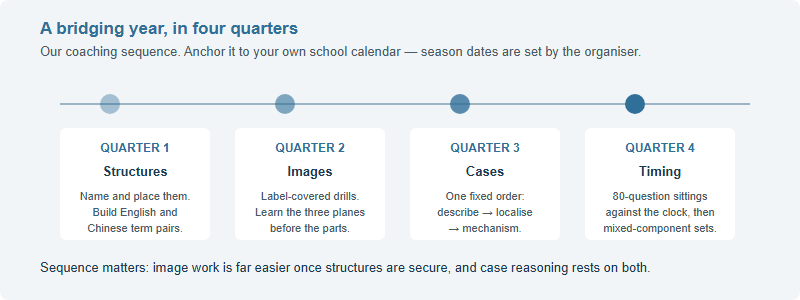
The bridging year: what a grade-8 student should actually build
If you are finishing grade 8, you have one year in which the marks do not yet demand image identification or case reasoning, and that is exactly when to build them. Doing so costs you very little in Junior terms — deeper structural knowledge helps the written paper and gives you something to draw on a team poster — and it removes the cliff.
A note on practice material, since there is no official public question bank. We maintain our own gathered pack of past-style questions and case prompts, put together by our teachers rather than downloaded from an official source; scan the QR code in the site footer if you would like it. Worked solutions cover some years and not others and we are still extending them, so use the pack for volume and habit-building rather than as a complete answer key.
One more thing changes: the route to the World Championship opens
This is the part students rarely have straight. Each national chapter sends exactly one representative to the IBB World Championship. In the China region, on the structure we work from, that single place goes to the highest-scoring first-prize winner in the Senior division.
Two implications follow. For a Junior student, no result — however strong — is a route to the World Championship in that year; the Junior division is its own destination. And for a Senior student, the realistic goal is a first prize, with the single international place being a much narrower outcome than that.
Some scale, again from our operator briefing rather than a published source: roughly 500 students reach the national round, with about 350 arriving on regional quota and around 150 on national ranking, and the award rate at the national round is approximately 40 per cent. Those figures are approximate, they can move between seasons, and they should be read as context rather than as a prediction about any individual.
The World Championship itself is a different assessment altogether, held in November alongside the Society for Neuroscience annual meeting. It runs four sections — neuroanatomy and neurohistology on real brains or images, a written test, patient diagnosis from video footage with a written history, and live oral judging on a two-strikes basis. The organiser is the International Brain Bee. Bodies including the Society for Neuroscience, the Dana Foundation, FENS, IBRO, the American Psychological Association and the Alzheimer's Association act as governance partners, not as the organiser.
Keeping expectations honest
Moving up a division is a genuine step in difficulty, and it is worth being plain about what a result at either level does and does not mean. We treat the Brain Bee as an extracurricular interest activity rather than anything tied to school advancement in China, and we would not encourage any family to treat a placing as an admissions instrument. What the Senior format does reward is a real skill set — recognising structure on an image, and reasoning from a presentation to a mechanism — which is closer to how clinical and research neuroscience actually works than a recall paper is.
For context rather than promise: at the 2026 China national round our own students took 7 first prizes — including 2nd and 8th place in the Junior division and 11th and 13th in Senior — along with 11 second prizes and 10 third prizes; separately, 31 students advanced out of the regional round. Those are our own de-identified figures, per Hanlin, and results vary between students and cohorts.
Registration for both divisions runs through the National Brain Bee Organizing Committee at chinabrainbee.com. Brain Bee has run in China since 2013, with university partners including Tsinghua University, the University of Hong Kong, Zhejiang University, Fudan University and the Chinese Academy of Sciences. If you want the wider picture before choosing a division, our introduction to the competition is the place to start.
Frequently asked questions
Which division does a grade-8 student enter?
Junior covers grades 5 to 8 and Senior covers grades 9 to 12 in the China region. Confirm the current division rules on chinabrainbee.com.
Is there a team component in Senior?
No. On the structure we work from, the Senior division is entirely individual; the team science poster sits only in Junior.
Can a Junior winner go to the World Championship?
Not on the structure we work from. The single Chinese place goes to the highest-scoring Senior first-prize winner.
Is there an age limit?
The one firm ceiling is that a national champion at the World Championship may not be older than 19. Otherwise divisions are set by grade.
This is an independent guide operated by Hanlin Education for China-based international-school students. We are NOT affiliated with, endorsed by, or sponsored by the International Brain Bee (IBB), and we are not the official Brain Bee China national round; registration runs through the National Brain Bee Organizing Committee at chinabrainbee.com. Confirm current rules, dates and formats on thebrainbee.org. Any error reported to us is corrected within 7 working days.