If you have been preparing for the Brain Bee and just heard about a “Brain Challenge”, they are two different competitions. The Brain Science Innovation Challenge (脑科学创新挑战赛) is a separate event the China region has run since 2020: a 3–5 person team submits an applied neuroscience proposal and defends it before judges. It runs 15–16 August 2026, and registration closes 31 July 2026. This is an independent guide — register through the official organiser.
Two different competitions, one shared name
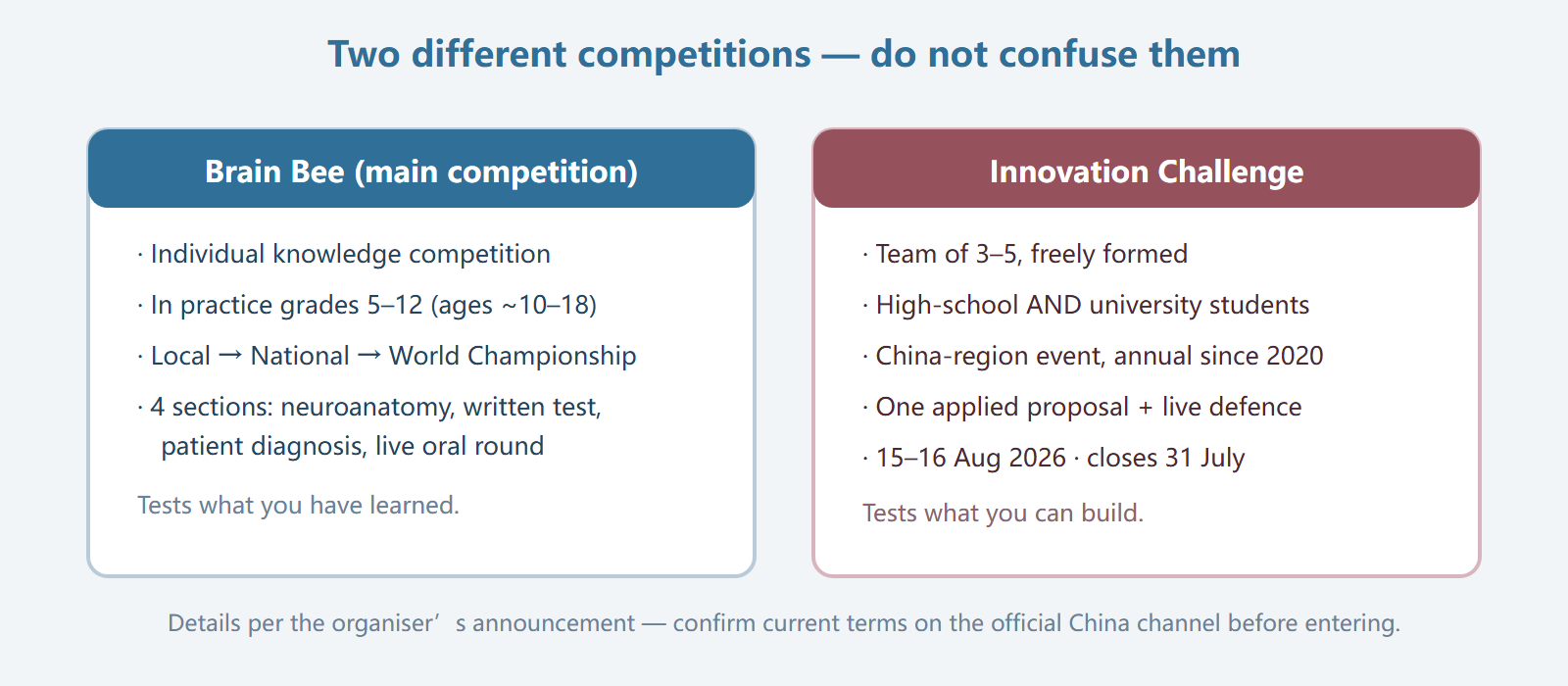
This is the confusion worth clearing up first, because the two events reward almost opposite things. The Brain Bee proper is an individual knowledge competition that ladders Local → National → World Championship, and it tests what you have learned: neuroanatomy, a written paper, patient diagnosis, a live oral round. The Innovation Challenge is a team project competition that asks what you can build: one applied proposal, defended live.
| Brain Bee (the main competition) | Brain Science Innovation Challenge | |
|---|---|---|
| Format | Individual | Team of 3–5, freely formed |
| Who enters | School students, in practice grades 5–12 (about ages 10–18), in divisions by grade | High-school and university students |
| What is assessed | Neuroscience knowledge across four sections, including specimen identification and a live oral round | One applied proposal plus a live presentation and judges’ questions |
| Structure | Three tiers, laddering to the IBB World Championship | A standalone China-region event, run annually since 2020 |
| 2026 timing | Season dates set annually — confirm officially | 15–16 August 2026; registration closes 31 July |
So they suit different students, and one does not substitute for the other. A student who has been drilling Brain Facts for the Brain Bee is not automatically ready for the Challenge, because the Challenge is not asking for recall — it wants a defensible plan for a real problem. Equally, a strong project team does not need to have placed in the Brain Bee to enter.
The three categories — pick one, and pick deliberately
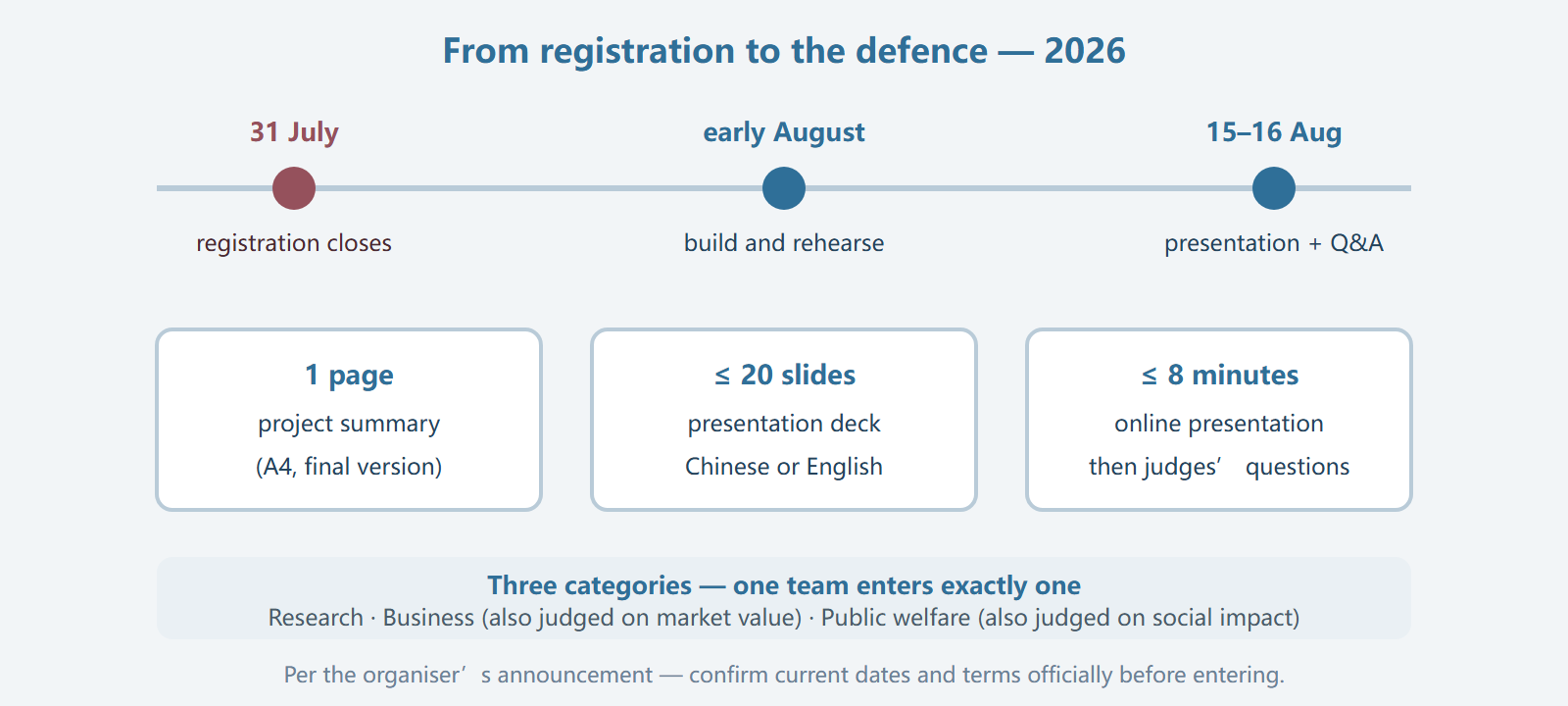
Every team submits one proposal into one category; you cannot enter the same project in two. All three ask the same underlying question — take a real problem in brain science and propose something scientific, effective and workable — but they judge the payoff differently:
- Research category (科研项目组) — fundamental brain science: brain function, prevention and treatment of brain disease, brain-inspired research. Strongest fit if your team’s advantage is reading literature and designing a study.
- Business category (商业项目组) — turning a research result into a market proposition: a product or service in brain research, brain-disease prevention and treatment, or cognitive enhancement. This category is additionally assessed on market value, so a team with no commercial reasoning will be marked against a bar it did not prepare for.
- Public-welfare category (公益项目组) — raising public awareness of mental health and brain disease, or supporting patients and their rehabilitation. Assessed additionally on social impact.
The practical advice is to choose from your team’s real strength rather than from which category sounds most impressive. A public-welfare project executed with genuine community contact will read better than a business plan written by a team that has never modelled a cost.
What you actually have to deliver
The deliverable is deliberately small, which makes it harder rather than easier — there is nowhere to hide a vague idea:
| Item | Specification |
|---|---|
| Project summary | Final version, one A4 page only |
| Presentation deck | No more than 20 slides |
| Language | Chinese or English — either is accepted |
| Live presentation | Online, no more than 8 minutes, followed by judges’ questions |
| Team size | 3–5 students, freely formed |
| Entry fee | Reported at RMB 500 per person — confirm on the official channel |
Judging runs on three dimensions: relevance (does the proposal target a real, significant problem in brain science?), scientific grounding (is it supported by neuroscience theory or research findings?) and practicality (can it actually be carried out?) — with market value added for business entries and social impact for public-welfare entries. First, second and third prizes are awarded within each category.
Read that list backwards and it tells you how to write: one A4 page means your problem statement and your proposed solution have to survive being stated in a few sentences. Eight minutes means roughly one minute per slide if you use all twenty — so most strong teams use far fewer. And “followed by judges’ questions” means the weakest part of your proposal is the part you will be asked about, which is a good reason to name your own limitation before a judge does.
If you are deciding this week
With registration closing on 31 July, the realistic question is not “can we win” but “do we have a team and a problem”. Three checks worth doing before you commit:
- Can you name the problem in one sentence? Not the topic (“Alzheimer’s”) but the problem (“early screening depends on clinic visits that rural patients rarely make”). If the team cannot agree on that sentence, the A4 page will not write itself later.
- Does anyone on the team own the evidence? Scientific grounding is an explicit judging dimension, so at least one member needs to be reading actual neuroscience sources rather than summarising news coverage.
- Which category does your strength actually fit? Choose before you build, because the business and public-welfare categories each add a judging dimension you have to design for from the start.
Registration, fees and any change to the schedule are handled entirely by the organiser — the National Brain Bee Organizing Committee, at chinabrainbee.com, which also lists competition enquiry contacts. We are an independent guide and do not process entries. If you are still deciding whether the Brain Bee itself is the better fit for a younger student, our guide to what the Brain Bee is sets out the three tiers and the four assessed sections.
Frequently asked questions
Is the Brain Science Innovation Challenge the same as the Brain Bee?
No. The Brain Bee is an individual knowledge competition that ladders from Local to National to the IBB World Championship. The Innovation Challenge is a separate China-region team event, run annually since 2020, in which a team of 3–5 submits an applied neuroscience proposal and defends it before judges.
Who can enter the Innovation Challenge?
Per the organiser’s announcement it is open to high-school and university students, competing in freely formed teams of 3 to 5. Confirm current eligibility on the official China channel.
When is the 2026 Challenge, and when does registration close?
The event is reported for 15–16 August 2026, with registration closing 31 July 2026. Dates are set by the organiser and can change — confirm before planning around them.
What does a team have to submit?
A one-page A4 project summary, a deck of no more than 20 slides in Chinese or English, and an online presentation of no more than 8 minutes followed by judges’ questions. Judging weighs relevance, scientific grounding and practicality, with market value added for business entries and social impact for public-welfare entries.
This is an independent English-language guide to the Brain Bee for Greater-China students, operated by Hanlin Education. It is not affiliated with, endorsed by, or the official International Brain Bee, nor the official Brain Bee China national round and its Brain Science Innovation Challenge, which are run by the National Brain Bee Organizing Committee (chinabrainbee.com). The details above follow the organiser’s published announcement; dates, fees, eligibility and the entry process are set by the organiser and can change — always confirm on the official channel before entering. Confirmed errors are corrected within 7 working days.