
There are two doors into the Brain Bee national round in the China region, not one. The operator briefing we work from describes roughly 500 students arriving each year: about 350 through a regional quota and about 150 on national ranking. Around 40 per cent of that national field is awarded. Understanding which door you are aiming at changes how you should read your regional score.
Ask a student preparing for the regional round what their goal is and you will almost always hear the same answer: qualify. Get through. Make it to nationals. That framing treats the regional round as a pass/fail gate, and it quietly assumes there is exactly one way through it.
According to the briefing, there are two. A regional quota accounts for the larger share — on the order of 350 of the roughly 500 students who reach the national round — and a national ranking route accounts for the remainder, on the order of 150. Those are two different competitions happening on the same paper. In the first you are being compared with the students who sat the round near you. In the second you are being compared with everyone.
Scope and sourcing note. These figures come from an operator briefing on the China region, not from a page the organiser has published. They are approximate, they describe the China region's selection process rather than the International Brain Bee World Championship, and quotas and ranking mechanisms can be revised between seasons. The precise size of any regional quota, and exactly how a national ranking is computed, are not published as far as we can see — confirm the current arrangement with the National Brain Bee Organizing Committee at chinabrainbee.com before you build a plan on it.
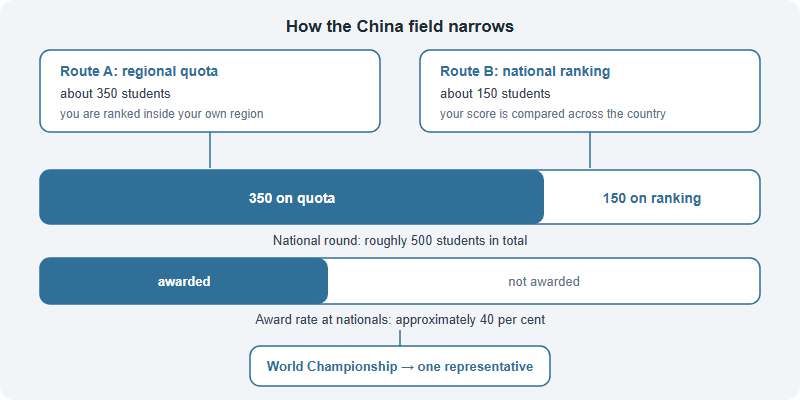
Why the second route changes how you should sit the paper
If there were only a quota, the rational strategy would be local: work out roughly what it takes to finish near the top of your own region and aim a comfortable margin above that. Once a national ranking route exists, that strategy leaks marks. Every additional correct answer keeps working after you have cleared any local bar, because it improves your position in a national list you cannot see.
Two consequences follow, and they point in opposite directions for two different students.
- If your region is strong, a quota can be brutal. Students who would comfortably qualify elsewhere can be squeezed out by their neighbours. The ranking route is the reason that is not automatically the end of the season — but it only helps if your absolute score is high, which means finishing the paper properly rather than coasting once you feel safe.
- If your region is quiet, the quota may be reachable on a score that would not survive national comparison. That is a comfortable place to qualify from and an uncomfortable place to arrive at nationals from, because the national round is a different assessment with components the regional paper never touched.
The practical instruction is the same in both cases and it is unglamorous: treat the regional paper as a scoring exercise, not a qualifying exercise. Answer every question you can. Do not leave the last block of a paper thin because you have already counted the marks you think you need.
What the regional and national rounds actually ask
The two rounds are not the same test made harder. They are different tests, and the gap between them is where most of the surprise at nationals comes from. The table below sets out the structure described in our briefing for the China region.
| Stage | Junior division (grades 5–8) | Senior division (grades 9–12) | What it rewards |
|---|---|---|---|
| Regional round | Written paper, 60 questions | Written paper, 80 questions | Breadth of syllabus, speed, secure recall of terms |
| National round | 40-question, 40-mark individual paper plus a team science poster worth 40 marks | Individual only, 100 marks in three parts | Junior: knowledge and live collaboration. Senior: knowledge, recognition and case reasoning |
| National round, Senior components | — | 50-question written paper (50 marks); 13 image or specimen identification items (26 marks), covering brain structures and CT or MRI; 8 case-diagnosis items from case video (24 marks) | Three distinct skills, trained differently |
| World Championship | One representative for the chapter, whatever the division split at home | Neuroanatomy and neurohistology, written test, patient diagnosis from video with a written history, and a live oral round | |
Notice what the Senior national round adds: 50 of its 100 marks sit outside the written paper. A student who arrives having revised only in the way that produced a strong regional result has prepared for half the assessment. Our overview of the competition and its three tiers sets out how the rounds relate; the point here is narrower — the selection numbers tell you where you are in the funnel, and the structure tells you what the next stage will actually ask.
The single seat, and why it should not be your target
At the top of the funnel the arithmetic becomes stark. Each national chapter sends exactly one representative to the International Brain Bee World Championship, which is held in November alongside the Society for Neuroscience annual meeting. In the China region, per our briefing, that representative is the highest-scoring Senior first-prize winner. Hong Kong, Taiwan and Macao are separate IBB chapters and send their own representatives.
One seat out of a national field of roughly 500 is not a target you can plan towards in any useful sense. It is an outcome that happens to one student per season, and building a preparation plan around it produces a predictable failure mode: the student measures a good year as a failure. The more useful move is to set a target you can act on, and to know in advance what each tier of outcome would mean.
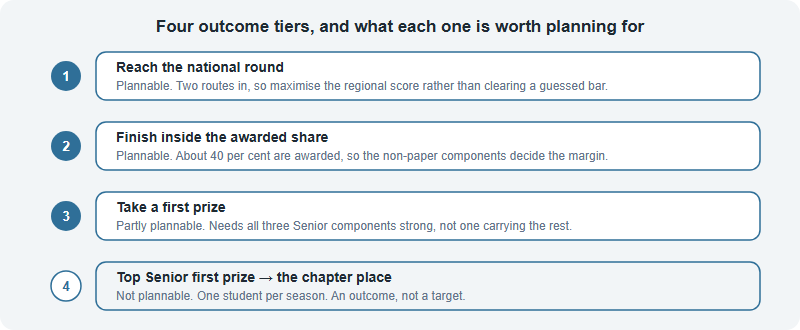
Reading the numbers against a real cohort
Abstract percentages are hard to plan against, so here is one de-identified cohort for scale. In the 2026 China national round, students we coached took 7 first prizes — including 2nd and 8th place in the Junior division and 11th and 13th in the Senior division — along with 11 second prizes and 10 third prizes, from 31 students who advanced out of the regional stage.
Read that carefully, because the shape matters more than the totals. Those totals add up to 28 awards from 31 students who reached nationals, 7 of them first prizes. Results vary between students, cohorts and seasons; this is one group in one year, described per our own records rather than as an official statistic, and it should not be read as a prediction for anyone else. What it does illustrate is the general shape the briefing describes: reaching nationals is the hard filter, an award is a realistic goal once you are there, and the very top places thin out fast.
It also shows that the Junior and Senior divisions produce strong placements independently, which is worth remembering if you are in grade 8 and weighing when to move up. The divisions are a China-region structure — Junior for grades 5 to 8, Senior for grades 9 to 12 — and are not part of the International Brain Bee's own arrangement.
What to do with this before your regional round
Four practical changes follow from the funnel, and none of them require extra study hours.
- Stop scoring yourself against a rumour. Cut-off scores circulate every year in group chats and are almost always someone's memory of a different region in a different season. The two-route structure means no single number is the bar.
- Finish the paper. On a 60- or 80-question regional paper, the last ten questions carry marks too, and they are disproportionately where a national ranking is won or lost.
- Start the non-paper work before you qualify, not after. If you are in the Senior division, half the national marks sit in identification and case reasoning. Waiting for a qualification result before you begin is how strong regional performers end up mid-table at nationals.
- Confirm this season's structure officially. Divisions, quotas, question counts and the award structure can all change. Registration and the authoritative calendar sit with the National Brain Bee Organizing Committee at chinabrainbee.com; we are an independent guide and do not run any part of the round.
Underneath all of it, the syllabus does not change: Brain Facts, published by the Society for Neuroscience and available at brainfacts.org, or Neuroscience: The Science of the Brain. The funnel tells you how selective each stage is. The syllabus tells you what to know. Our guide to what the Brain Bee is and how its rounds fit together is the place to start if the structure is still new to you.
Questions students ask about the numbers
How many students reach the Brain Bee national round in China?
Our operator briefing puts it near 500 a year, about 350 on regional quota and 150 on national ranking. Confirm current numbers officially.
What is the award rate at the national round?
Approximately 40 per cent of the national field receives an award. That figure is approximate and can move between seasons.
Who represents China at the World Championship?
Per the operator briefing, the highest-scoring Senior first-prize winner. Each national chapter sends exactly one representative to the World Championship.
Does missing my regional quota end my season?
Not necessarily. The briefing describes a second route into nationals on national ranking, so your absolute score still matters.
This is an independent English-language guide to the Brain Bee, operated by Hanlin Education for China-based international-school students. It is not affiliated with, endorsed by, or sponsored by the International Brain Bee (IBB), and it is not the official Brain Bee China national round, which is run by the National Brain Bee Organizing Committee at chinabrainbee.com. Selection figures described here come from an operator briefing on the China region and are approximate; student results are our own de-identified records, results vary, and no competition result is tied to school admission. Confirm current details on thebrainbee.org. Errors are corrected within 7 working days of notification.