
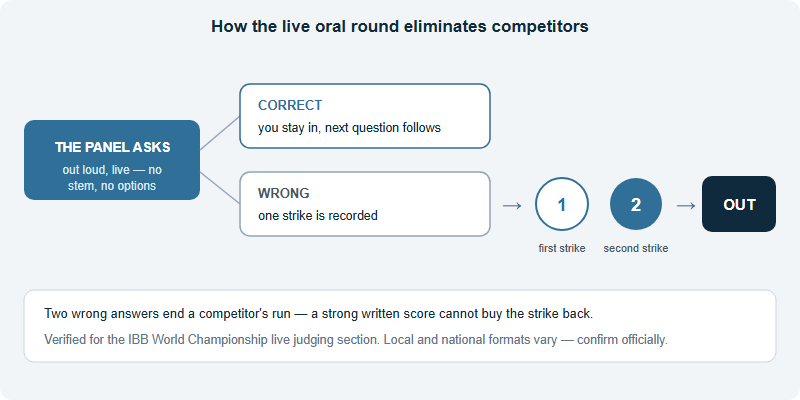
The Brain Bee is one of very few science competitions that ends by making you speak. At the IBB World Championship, one of the four sections is a live oral judging round: judges put questions to competitors live and out loud, and two wrong answers eliminate a competitor. It rewards a skill no amount of silent revision builds — fast, precise retrieval with no written stem to lean on and no second attempt — and it is the section students prepare for last, if at all.
What the live round actually is
Set it in context first. The Brain Bee runs in three tiers — Local, then National, then the IBB World Championship — and each national chapter sends exactly one representative to the world final, which is held in November alongside the Society for Neuroscience annual meeting. The world final has four sections: neuroanatomy and neurohistology on real brains or images; a written test; patient diagnosis from video footage with a written medical history; and the live oral judging round. Our Brain Bee overview sets out how the tiers and sections connect.
Two features of the oral round decide how you should train for it. The first is elimination: this is not a section where a weak answer costs you a few marks that a strong answer elsewhere can recover. Two wrong answers and your run is over, regardless of how well you did on the written paper. The second is that it is spoken, live and unprompted. There is no written stem to re-read, no option list to narrow, no chance to draft the answer before you commit to it, and the ruling follows immediately. That changes the cognitive task in a way students consistently underestimate until the first time they experience it. How the section is staged — and who else is in the room — is set by the organisers, so confirm the setting of the round you are actually entering.
One scope note, and we want to be strict about it: the four-section structure above is the World Championship format. Whether a given local or national round includes a live oral stage — and in what form — varies, and any answer clock, question count or ruling procedure is set by the organisers. We do not restate numbers we cannot verify. Confirm the format of the round you are actually entering through official channels; for the China round that is the National Brain Bee Organizing Committee at chinabrainbee.com, which is also where registration lives. This site is an independent guide and does not run that round.
Why it punishes a different skill from the written test
A written test lets you reconstruct. You read the stem, the wording nudges your memory, you eliminate two options, and you commit. The whole process can take thirty seconds of visible thinking and nobody minds. A live oral round removes every one of those supports at once: there is no stem to re-read, no option list to eliminate, no chance to skip and return, and no way to work through it silently before you commit.
What is left is pure retrieval — the ability to pull a specific term out of memory on demand and say it. That is why students who score well on paper can still lose early here. Their knowledge is stored in a recognition-shaped form: it activates when prompted by text but not when prompted by a spoken question. The fix is not more content. It is changing how the same content is rehearsed, which is why our study method insists that every chapter produces material you can be tested on rather than pages you have read.
There is a second, quieter factor for international-school students in China. Nearly all of this vocabulary is learned by eye. A student may have read “hippocampus,” “substantia nigra” and “myelination” a hundred times and never once said them out loud. Under pressure, an unpractised word does not just come out mispronounced — it comes out slowly, and the hesitation costs more than the accent does.
The three ways students lose a strike
Before changing how you prepare, work out which strike you actually lost. In practice sessions the three causes look identical from outside — a wrong answer — but they need three different fixes.
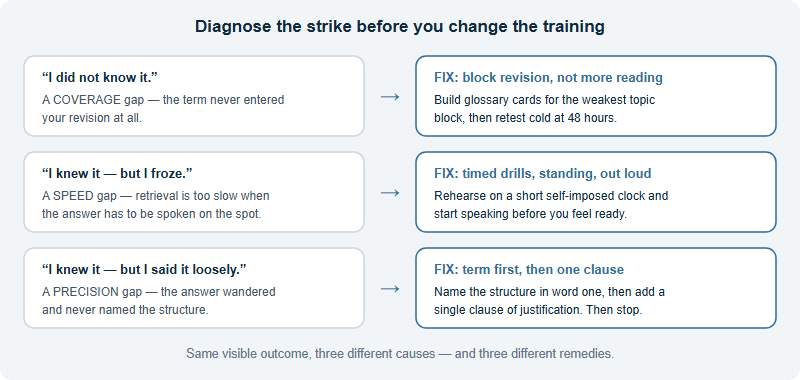
The precision gap deserves an extra word, because it is the one that surprises strong students. Asked “which structure relays sensory information to the cortex?”, a student who genuinely knows the answer will often begin: “So, um, there is a structure in the middle of the brain, it sits near the ventricles, and basically almost all of the senses except smell pass through it, and I think it is called…” Everything in that sentence is correct. It is still a bad answer, because the first word should have been “thalamus.” Train the habit of leading with the term and adding justification afterwards, and a whole category of strikes disappears.
A four-week drill ladder
You cannot rehearse the real format, because you do not control the panel, the questions or the ruling. What you can rehearse is every component skill, using your own glossary cards and whatever sits in our preparation resources. The ladder below moves from private to public deliberately — the point is to add pressure one layer at a time rather than discovering all of it on competition day. The clocks in this table, and the practice audience in week four, are our training standard, not a published competition rule or a description of how the official round is staged.
| Week | Drill | The rule | How you know it worked |
|---|---|---|---|
| 1 | Say the cards. Work through your glossary cards aloud, alone, sitting down. | Every term is spoken, never read silently. Mark any word you stumble over. | You can pronounce every term on the card without hesitating |
| 2 | The short-clock answer. A partner reads a recall question; you answer aloud on a self-imposed clock of roughly eight seconds. | Term first, then one clause. No preamble, no “so basically.” | You start speaking within two seconds and finish in one sentence |
| 3 | Standing, with a stranger. Same drill, but standing, with someone who is not your usual study partner. | No restarting an answer once begun. Commit and move on. | Your accuracy does not fall when you stand up |
| 4 | Mock two-strikes. A small audience; two wrong answers and you sit down; a second competitor takes over. | Rulings are final. No arguing, no re-answering. | You survive more questions than in your first attempt |
| Ongoing | Image-to-voice. A partner points at a structure on a diagram; you name it aloud. | Name, then location, then one function — in that order. | Naming is automatic and does not need a run-up |
Two practical notes on running these. First, record week two on a phone and listen back once; almost every student is shocked by how much of their answer was filler, and hearing it is more persuasive than being told. Second, when the mock round in week four gives someone a strike, ask them to say which of the three gaps caused it before the next question. Naming the cause out loud is what turns a practice round into a diagnosis.
Saying it in English: the part nobody drills
For students working in a second language, three specific habits do more than general “speaking practice.”
- Add a pronunciation column to your glossary card. Break the word into syllables in whatever notation you like and say it five times when you first meet it. Long Latin terms — substantia nigra, corpus callosum, oligodendrocyte — are the ones that stall an answer.
- Learn a small set of answer frames. “The [structure], because [one clause].” “It is [term]; it sits [location].” “[Term] — damage there produces [sign].” Having three ready-made shapes means your working memory can spend itself on content rather than grammar.
- Ban the hedge. “I think maybe it could be” buys you nothing and costs you the clock. If you are unsure, give your best single answer cleanly. An uncertain correct answer scores the same as a confident one; a hedge that runs out of time scores nothing.
None of this is about sounding native. It is about the gap between knowing a word and being able to produce it under pressure — which, for a section decided by two mistakes, is the whole game.
What our own cohort shows — and what to confirm officially
Across the 2026 China national round, students prepared by Hanlin took 7 first prizes — including 2nd and 8th in the Junior division and 11th and 13th in the Standard (grades 9–12) division — Junior and Standard being China-region divisions rather than an International Brain Bee structure — along with 11 second prizes and 10 third prizes, with 31 students advancing from the regional stage. Those figures are de-identified, reported by Hanlin, describe one cohort in one season, and are not a prediction for any individual student; results vary.
The observation worth passing on is not the count. It is that in spoken practice, the students who struggled were not the ones with the weakest content. They were often the strongest readers — students whose knowledge was deep but stored entirely in written form, who had never been asked to produce it out loud at speed. Once the same students spent a few weeks answering standing up on a clock, their accuracy under pressure moved quickly, because the underlying knowledge had been there the whole time. That is an encouraging finding: the oral skill is trainable in weeks, while the content takes months. Which means the sensible order is content first, voice second — but never voice never.
Before you build a plan around any of this. Confirm three things officially rather than assuming them from this article. Whether the round you are entering includes a live oral stage at all; what its rules are, including any answer time and how rulings are made; and the current season's dates, which move every year. For the China round, the official channel is the National Brain Bee Organizing Committee at chinabrainbee.com — note also that Hong Kong, Taiwan and Macao are separate chapters rather than part of the China chapter. Everything verified above about the four sections and the two-strikes rule describes the IBB World Championship, and is documented on thebrainbee.org.
Frequently asked questions
What is the Brain Bee live oral round?
It is one of the four World Championship sections: judges put questions to competitors live and out loud, and two wrong answers eliminate a competitor.
How many wrong answers can you give?
Two. The live judging section is a two-strikes elimination format, so a second wrong answer ends that competitor's run.
Does the China round have a live oral stage?
Formats vary by round and by year. Confirm with the official China chapter at chinabrainbee.com before planning around it.
How do I practise for a spoken round?
Answer aloud on a short clock, standing, with term first and one clause of justification — then run a mock two-strikes session.
This is an independent English-language Brain Bee guide operated by Hanlin Education for China-based international-school students. It is not affiliated with, endorsed by, or sponsored by the International Brain Bee (IBB), and it is not the official Brain Bee China national round (run by the National Brain Bee Organizing Committee / chinabrainbee.com). Round formats, rules, eligibility and dates are set by the organisers and change from year to year — always confirm current details on thebrainbee.org and the official China channel before planning around them. Practice clocks and drills described above are our own training standards, not published competition rules. Competition results reported here are de-identified, provided by Hanlin, vary by student, and are not a prediction of any outcome. Confirmed errors are corrected within 7 working days.