The Brain Bee is a neuroscience competition for teenagers, founded in 1998 and run internationally by the International Brain Bee (IBB). It runs in three tiers — Local → National → World Championship — and tests neuroscience through written questions, real-brain neuroanatomy, video patient diagnosis and a live oral round. This is an independent guide for Greater-China students; the official body is the IBB, and the official China national round is run separately (see below).
Who runs the Brain Bee, and since when
The Brain Bee was founded in 1998 by Dr. Norbert Myslinski at the University of Maryland, and became a formal non-profit in 2018. Its stated mission is to motivate students to learn about the brain and consider careers in neuroscience and medicine. The IBB is backed by a group of neuroscience and medical organisations that act as governing partners — the American Psychological Association, the Dana Foundation, the Federation of European Neuroscience Societies (FENS), the International Brain Research Organization (IBRO) and the Society for Neuroscience (SfN), with the Alzheimer’s Association joining in 2021. That backing is one reason a Brain Bee result reads as a genuine neuroscience credential rather than a generic quiz medal.
One clarification up front, because it is the single most common misconception: this website is an independent guide. We are not the International Brain Bee, and we are not the official Brain Bee China national round. Where you need to register or confirm a rule, we point you to the official channels.
The three tiers: how a student advances
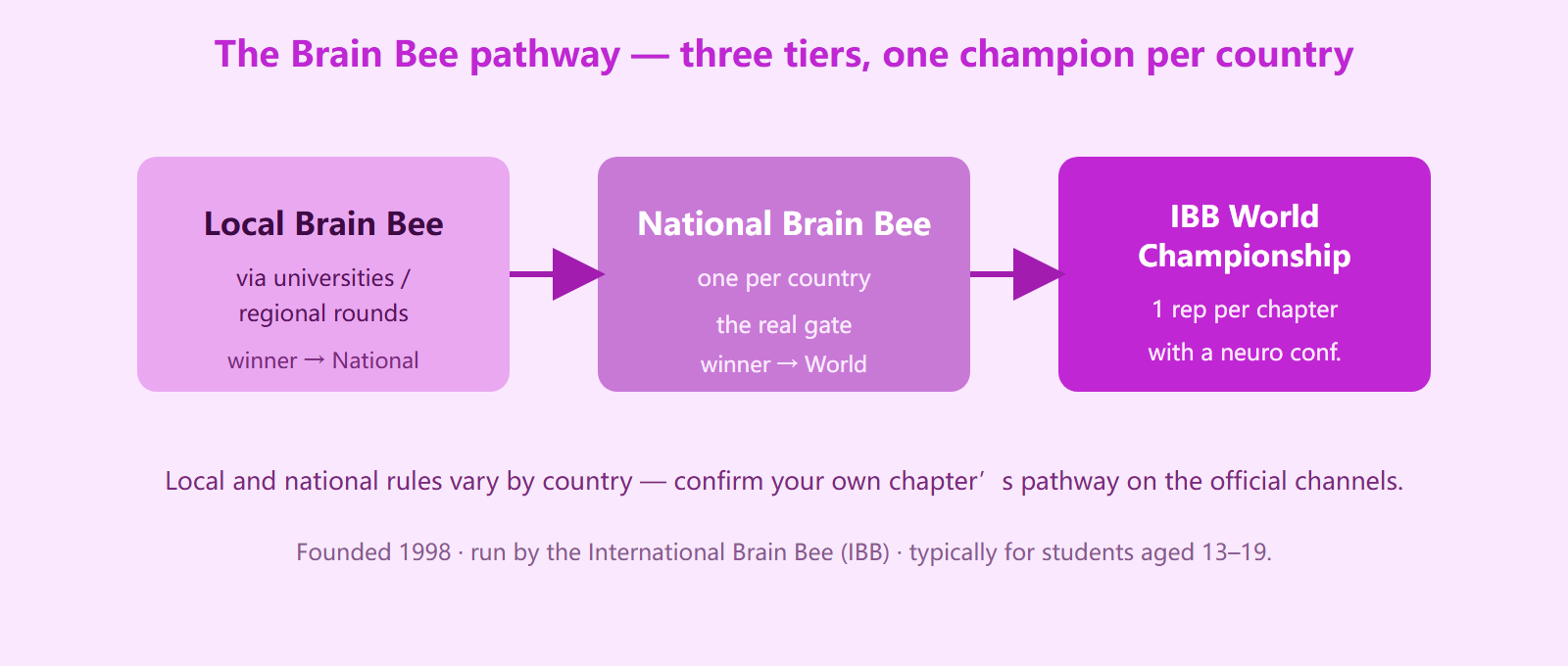
The Brain Bee is one competition run at three levels, and each level is a gate to the next:
| Tier | What it is | Who advances |
|---|---|---|
| Local Brain Bee | Organised through universities, research institutions or a national chapter’s regional rounds | The winner of each Local advances to their National |
| National Brain Bee | Each country runs its own national competition | The winner of each National represents that country at the World Championship |
| IBB World Championship | The global final, held alongside a major neuroscience conference | Each national chapter sends one representative; top finishers earn international recognition |
The key structural fact: each national chapter sends exactly one student to the World Championship — its national champion. That is what makes the national round the real gate, and it is why understanding your own country’s national pathway matters more than memorising the world final’s format.
What the rounds actually test
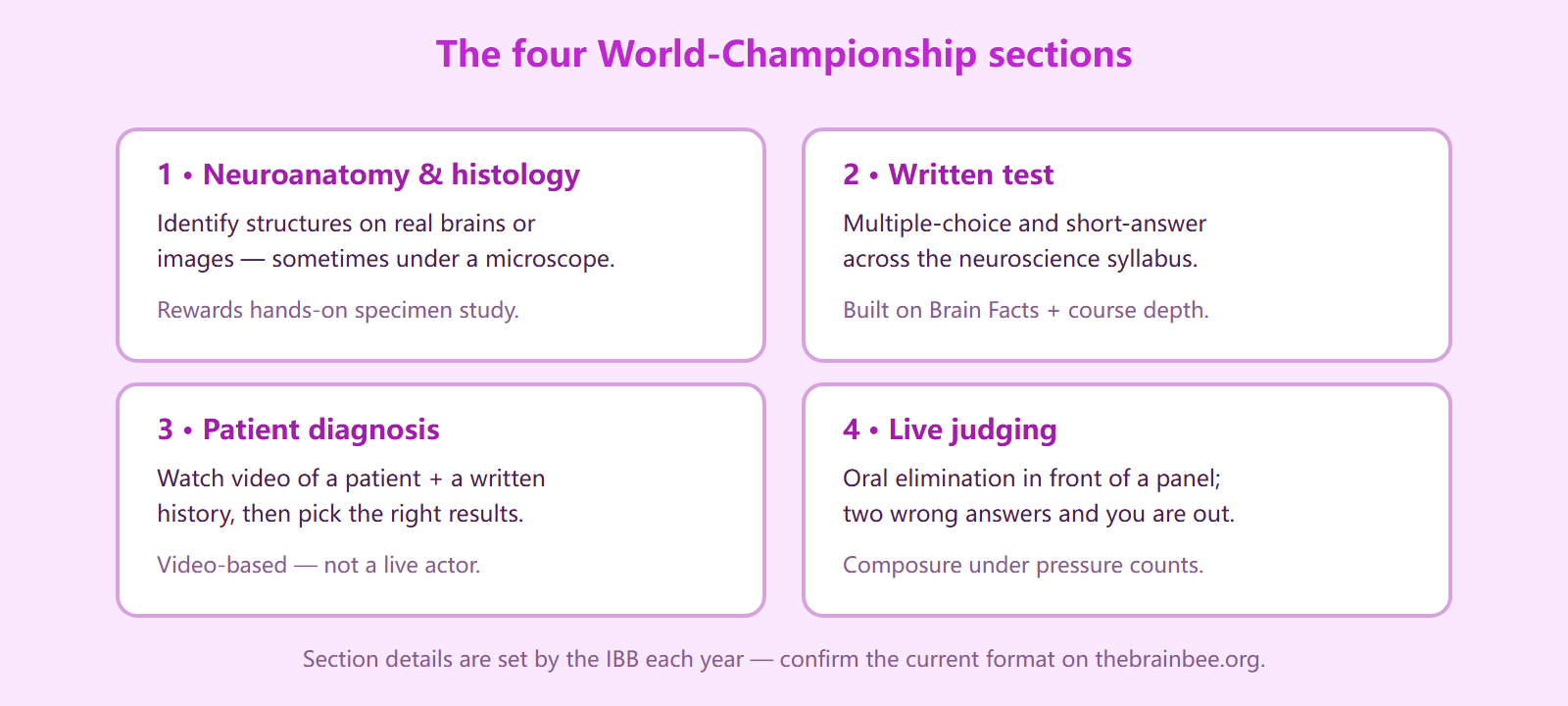
At the World Championship the competition has four sections, and they are more varied than a typical written olympiad:
- Neuroanatomy & neurohistology — identifying structures on whole or sectioned human brains, or from detailed images, sometimes under a microscope. This is the section that most rewards hands-on specimen study rather than pure reading.
- Written test — multiple-choice and short-answer questions across the neuroscience syllabus.
- Patient diagnosis — students watch video footage of patients together with a written medical history, then choose which laboratory or imaging results fit. (It is video-based; it is not a live actor-patient exercise.)
- Live judging — an oral elimination round where a panel poses questions in front of an audience, and two wrong answers (two strikes) eliminate a competitor.
National and local rounds are usually lighter than the world final, but the same skills — neuroanatomy recognition, precise recall, and applying knowledge to a clinical case — run through every level. That is why building those skills early pays off no matter how far a student advances.
What to study: the Brain Facts book
Local and national competitions are based on one of two texts: Brain Facts, published by the Society for Neuroscience, or Neuroscience: The Science of the Brain. Brain Facts is the more commonly used starting point and is available to download at brainfacts.org. The World Championship goes deeper, drawing on university and medical-school course content prepared each year by the IBB’s academic committee — so the honest expectation is that the world final asks more than the Brain Bee books alone. For most students building toward a national round, working carefully through Brain Facts, and turning each chapter into neuroanatomy diagrams and a glossary of terms, is the highest-value first step.
Who is eligible
The Brain Bee is a school-age competition, run in practice for students roughly in grades 5 to 12 (about ages 10 to 18), with chapters splitting entrants into divisions by grade. The one firm ceiling sits at the top of the ladder: a national champion competing at the World Championship may not be older than 19. Everything below that — the exact age band, grade requirement and division structure — is set by your own national chapter and varies by country, so check it there before planning around it.
How a student in China fits in
China has an official IBB national chapter, listed by the International Brain Bee, whose winner is the one eligible for the World Championship. That official China national round is run by the National Brain Bee Organizing Committee and its coordinator, with its own registration and schedule — and it is the channel to use to enter. This independent guide does not run that competition; where you need to register, we send you to the official China channel.
Two practical notes that trip students up. First, the Brain Bee in China runs two divisions defined by school grade — Brain Bee Junior for grades 5–8 and the Standard Brain Bee for grades 9–12. That division structure is a feature of the China round rather than of the International Brain Bee itself, so treat it as China-specific and confirm the current year’s divisions on the official channel. Second, Hong Kong, Taiwan and Macao are listed by the IBB as separate chapters with their own coordinators — they are not part of the mainland-China chapter. As for timing, the China round has typically run its regional stage in spring and its national stage in April, with the world final later in the year, but exact dates change annually — confirm the current season before you plan.
Where does this guide help? Not with registration — that is the official chapter’s job — but with the parts that decide how well you do: understanding the four rounds, working through Brain Facts, building neuroanatomy recognition and a neuroscience glossary, and choosing between the Brain Bee and adjacent competitions. If you are also weighing biology or psychology routes, see how the neuroscience angle compares in our companion coverage of the USA Biology Olympiad and the psychology olympiad.
Frequently asked questions
What is the Brain Bee?
It is a neuroscience competition for teenagers, founded in 1998 and run internationally by the International Brain Bee. It runs at three levels — Local, National and the IBB World Championship — and tests neuroscience through written questions, neuroanatomy, video patient diagnosis and a live oral round.
How do you advance in the Brain Bee?
The winner of each Local Brain Bee advances to their National Brain Bee, and the winner of each National represents their country at the IBB World Championship. Each national chapter sends one representative.
Who is eligible for the Brain Bee?
It is a school-age competition, run in practice for roughly grades 5 to 12 (about ages 10 to 18), with divisions by grade. The firm ceiling is at the top: a national champion at the World Championship may not be older than 19. Local and national rules vary by country — confirm your chapter’s exact requirements.
Is there an official Brain Bee China?
Yes. China has an official IBB national chapter, run by the National Brain Bee Organizing Committee, whose champion is eligible for the World Championship. This site is an independent guide, not that official round; use the official China channel to register. Hong Kong, Taiwan and Macao are separate chapters.
What should I study for the Brain Bee?
Local and national rounds are based on the Brain Facts book (published by the Society for Neuroscience, available at brainfacts.org) or Neuroscience: The Science of the Brain. The World Championship goes deeper into university-level material set by the IBB each year.
This is an independent English-language guide to the Brain Bee for Greater-China students, operated by Hanlin Education. It is not affiliated with, endorsed by, or the official International Brain Bee, nor the official Brain Bee China national round (run by the National Brain Bee Organizing Committee / chinabrainbee.com). Rules, rounds, eligibility, dates and the official registration pathway are set by the organisers and can change each year — always confirm current details on the official channels (thebrainbee.org and the official China chapter) before planning around them. Confirmed errors are corrected within 7 working days.