
Are your children looking to enter international biology competitions but find the BBO and USABO too advanced and difficult? The Brain Bee Neuroscience Competition offers a lower barrier to entry and broad applicability, making it a new benchmark for international students seeking to enhance their academic profiles.
Why Are International Students Choosing the Brain Bee Competition?
The Brain Bee is not a traditional "pure biology" competition. Instead, it focuses specifically on neuroscience and brain science, giving it three irreplaceable advantages for college applications:
1. Provides a Differentiated Academic Profile
The Brain Bee encourages students to explore and research the human brain, paving the way for future careers in foundational brain research, prevention and treatment of neurological and psychiatric disorders, and brain-inspired computing. Students applying for biology, neuroscience, medicine, psychology, computer science, and AI often cluster in traditional biology competitions, leading to highly homogenized profiles. The Brain Bee's content aligns closely with these cutting-edge fields, serving as a key differentiator in college applications.
2. Aligns with International Curricula & Offers High Prep ROI
The competition's structure aligns well with international high school curricula, making preparation highly efficient and cost-effective. Its focused scope allows students to build a strong academic foundation without the overwhelming breadth of traditional biology olympiads.
3. Authoritative Endorsement & High Recognition
Co-hosted by authoritative academic institutions such as the American Psychological Association (APA) and the Federation of European Neuroscience Societies (FENS), the Brain Bee ranks alongside the BBO and USABO as one of the top three international biology competitions. In college admissions, its awards not only prove academic ability but also demonstrate interdisciplinary thinking and research literacy, making it highly valued by admissions officers at top global universities.
Competition Rules & Format
1. Eligibility
Open to students in grades 5–12. The competition is divided into two categories:
- Junior Division (Brain Bee Junior): Grades 5–8. No specific language requirement.
- Senior Division (Brain Bee): Grades 9–12. Ideal for students who may lack confidence in English but still need competition experience for their applications.
2. Exam Format
Closed-book written exam. Duration: 90 minutes. Total: 80 questions, consisting of fill-in-the-blank and multiple-choice formats.
3. Exam Language
Available in Chinese or English.
4. Competition Schedule
The Brain Bee follows a three-tier progression: Regional, National, and International.
- Regional Round: March 21, 2026. Results released approximately 2 weeks after the exam.
- National Round: April 18–19, 2026. Results released 1–2 weeks after the exam.
- International Round: August 2026. Results released 1–2 months after the exam.
Award Structure & Difficulty
Both the Junior and Senior divisions offer First, Second, and Third Prizes, with an overall award rate of approximately 40%.
National Round Qualification: The total number of qualifiers for the national event is maintained at around 500 students (across both divisions). This includes 350 regional quota spots and 150 comprehensive quota spots.
Overall Assessment: The regional round features low difficulty and a low entry barrier, making it highly accessible for beginners. While the national round is more challenging, its knowledge framework is more focused and the preparation direction is clearer compared to traditional biology competitions. With systematic study, the probability of winning an award is significantly higher than in highly competitive events like the BBO or USABO.
High-Frequency Knowledge Points
Regardless of the division, the exam revolves around five core modules: Brain Basics → Brain Functions → Brain Diseases → Brain Research → Brain Health. This forms the foundational framework of neuroscience.
1. Basic Brain Structure (Fundamental & Mandatory)
Tests the basic components of the brain and their primary functions. Low difficulty, primarily memory-based, and closely aligned with elementary science and middle school biology curricula.
2. Brain Functions & Cognition (Core & Medium Differentiation)
Examines core brain functions such as learning and memory, emotion and stress, attention and sleep, and language and thinking.
3. Common Brain Disorders & Prevention (Practical & Foundational)
Covers neurological and psychiatric conditions accessible to youth, such as ADHD, depression, Alzheimer’s disease, and epilepsy. Focuses on basic symptoms, prevention strategies, and simple coping mechanisms.
4. Brain Research Techniques & Frontiers (Extension & Medium Differentiation)
Introduces foundational neuroscience research methods like MRI, CT, and EEG, along with current advancements in the field. Students are not required to master deep technical principles.
5. Brain Health & Lifestyle Habits (Foundational & High-Scoring)
Tests knowledge on protecting brain health through daily habits, including balanced nutrition, regular sleep schedules, moderate exercise, and scientific screen-time management.
Preparation Strategy for Beginners
For students starting from scratch, it is crucial to avoid these four common preparation pitfalls:
- Pitfall 1: Blind Memorization Without Understanding. Neuroscience concepts may seem complex, but true understanding is required to tackle flexible exam questions. Rote memorization leads to quick forgetting and lost points.
- Pitfall 2: Ignoring Past Papers in Favor of Random Practice. Past exams best reflect the syllabus and question patterns. Practicing without them is inefficient. Prioritize past papers, then use supplementary exercises for reinforcement.
- Pitfall 3: Inconsistent Preparation Pace. Success for beginners relies on a gradual, structured approach. Avoid rushing at the start. Plan your prep in phases and progress steadily.
- Pitfall 4: Over-Focusing on Difficult Questions While Neglecting Basics. Over 80% of the Brain Bee consists of basic and intermediate questions. Beginners should focus on securing these foundational points first before attempting advanced problems.
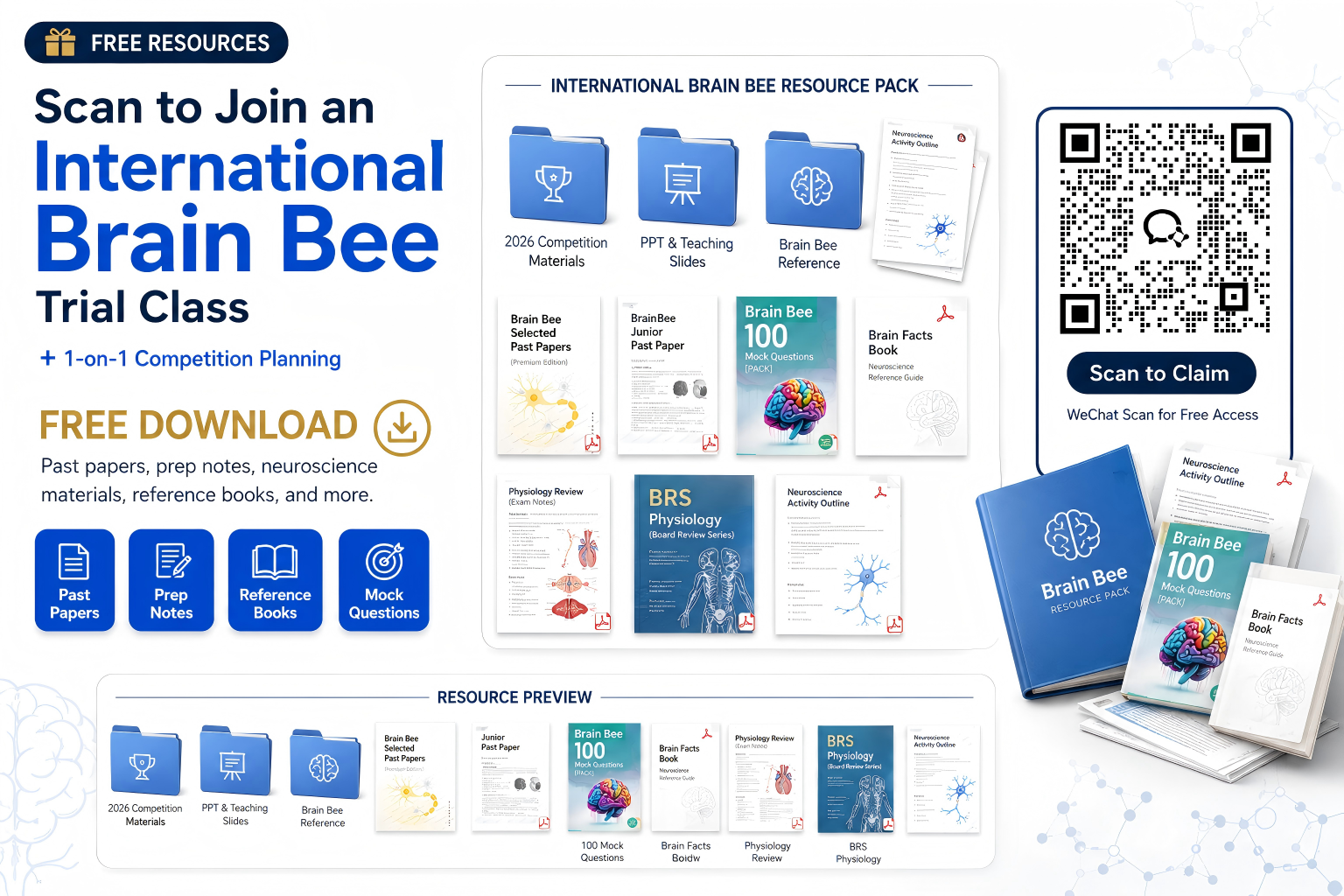
Get FREE Brain Bee Preparation Materials
Scan the QR code below to access free practice papers, study guides, and past competition materials. Start preparing today!