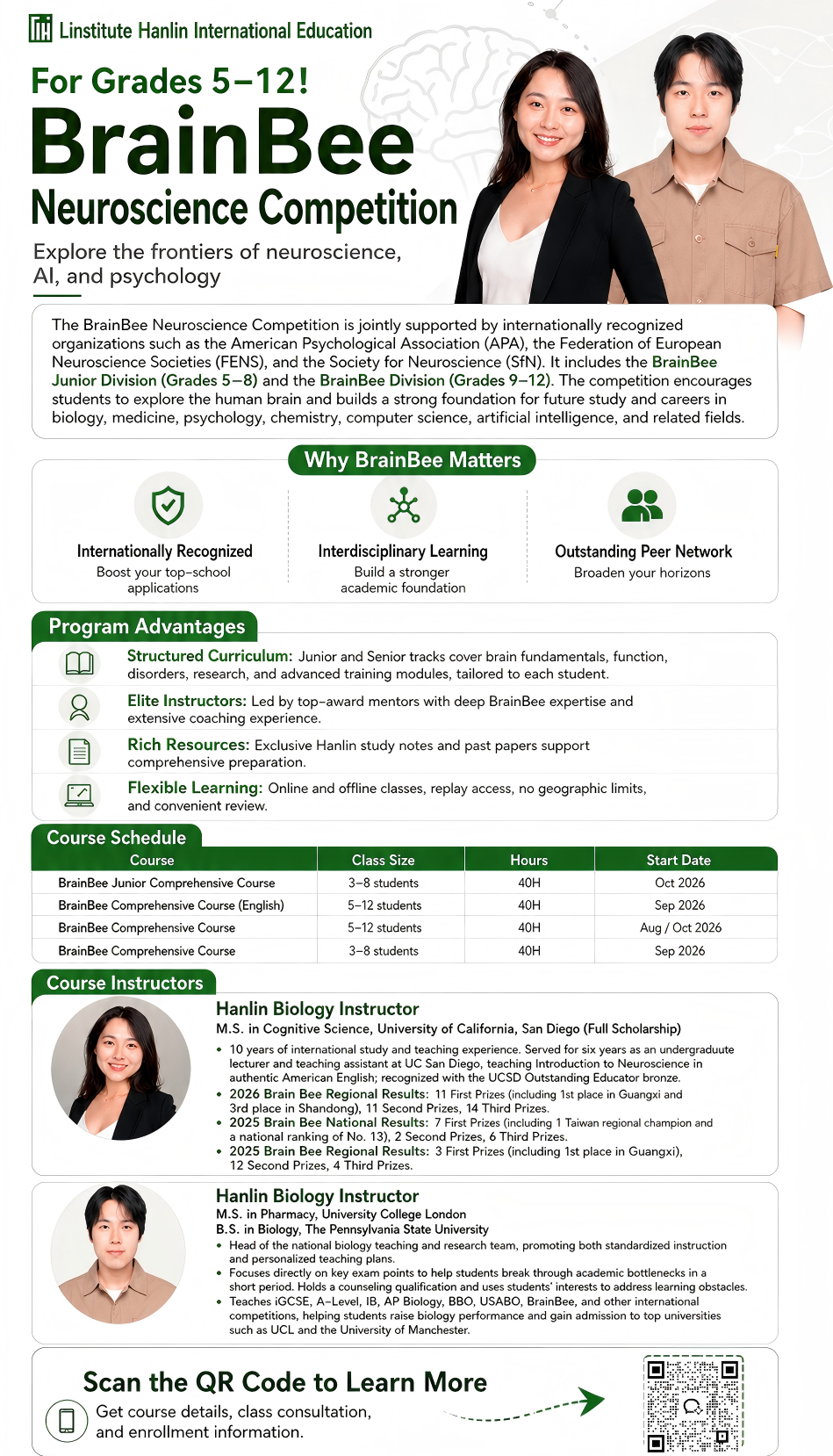

BrainBee is one of the world’s leading neuroscience competitions for young students. Covering more than 50 countries and attracting over 100,000 participants each year, BrainBee is widely regarded as a valuable academic credential for students interested in biology, medicine, psychology, neuroscience and related fields.
Together with USABO and BBO, BrainBee is often considered one of the top international biology-related competitions. It is highly recognized by top universities in the United States and the United Kingdom, making it a strong profile-building opportunity for students planning to apply to science, medicine, psychology or interdisciplinary majors.
Why BrainBee Is Highly Valuable
Strong Support for University Applications
BrainBee can provide significant support for university applications. According to available data, 73% of National Round award winners are admitted to world Top 50 universities. Many past winners have gone on to study at prestigious institutions such as Harvard, Princeton, Stanford, Cambridge and Oxford.
For students aiming for biology, medicine, neuroscience, psychology or cognitive science, BrainBee can demonstrate early academic interest, scientific thinking and subject-specific potential.
Beginner-Friendly and Suitable for Students with No Prior Background
BrainBee is accessible to students with little or no prior neuroscience background. Since the competition is divided into Junior and Senior divisions, students can choose the level that best matches their grade and academic foundation.
Overall, the difficulty is moderate, making BrainBee a suitable entry-level international science competition for students who are interested in exploring brain science.
Interdisciplinary Learning Experience
BrainBee covers knowledge from multiple fields, including biology, medicine, psychology, neuroscience, cognitive science, chemistry, computer science and artificial intelligence.
Through preparation, students can quickly gain exposure to cutting-edge interdisciplinary topics and expand their academic interests beyond traditional school subjects.
BrainBee Competition Rules
Division Settings for Grades 5–12
| Division | Suitable Grades | Focus Areas |
|---|---|---|
| BrainBee Junior Division | Grades 5–8 | Basic brain science knowledge, engaging neuroscience topics and teamwork |
| BrainBee Senior Division | Grades 9–12 | Neuroanatomy, brain diseases, neuroscience research frontiers and advanced high school biology content |
Three-Level Competition Pathway
BrainBee follows a three-stage competition pathway: Regional Round, National Round and International Round.
| Stage | Time | Format |
|---|---|---|
| Regional Round | Every March | 90-minute closed-book written test. Junior Division has 60 questions, while Senior Division has 80 questions. The test includes multiple-choice and fill-in-the-blank questions, with bilingual Chinese-English terminology. |
| National Round | Every April | Senior Division includes written test, specimen identification and case diagnosis. Junior Division includes written test and team poster presentation. |
| International Round | Every August | The national champion represents China and competes with top students from around the world. |
BrainBee Award Structure
| Stage | Awards |
|---|---|
| Regional Round | First, Second and Third Prizes are awarded, with an overall award rate of around 40%. |
| National Round | National First, Second and Third Prizes are awarded based on total score ranking, with an overall award rate of around 40%. |
| International Round | The China representative is selected from the highest-scoring National First Prize winner. |
Why Students Should Consider BrainBee
BrainBee is a strong choice for students in grades 5–12 who want to explore neuroscience and build an academic profile in biology, medicine, psychology or interdisciplinary science.
For younger students, the Junior Division provides an accessible introduction to brain science and scientific thinking. For older students, the Senior Division offers more advanced academic challenges involving neuroanatomy, neurological diseases, specimen identification and case analysis.
Because the competition is relatively beginner-friendly, interdisciplinary and globally recognized, BrainBee is especially suitable for students who want to start building a science competition profile early.